In honor of Mother’s day coming up in a few days, I’ve decided to write about some of the most touching mother-child stories in cinematic history: Alfred Hitchcock’s Psycho and Notorious, the original The Manchurian Candidate and Friday the 13th, and Brian de Palma’s Carrie.
By now, you have realized that the word “touching” is inaccurate. So rather, stay put for some of the most… let’s say interesting mothers in film history. (Spoilers ahead for all those mentioned above, but I mean come on, if you haven’t seen at least Psycho, if not all of those, by this point, then what are you doing?)
The Manchurian Candidate (1962)
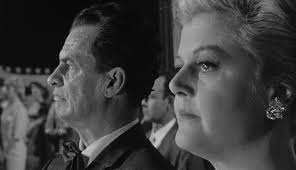
In a performance that should’ve won her an oscar (although nominated, she lost to Patty Duke in The Miracle Worker), Angela Lansbury portrays the mother of Korean War hero Raymond Shaw, a woman obsessed with only one thing: power. She marries a senator (reminiscent of Joseph McCarthy) and acts as a sort of twisted puppeteer behind his rise to power through fear. To this end, she brainwashes her son to carry out an assassination for political purposes. Shaw, upon having this plot revealed to him (by none other than Frank Sinatra), takes the somewhat extreme (although reasonable, due to the events of the film) step of killing his mother and the senator, before he kills himself. It doesn’t take a genius to figure out that a mother who drives her son to this ins’t exactly the best. And again, Lansbury is completely fantastic.
Psycho (1960) & Notorious (1946)
As one could discern from pretty much any of his films, Alfred Hitchcock had kind of a rough relationship with mothers. In his films, the mother is almost always an antagonistic character, which is a product of his complicated relationship with his own mother. The two most prominent examples of this are in his landmark Psycho and his classic Notorious.
In Notorious, Austrian silent film star Leopoldine Konstantin plays the scheming mother of Claude Rains (in his best performance after Casablanca), a nazi war criminal hiding out in Brazil. When Ingrid Bergman’s Alicia Huberman gets married to Rains as part of a government operation and Rains finds out, his mother suggests poisoning Bergman’s character. While the main conflict of the movie is Huberman’s twisted relationship with Cary Grant, the climax of the film (and second most intense scene after the scene in the wine cellar) features Rains carrying out his mother’s plan and poisoning Alicia. She suffers throughout the remainder of the film before Grant’s character comes to rescue her. The conclusion of Notorious brings the film full circle in something of a typical, twisted, Hitchcockian romantic way. Yet the cause of the action that brings the film to its end it spurred on by the mother. This cements Hitchcock’s distaste for mothers in Notorious, and in doing so pushes the film over the finish line and creates one of his greatest accomplishments.
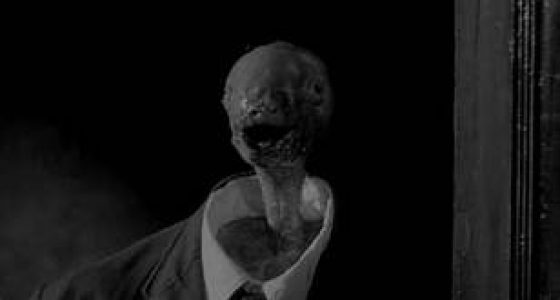
In Psycho, obviously, the mother/son relationship is a little different than most other movies. Norman Bates’s relationship with his mother is… intimate. In fact, a lot of the reason that Psycho works as well as it does, which is to say about as well as anything does, is because of the dynamic created by the hidden (or, as it turns out, not hidden) antagonist throughout the majority of the movie. The “mother” is responsible for some of the greatest moments in the whole movie, such as the brilliant ending monologue (she wouldn’t even harm a fly), the reveal of the real mother (one of the most frightening moments in the whole film), the murder of Milton Arbogast (the single most terrifying moment in the whole film and an absolute masterwork of direction) and of course, the shower scene (I don’t think I have to give any explanation here). While Anthony Perkins turns in a great performance as Norman Bates and Janet Leigh is exceptional as Marion Crane (well, while she’s alive), it could be argued that the mother steals the film and makes it what it is, and that’s a testament to Hitchcock’s skill as a director.
Friday The 13th (1980)
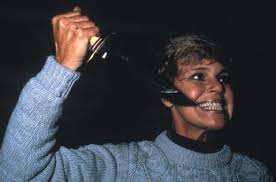
Speaking of villainous horror movie mothers who spend most of the film in the shadows (wow, that’s a niche category), you really can’t beat Mrs. Voorhees in the original Friday the 13th. Before I begin here, full disclosure: I’m not a fan of this movie. It has some redeeming qualities (holy crap, is that Kevin Bacon?), and is no way a failure, it spends most of its runtime trying to be Halloween. However, one of those redeeming qualities is the twist that the killer is not Jason, but in fact his mother. Sure, some of the impact is lessened by the fact that it’s an incredibly well-known twist, yet it’s a brilliant subversion of horror movie tropes. The effectiveness of the twist is due in large part to how unbelievably creepy Betsy Palmer is in the role. The movie ramps up the intensity at an incredible level the moment she is revealed to be the killer, and it does a very good job of keeping the intensity up until the final jump scare (a final jump scare that manages to be scarier than anything else in the movie, another niche category. More on that in a second). The character of Mrs. Voorhees does an excellent job of elevating the film, which speaks to the quality of the character.
Carrie (1976)
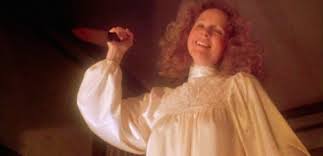
The scariest part of Brian de Palma’s classic Carrie is of course that final jump scare, but Piper Laurie’s character comes pretty close. Laurie plays the titular character’s fundamentalist Christian mother, a psychotic being of pure evil whose only purpose is to make Carrie’s life somehow even worse than her classmates try to make it. Margaret White manages to be perhaps the single most evil screen mother in a couple of ways. The first is that Laurie turns in an all-time performance. She was nominated for the Oscar for best supporting actress, but lost to Beatrice Straight in Network (which, I mean, I love Network a lot, but come on, she’s in one scene). Although Sissy Spacek turns in another legendary performance as the eponymous protagonist, Laurie steals every scene she’s in. The second reason that the character is so terrifying is simply the painfully sad irony of her: Carrie’s life is miserable, and the person who should be there for her to lean on is so awful to her that, when she’s just had the worst experience of her life (understatement), she exacerbates the situation by literally trying to kill her daughter. The previously mentioned mothers on this list are terrible, but nobody actually went that far.
I close with the absolute worst mother in film history. I am talking, of course, about Nancy’s mom in the original A Nightmare on Elm Street. I can’t even bring myself to write an entire paragraph about her. All the adults in that movie are idiots and watching them ruin the lives of their children is a special kind of torment, but she stands alone. Ok, quick tangent for a second: she KNOWS that Krueger is out there and she KNOWS what he intends to do, yet not only does she not believe her daughter, SHE INTENTIONALLY PREVENTS HER FROM TRYING TO SAVE HER OWN LIFE. SHE WANTS HER TO DIE. SHE’S FAR WORSE THAN FREDDY KRUEGER. So in conclusion, happy mother’s day, and screw you, the mom from Nightmare on Elm Street.

 The Movie Files