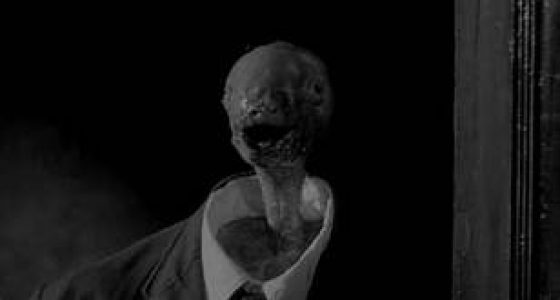
The Night of the Hunter is remarkably ingrained into popular culture for something that so few people have heard of. Everyone knows the Love/Hate tattoos thanks to Do the Right Thing, although the majority of people would likely attribute them to the latter film. Robert Mitchum’s character has been parodied often enough that the average person watching the film for the first time would recognize him. Among its devotees, the story behind The Night of the Hunter is legendary: the great English actor Charles Laughton directed exactly one film, one that was panned by critics at the time to the point where he never directed again. Today it’s considered by some to be the equal of the likes of Citizen Kane or Vertigo. So why has perception of the film changed so drastically in the 60+ years since its release? Because it’s simply amazing, and people were bound to wise up to that at some point.
Everything about The Night of the Hunter works, from The Magnificent Ambersons cinematographer Stanley Cortez’s striking black and white photography and Laughton’s unfortunately never-repeated direction. But everyone knows who the real star of the film is: Robert Mitchum, in his career-best performance as deranged reverend Harry Powell. Powell is among the absolute greatest screen villains ever, on the same tier as Hannibal Lecter, Annie Wilkes, Anton Chigurh, and Darth Vader. He terrorizes the children at the film’s center in a way that’s so abhorrent yet so much fun to watch. Mitchum turns in one of the all time greatest performances as he charms and kills his way through the film in pursuit of $10,000. The duality of his character is represented best by two scenes: the first is the love/hate tattoo scene in which he makes it clear that his intentions are to charm everyone around him. The second is the scene in which he murders his wife. The first scene is far more ubiquitous (again, Do the Right Thing), yet the second displays Mitchum’s acting ability better. The image of him, leaning over his wife, with a knife in his hand extended in the air is imprinted into my mind, and a lot of that has to do with Mitchum’s acting in the scene. Certain examples of facial acting in scenes stand out, such as Robert De Niro’s decision to kill Morrie in Goodfellas or Orson Welles’s first appearance in The Third Man. But what Mitchum does in the scene is not just facial acting, or verbal acting. He brings his entire body into it, inhabiting the personification of undiluted evil that is his character. It is in this scene that the film truly becomes great. It’s the first time we see Powell kill, the first time his charming facade is truly shown to be a lie. Sure, the first time that the character is introduced, he’s in jail, but this is a confirmation that the guy is who we thought he was. From this point forward, the dynamic between Powell and the townspeople who so admire him provides the film with an incredible amount of dramatic irony, which serves as the basis of the rest of the story. From that point forward, the journey of the children has a new kind of urgency. Mitchum’s twisted father figure feels like the polar opposite of Gregory Peck in To Kill a Mockingbird, and his performance is far and away the best part of The Night of the Hunter. But that doesn’t mean that it’s the only great aspect of the film.
The cinematography of The Night of the Hunter is astounding, giving the film an alluring yet dangerous atmosphere. So much of the film is that unique atmosphere, a cocktail of all-time cinematography and a terrifying villain and central plot. It really does play out like a bizarro To Kill a Mockingbird, from Mitchum’s aforementioned murderous father figure to its depiction of southern life. The film radiates terror, even if it’s not particularly terrifying to watch. This terror starts off hidden. Something is off, and Powell certainly isn’t how he presents himself (notice how he always wears black and nobody else does), but overall, prior to his murder of his new bride, the atmosphere is docile, and there’s no reason for concern. After the killing, the terror feels like a real thing, as the children begin to run for their lives. They end up with silent star Lilian Gish, who steals the latter part of the film as a shotgun-toting senior citizen, but Powell isn’t far behind. By the time he shows up where the children are and confronts Gish, the terror that has punctuated the film to a small degree to that point is there, it’s in the faces of the audience. There’s no more avoiding it, there’s no more hiding. That’s why it’s such a shame that Laughton never directed again, he creates so much tension in this film that it’s elevated to masterpiece status. Even after the film concludes and Powell’s threat has dissipated, that terror stays with you. The Night of the Hunter doesn’t wash off easily. And although the film is incredible based on its content alone, that staying power might be the most incredible thing about it. That’s why it’s a classic. And that’s why it needs to be more widely seen. It’s a hard world for little things, but The Night of the Hunter is far from that.

 The Movie Files