A great score has more power to make a film great than almost anything. Think about Spielberg’s masterworks: Jaws, Raiders of the Lost Ark, Jurassic Park. The odds are pretty good that music popped into your head. Think about the shower scene in Psycho, a scene so iconic that it only needs those three words to appear in your head. Now think about the music that goes with it. That’s what makes a score great- when it transcends its role and becomes an essential part of the viewing experience. Here are some such scores, ranked in objectively correct order (except probably not).
Really quickly- an honorable mention to Nicholas Britell’s score for If Beale Street Could Talk, the best score of last year. Completely robbed of the oscar. Also a best picture nod. Go watch this film.
10- Jurassic Park (John Williams)
John Williams is gonna be pretty represented on this list. 4 out of the 10 entries are his scores (and 4 out of the 6 scores on the list composed by people named John). His Jurassic Park score is as iconic as the rest of them- the theme song is perfect for the atmosphere of wonder Spielberg conjures up in the beginning of the film. It’s one of Williams’ best themes, which as you’ll see, is saying a lot.
9- Halloween (John Carpenter)
Creating one of the most iconic and terrifying villains in horror movie history is no small feat, and it probably couldn’t have been done without the brilliant theme that director/composer John Carpenter cooked up. Extra points for the fact that Carpenter himself did it, he’s done a lot of his own scores throughout his career. The most notable exception is probably The Thing, which was scored by Ennio Morricone, who makes this list multiple times and very nearly made it for his truly excellent Thing score. Said score, by the way, was nominated for a razzie award. Wild.
8- Raiders of the Lost Ark (John Williams)
One of the most legendary action and adventure films of all time holds that position because of its score. Try to imagine the boulder scene with any other music. You can’t. Physically impossible. It’s around this point that I’m realizing that my argument for Morricone being better than Williams in terms of film score composers is in bad shape.
7- The Untouchables (Ennio Morricone)
Here he is! The legendary Ennio Morricone’s career has spanned decades, culminating in his long-overdue first Oscar win for The Hateful Eight in 2016. One of his career highlights is the 1987 Brian De Palma film The Untouchables. Morricone uses his score to add excitement to action sequences, menace to Robert De Niro’s indelible Al Capone, and overall further one of the greatest gangster films of all time.
6- The Godfather (Nino Rota)
Speaking of all time great gangster movies, here’s The Godfather, a film that certainly needs no introduction. It’s one of the most perfect films of all time, right down to the ionic theme music. Watching The Godfather for the first time, you realize that the hype is all true the moment that theme kicks in for the first time.
5- Jaws (John Williams)
Jaws has to be one of the most well-known films of all time, and yet the thing it’s most known for, the most ubiquitous aspect of it in popular culture, is the theme. It’s the go-to for any situation in which something is approaching something, or something scary is about to happen. It’s as used as the Jeopardy theme. It wouldn’t be a bad bet to say that like 90% of the world’s population knows it. When I write “Duuuuh nuh” the odds are good you think of Jaws, and that’s why it’s an all time great score.
4- There Will be Blood (Johnny Greenwood)
There Will be Blood is a film about greed and its destructive power over people. Director Paul Thomas Anderson conveys this through haunting imagery, brilliant writing, and a career best performance by one of the greatest actors of all time. But none of it would really work without Radiohead guitarist Johnny Greenwood’s score. Famously ineligible for an oscar nomination, the score is unique among ones on this list in that there’s no one piece of music that jumps to mind. It works because it’s perfectly suited to the film, it complements it incessantly and continuously drives it forward. It’s an overpowering score, creating an atmosphere so totally essential to one of the greatest films of the 21st century.
3- Star Wars (John Williams)
HEEEEEEERE’S JOHNNY! Williams’ highest entry on this list is his only listed one not in collaboration with Steven Spielberg. It gets this ranking simply because of how linked it is to such an iconic film. In short, without this score, there is no Star Wars as we know it today. And without Star Wars as we know it today, the movie world (and actually, probably, real world would be quite different. Nobody tell Danny Boyle.
2- Psycho (Bernard Herrmann)
There are no words for how hard is was not to put this at number one. This score changed everything. It was the first time music was fully entwined with drawing emotion out of the audience. The shrieking strings in the shower scene are legendary, featuring prominently in every one of the many (many) parodies of it. The theme that plays over the opening credits is iconic. It’s the best work the legendary Bernard Herrmann ever did, and he did the scores for Citizen Kane, Vertigo, and Taxi Driver, among other things. He also did the score for Twisted Nerve, which is only notable because the theme is the song that Elle Driver whistles in Kill Bill. So the guy is a legend. And Psycho still stands out as his greatest achievement.
1- The Good, The Bad, and The Ugly (Ennio Morricone)
Ennio Morricone’s legendary score for Sergio Leone’s masterpiece The Good, The Bad, and the Ugly gets the top spot on this list for a few reasons. It’s the only score on this list that I felt absolutely required two videos, and it’s the only score ever that I have listened to on spotify (it came up as suggested and I decided to go with it). It completely makes the film, which would be great otherwise but not nearly on the same level. The legendary final scene (one of the best ever) wouldn’t be the same without it. It features The Ecstasy of Gold (second video above), which is one of the rare pieces of film music to transcend its film and become used regularly in other ways. The theme is absolutely iconic. The whistles are so famous that hearing them reveals to anyone what movie is being watched. It’s impossible to imagine the film with any other score, and that’s why it’s number one.
Through two feature films and several shorts (of varying notability), Ari Aster has shown that he is a really, really good filmmaker. Yes, he’s most notable for his work in the horror genre, but his films transcend that. They’re obviously terrifying and horribly upsetting, but underneath that there are films that work just as well as dramas. Hereditary and The Strange Thing About the Johnsons are horror films, but they’re also melodramas about family and loss. They’re also incredible. Something definitely happened to Aster, but man does he know how to make a movie. And Midsommar is his best one yet.
Midsommar opens on a snowy day in the dead of winter, which is the most badass way to possibly open a movie with (a variation of) the word summer in the title. And then Aster gets down to business, as a double murder/suicide occurs within the first, I don’t know, ten minutes? From there it becomes clear what the movie is about- Dani (Florence Pugh, in an absolutely unbelievable performance) and her boyfriend Christian (Jack Reynor), and their deteriorating relationship. This simple domestic conflict is typical for an Aster film, but two things set it apart from Hereditary quality-wise. These things are as follows: The first is that it’s absolute art. Not that Hereditary isn’t, it’s just that Midsommar is on another level. The second is that it’s totally batsh*t. It’s a bright, colorful nightmare with dementedly brilliant drug trip sequences and the single wildest sex scene in cinematic history. Pawel Pogorzelski’s cinematography is at its best.
I mean, come on. But there’s more to Midsommar than how it looks. The drama created by the relationships between the characters propels the film to greatness (oh by the way, here’s where the spoilers start, so if you intend to see Midsommar, which you should, read no further). I already talked about how the core of the film is Dani and Christian’s relationship. But there’s so much more at play here. Mark (Will Poulter, who provides the movie with most of its shockingly plentiful humor) and his reluctance to have Dani join them on their trip to Sweden, Christian leaching off of Josh’s (William Jackson Harper of The Good Place) thesis topic, and Pelle (Vilhelm Blomgren) trying to bond with Dani over their past experiences of loss. These relationships end, respectively, with death by an unknown cause followed by the removal of his face, death by head trauma on behalf of someone wearing a mask of said face, and the decision to condemn a cheating boyfriend to death by burning while inside of a disemboweled bear carcass. That’s why Midsommar works so well- the events of the film are gloriously over the top and upsetting (I’m not going to talk about the ritual suicide scene except to say this: WHYYYYYYYYYYYY AHH GOD WHY), but it’s all rooted in human conflict and human emotion. This is where Ari Aster shows why he’ll be so successful in whatever genre he decides to work in next. It’s why Midsommar is his best film, one of A24’s (the best movie studio in the world, by the way) best, and the second best film of the year so far (it doesn’t quite reach the level of Us). Midsommar is such a masterpiece because, for all of its horror and fantastical elements, it’s very much of this world.
I need a few more days to fully come to terms with Midsommar before I write about it, and the thing I’ve been planning to write for a while about the films of Claire Denis isn’t all the way there yet, so in the interim I’m gonna rank some stuff. Namely, (most of) the filmography of one of my absolute favorite filmmakers: Martin Scorsese. When I say most of, I mean I haven’t seen all of his films. The ones that will not be appearing on this list are- Who’s That Knocking at my Door,Boxcar Bertha, Alice Doesn’t Live here Anymore, New York, New York, The Color of Money, The Last Temptation of Christ,The Age of Innocence, Kundun, Bringing Out the Dead, The Aviator, and Silence. Which, now that I write it all out, seems like too much to leave out. But I’ve already written all this, so away we go. Also, only narrative feature films. So no New York Stories, Shine a Light, The Rolling Thunder Revue, The Last Waltz, etc. This list will be updated as I watch more of Scorsese’s films. Anyway for real now let’s go.
Honorable mention- Quiz Show
I’d like to use this opportunity as a reminder of two things- Martin Scorsese is in Quiz Show, and Quiz Show rules. I promise the list is about to start.
14- Casino (1995)
Blech. I don’t understand what people love about this movie. I mean, it has its moments. Joe Pesci’s narration cutting out mid-sentence because of his character’s death is straight-up brilliant. The blueberries scene is good. There’s a Saul Bass title sequence. And that’s it. Casino isn’t exactly a Goodfellas retread, but it isn’t not. Everything great about Goodfellas is duller and more mediocre here. The narration is overdone. De Niro is more subdued, less dynamic. Pesci is playing the same character but… less. It’s just less than Goodfellas. It’s also too long and weirdly boring. It’s like a predictive text Scorsese movie, and that’s not a good thing.
13- Hugo (2011)
I gotta be honest- I don’t really remember this one. Which, while it’s true that I saw it when I was very young, probably isn’t that good. What I do remember isn’t spectacular. The feeling I got kinda reminds me now of a 2010s Spielberg movie- not bad by any measure, but really unremarkable (shoutout to Bridge of Spies, however, that movie owns). It gets a pass over Casino because Casino sucks. Hugo, in my memory, is unremarkable at worst. Everything above here is phenomenal, so there’s nowhere else it could’ve been.
12- The King of Comedy (1983)
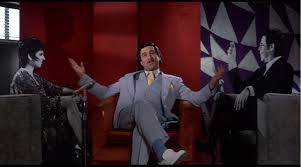
11 out of the 13 films on this list are masterpieces, this one is just the least amazing. It’s De Niro’s best against-type performance, and the story remains extremely relevant. The King of Comedy was what Scorsese settled on when De Niro expressed his desire to do a lighter film, after the two had collaborated on Mean Streets, Taxi Driver, and Raging Bull, among other things. The King of Comedy is as dark as any of them. But much funnier.
11- Cape Fear (1991)
Robert De Niro being one of the greatest actors in the history of film is a common theme on this list (part of why Casino is so bad is because his performance really isn’t that good). But taking on a role made iconic by Robert Mitchum, another of history’s greatest actors and improving on it (I won’t get into that now but there’s an argument to be made either way)? That’s an achievement on an impressive level. De Niro’s tour de force here powers Cape Fear to the status of one of the greatest remakes of a classic film ever, but the film succeeds for other reasons too. Nick Nolte is fantastic, and the neo-noir atmosphere is just so much fun. It’s a perfect follow-up to Goodfellas– scaled down and not trying to top it. And in doing so, it creates something of its own, something fantastic and brilliant.
10- Gangs of New York (2002)
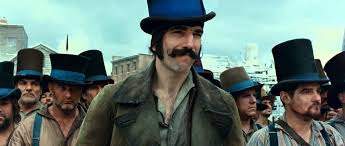
We interrupt this Robert De Niro appreciation-fest to bring you Daniel Day-Lewis. Day-Lewis dominates the film so much as the diabolical gangster Bill “the butcher” Cutting that he received an oscar nomination for Best Lead Actor (it’s totally a supporting role. A big one, but still a supporting one). It’s a career highlight that clearly laid the groundwork for his absolute best role in There Will be Blood. Outside of Day-Lewis, there’s still a lot in this one. Gangs is an epic film that was the start of Scorsese’s collaboration with Leonardo DiCaprio. It also features turns from Cameron Diaz, John C. Reilly, Liam Neeson, and Brendan Gleeson, all of whom are various degrees of great. It’s visually brilliant, which is even more impressive when you find out that there’s exactly one piece of CGI: the elephant (which they wanted to do practically!). At its worst, Gangs of New York drags a little. At its best, it’s a masterwork, an odyssey of redemption and honor that serves as maybe the most integral part of Scorsese’s chronicles of New York besides Taxi Driver. Scorsese is the best New York filmmaker, by the way. Sorry Woody Allen. Also, Gangs of New York is one of the most nominated films in oscar history to not receive a single award (It had 10 nods. True Grit in 2010 and American Hustle in 2013 also had 10, while the record is shared by The Turning Point in 1977 and The Color Purple in 1985).
9- Shutter Island (2010)
Mysterious, eerie, and dark as hell, this period stunner wouldn’t work as well as it does in the hands of a lesser filmmaker. While Scorsese’s films aren’t typically this genre-specific, he kills it with this one. Gorgeously shot by Tarantino regular Robert Richardson, Shutter Island is entirely atmospheric. And WOW what an atmosphere. I first saw this one knowing nothing about it except that it was directed by Scorsese and it had a great twist (it does). I wasn’t expecting the masterpiece of a slow burn thriller I proceeded to experience. It was after watching this that I first realized that DiCaprio is one of the greatest actors of all time (this was before having seen The Wolf of Wall Street and The Revenant). Mark Ruffalo is great as usual, as is Ben Kingsley. And MAX VON SYDOW is in it. It’s a perfect movie. Also, it’s almost a shame to mention this because it takes away from what a gloriously brilliant achievement the film is, but the twist is all-time. Up there with Fight Club and The Sixth Sense.
8- Mean Streets (1973)
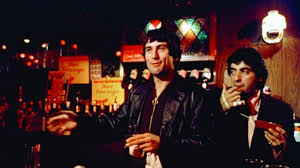
Eighth place feels incredibly low for the movie that, in one scene, invented both movies and music. Seriously, watch it.
Oh, and also it was Martin Scorsese’s first commercial success and it launched the career of Robert De Niro. Richie Aprile from The Sopranos is in it. I’m not sure I have to say any more, but I’m gonna. It features a brilliant opening scene (below), one of Harvey Keitel’s greatest performance (although he is outdone by De Niro to the point that Scorsese replaced Keitel as his leading man in the next movie he did). It features brilliant examinations of some of Scorsese’s most important themes, such as masculinity and Catholic guilt. And it’s seventh on this list. That should tell you something.
7- After Hours (1985)
Is this the most underrated film of all time? Considering it’s directed by a legendary auteur and is solidly well-known, probably not, but it’s up there simply because it’s SO GOOD. The true essence of a midnight movie, this one works best when watched at night (In my experience, Eraserhead and Kill Bill are other great midnight movies, if you’re looking for recommendations). The brilliance of After Hours is that it’s absolutely nuts. Guy meets girl, guy goes to girl’s apartment to buy magnet, guy is wrongfully blamed for girl’s death, guy spends the night on the run, guy gets built into a sculpture that is then stolen. Not exactly a classic story. Directed by Scorsese, but you would never know it. He’s having fun here- you can see it in the camera angles (think the falling keys), in the general absurdity of the comedy, and in the fact that it’s focused on entertaining before making a broad statement about human nature. In this case, that isn’t a problem. There’s truly nothing like it.
6- The Wolf of Wall Street (2013)
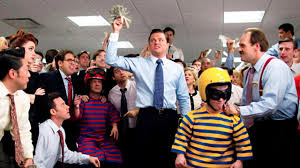
This list has been going through masterpieces since the 11 spot, but this is where it gets real. The Wolf of Wall Street is many things, which is only fitting because it’s a film that deals entirely in excess. The sex, the drugs, the length, the language (record for uses of “f**k” in a movie that isn’t about swearing), they all serve one purpose: to further the theme of excess. Jordan Belfort’s lifestyle isn’t presented this way by Scorsese just because, it’s to tell the story accurately. The story is one of American greed in its purest form. How quickly greed takes over and the kind of things it does to people. It’s like Goodfellas, if the violence were traded in for financial scams. Also, DiCaprio has never been as good and Jonah Hill is revelatory. The Wolf of Wall Street is a glorious, phenomenal sensory overload of a movie. One of the greatest films of the 2010s. And it only gets better from here.
5- The Irishman (2019)
Scorsese’s latest is clearly one of his masterpieces. It earns every second of its titanic length with brilliant performances across the board (Pacino is a god), masterful storytelling, and a brilliant commentary on human mortality. It’s a late-career work in every sense, but that doesn’t mean he’s slowed down. The Irishman could probably be ranked below Wolf of Wall Street, but it could also be one or even two spots higher. It’s a breathtaking feat of cinematic excellence, the kind of thing that Scorsese does far more often than he has any right to. Reviewed in greater depth here.
4- The Departed (2006)
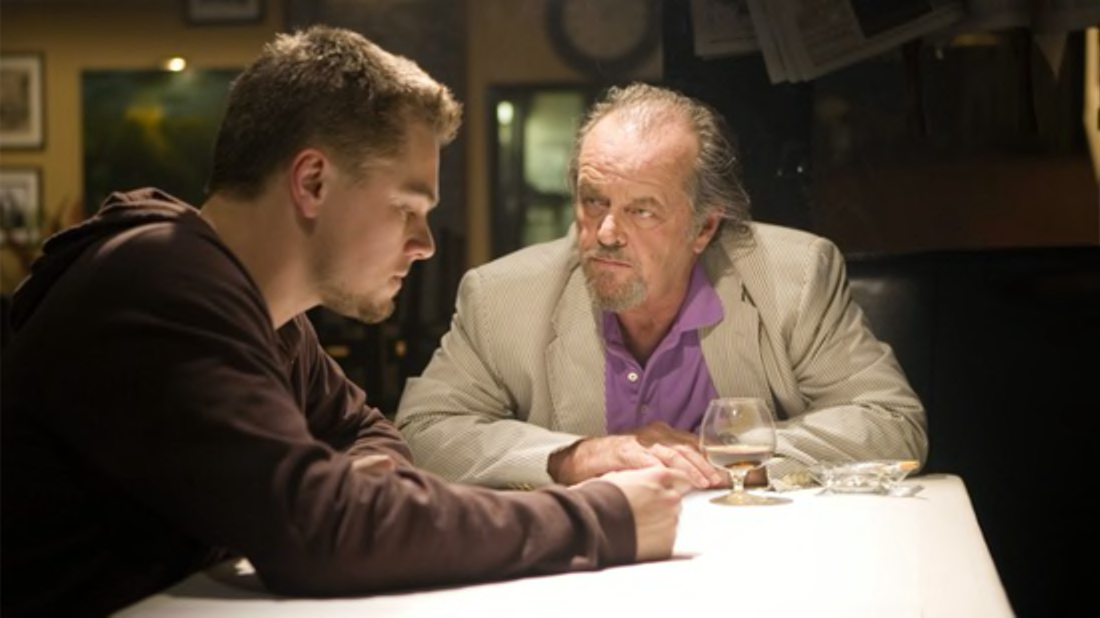
*Insert depahted joke*. Now that that’s out of the way, let’s talk about this, my second favorite Scorsese movie. The plot is so genius, complex, and Scorsese-an that it’s crazy that Scorsese didn’t think of it (for those uninitiated, it’s a remake of Infernal Affairs, a 2002 Hong Kong film). With the combination of director and plot, the least The Departed could’ve been was only slightly great. Instead, it’s an all timer. Matt Damon and Leonardo DiCaprio are equally brilliant as the gangster inside the cops and the cop inside the mob, respectively. Mark Wahlberg is awesome. For real, the only other place the guy is this good is Boogie Nights (another of my favorite films. Huh.), and you could argue that he should’ve won the oscar for supporting actor over Alan Arkin for Little Miss Sunshine (but damn is Arkin great in that). But the true best performance goes to the one and only Jack Nicholson (this has become a rundown of the greatest actors ever. All that’s missing is Brando). Nicholson is so unbelievably entertaining, over the top, and just plain great. I’ve seen it said that he tanks the movie and isn’t good. To that I simply say no. It’s one of the best performances of his career, and I understand the gravity of that statement. Also, in the last like 20 minutes it devolves into a Shakespearean tragedy. Huge plus.
3- Raging Bull (1980)
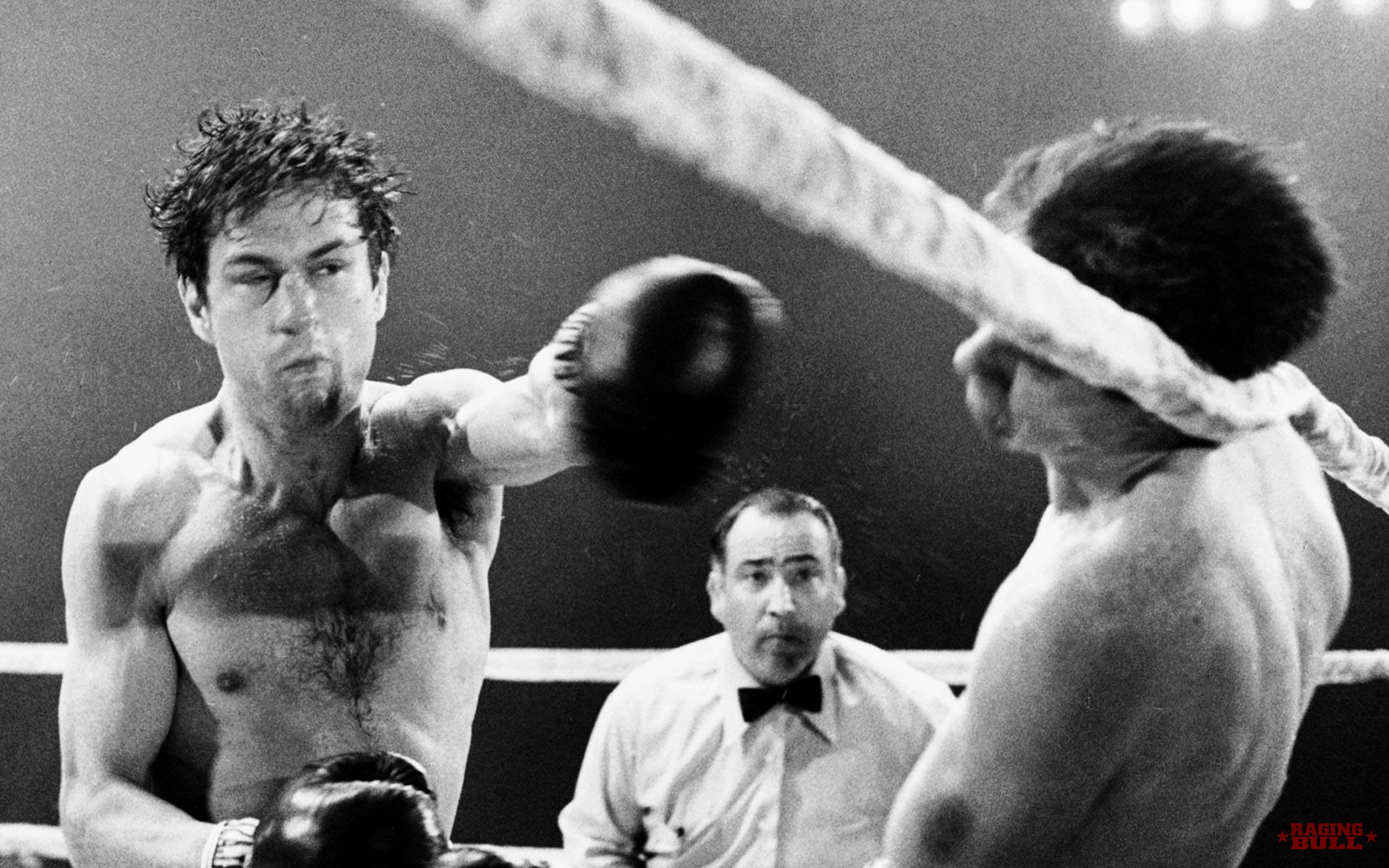
The greatest sports movie of all time. The (tied) greatest ever De Niro performance (I can never decide between this and Taxi Driver so I’ll call it a tie). The greatest study of self ruination that Scorsese ever accomplished (the two films above this are studies of ruination by other things). Raging Bull‘s one-two punch (sorry) of De Niro and technical wizardry (commonly referred to as the best edited film of all time. In my opinion, that’s probably correct, but Thelma Schoonmaker’s best work is the Sunday, May 11th sequence in Goodfellas. Rant over) cements it as a legendary work. It’s a boxing movie on multiple levels- sure, it deals with Jake LaMotta’s career inside the ring, but it’s also the story of his fight outside of it. And the technical genius of all involved elevate it into a masterpiece (in a way quite similar to the 2009 Claire Denis film White Material, which I will be discussing in a later post. Yeah I’m plugging my own stuff, so what?).
2- Taxi Driver (1976)
A visionary exploration of madness unlike any other. There’s so much going on within Taxi Driver: the film is simultaneously an indictment of the Vietnam war, the vigilante mindset, politics, and child prostitution. And yet it’s an indictment of none of these things. It presents them not positively or negatively, they are. Is Travis Bickle a hero, as he believes himself to be, or is he a violent psychopath? Is he actually lauded for his crimes, or is he imagining this reality as he dies? The film not only refuses to answer these questions, but it doesn’t provide a way to feel about it. It’s a film so important to cinematic history that anything else would feel like piling on. Peter Boyle, who plays “Wizard” in this, is the monster from Young Frankenstein.
1- Goodfellas (1990)
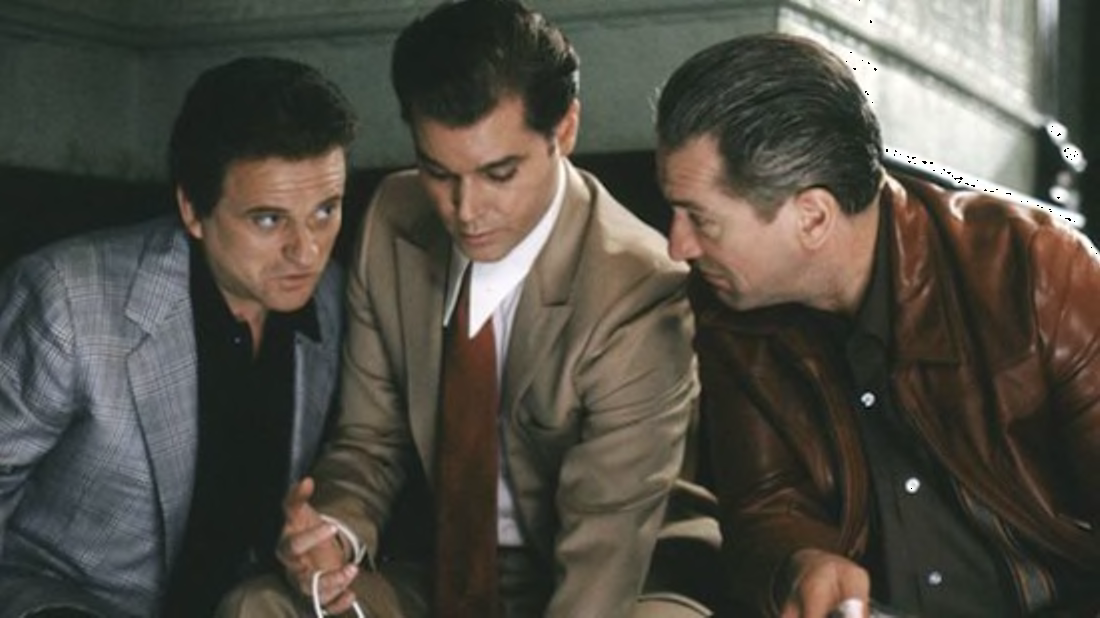
Full disclosure: this is my absolute single favorite film of all time. Nothing else comes close. So it was impossible for me to rank the films of Martin Scorsese with total objectivity. Even so, I have to feel that this would come in first if I could. It’s perfect in every way: Schoonmaker’s aforementioned editing is at its peak, Scorsese’s direction is as good as it’s ever been, the acting all around is brilliant. Liotta, Pesci, Bracco, and Sorvino turn in career bests and De Niro is amazing too. His facial acting in the bar when he decides to whack Morrie is completely incredible. That scene is a microcosm of why the film is so great- it’s the epitome of Scorsese’s cinematic sensibilities. That acting combined with the brilliance of the Sunshine of your Love needle drop and the use of slo-mo is a perfect example of the singular style that propels it into the annals of all time greatness. I could go on listing moments for days- Billy Batts’ death, the tracking shot through the Copacabana, the May 11th sequence, the opening scene, the third wall break, the Layla montage- but the point is already made. The film is perfect, and it’s the summation of Scorsese’s career and the highest peak he’s ever reached. And now we wait for The Irishman.
Before I begin, let me be clear that this is not just going to contain spoilers, but it’s really gonna be about spoilers. If you haven’t seen Enemy, go watch it without knowing anything about it. It’s on Netflix. Go now.
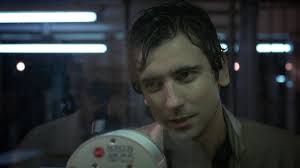
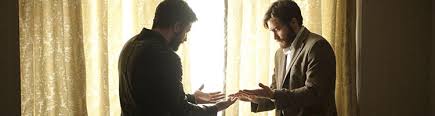
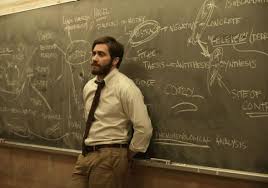
Denis Villeneuve’s 2013 film Enemy is peculiar, to say the least. In it, Jake Gyllenhaal (in maybe his best performance, second only to Nightcrawler) plays a burnt-out history professor who discovers his exact double in the background of a movie. He meets up with said double (also Gyllenhaal), an aspiring actor, who is a jackass who proceeds to blackmail teacher Gyllenhaal into swapping places so actor Gyllenhaal can have sex with teacher Gyllenhaal’s girlfriend. Actor Gyllenhaal and teacher Gyllenhaal’s girlfriend die in a car crash and teacher Gyllenhaal assumes actor Gyllenhaal’s identity. It’s a bizarre plot, and it creates a totally unique atmosphere of unease and confusion. No explanation is given as to any confusing plot elements, and it wraps up as an incredibly well-done thriller with a lot to think about.
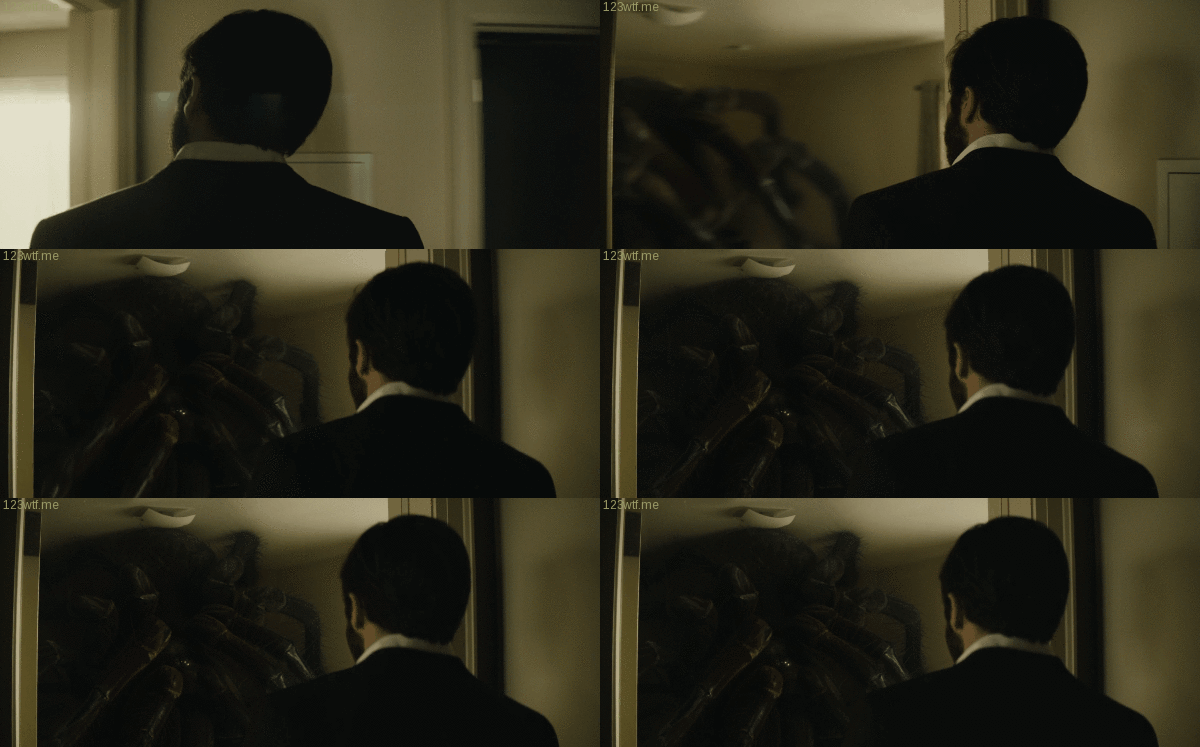
Oh, I forgot one thing: Enemy concludes with teacher Gyllenhaal, having taken on actor Gyllenhaal’s identity, asks his wife (Sarah Gadon, in an unreal performance), if they have anything going on that night, because he needs to go out to his weird spider sex club thing (more on that later). She doesn’t reply, Gyllenhaal goes to check on her and instead finds A GIANT GODDAMN TARANTULA in her place. Fin.
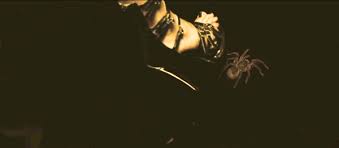
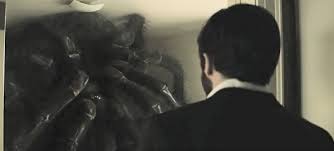
So what I will attempt to discern, in the following series of inane ramblings, is the answer to this simple question: what the actual hell does it all mean? First, some background on the spider: spiders are something of a theme throughout Enemy. The opening scene takes place in a strange place (the aforementioned spider sex club, which I promise I will address in greater detail) in which there is a spider shown (as well as Jake Gyllenhaal). There is a very notable scene in the middle of the film in which a giant spider-like alien thing is shown atop the city of Toronto, the setting of the film (see image below). And in the climactic car crash, the camera slowly zooms towards the windshield, which is prominently cracked in the shape of a spider web. So there is some precedent for the spider at the end, it just isn’t clear what the spiders all represent. Or is it?
Obviously it isn’t. It’s a total nightmare to try to figure out what it all means, but I think I’ve landed on something. There are countless interpretations of the ending, and they all depend on where you stand on one important issue in the film- if teacher Gyllenhaal, named Adam Bell, and actor Gyllenhaal, named Anthony Claire, are two sides of the same person. Adam is the character that is introduced first. His life doesn’t seem to be going too great, he’s shown to be living in a small apartment and working a repetitive job. His apartment is dimly lit and illuminated by a tan-yellowish hue (this is, in fact, important). Adam is timid, and presented as something of a nice guy. Anthony, by contrast, is a brash jerk who spends his time lecturing his wife on the importance of keeping blueberries in the house (somehow, also important) and driving around on a motorcycle. His apartment is shown to be more spacious and, notably, better lit. The lighting of Adam’s apartment is the shade in which most of the movie is shot, except for the scenes in Anthony’s apartment- with a few exceptions. I’ll get back to that, as the main concern right now is if Adam and Anthony are the same person. In my opinion, they are, and here’s why.
Personality-wise, Adam and Anthony are polar opposites, yet physically they are the exact same, down to identically placed scars and, oddly, the same exact style of beard. One could make the argument that they are separated twins, but two things disprove this. The first is the beard- it’s the exact same. That would be a huge coincidence if they were just twins. The second is the better evidence. Towards the end of Enemy, Anthony goes to meet with his mother (Isabella Rossellini) who adamantly debunks the idea that he had a twin or even a brother. This conversation also yields a few more interesting things: Anthony has historically had trouble committing to women (SUPER important), that she’s proud of his good job, and that she disapproves of his “dreams of becoming a third rate actor”. So obviously, being an actor is not his primary job. But being a professor could be. This is pretty good evidence that they’re two sides of the same person, but there is a lot more. In every scene in which they are seen together, there are no other characters present. The only exception is when Adam is driving away from their first actual meeting and Anthony drives past him on his motorcycle… with a helmet on. Additionally, in the scene where Anthony’s wife Helen goes to see Adam at his work, Anthony picks up her call immediately after Adam disappears from view. Finally, after Adam and Anthony switch places, Helen asks Adam the question “How was school?”. Now this is a tricky one, as there is a case to be made that Helen realized that they had switched and, not caring, targeted the question at Adam. While this makes sense, there is also a different (and super long) explanation.
My theory as to what happens in the movie (up to the spider part) goes like this: Adam is the real person. It’s Anthony’s life that’s real, and Anthony is his actual name, but Adam is his actual conscience. He teaches history at a local college and on the side aspires to be an actor. He cheats on his wife, runs spider sex clubs (soon, I promise) and is just generally a bad person. His wife gets pregnant and, whether it’s out of a fear of commitment or a realization that he’s probably unfit to be a father, creates an alter-ego (Adam). In Adam’s life, he cheats on his wife with another woman and totally rejects his career as an actor (hence Adam saying that he doesn’t really like movies). It is stated that he has been absent from his talent agency for six months, the same amount of time Helen has been pregnant. His actual life, as Anthony, disgusts his Adam persona, who attempts to reject everything about Anthony (he doesn’t like blueberries, which Anthony is shown to love, as well as the movie thing). Helen, concerned, goes to see him at work and is shaken up, not because Adam looks exactly like Anthony, but because Anthony doesn’t recognize her. Eventually, Adam realizes that he can’t run from his life any more and slips back into his actual role. The car crash represents the killing of one split personality (the Anthony half) as well as the end of his relationships with other women, as his girlfriend is also killed in the crash. When Adam returns home, an important thing happens. Anthony’s apartment takes on the lighting that had been previously confined to Adam’s apartment for the duration of the movie. Why does this happen? Look at Anthony’s fear of commitment. While he’s Adam, his apartment takes on that shade to represent the sleaziness of what he’s doing (in abandoning his wife and cheating on her). Anthony’s apartment is more appealing, as it’s where he’s being faithful to his wife and doing what he should be. So why does the apartment take on this quality? He intends to return to his old ways. And this is where the spider sex club comes into play.
An unfortunate disclaimer- I cannot provide any guesses as to what exactly goes on in what I’m referring to as the spider sex club, but it feels like a safe guess to say that it involves the nouns in the title. What he do know is that Anthony runs this club. He is seen there during its only actual appearance in the opening scene, and his landlord makes a reference to needing to get back because he couldn’t stop thinking about it. The landlord also mentions that the key has been thrown out. In the final scene, Anthony opens a package that contains a new key. He promptly decides to reopen the club that night, leaving Helen alone (“I have to go out”). The club represents his failure to stay faithful to Helen, as right after he decides to reopen it, she turns into a giant spider. Or at least, I originally thought she turned into a giant spider. In my first interpretation of the ending of the film, the spider represents his fear of commitment. He sighs when confronted with it because he knows that, now that he has returned to his life, he has to face this fear. This isn’t far off from what I believe now, but it also differs in two major ways. The way I see it now, she doesn’t turn into the spider, she is eaten by it. And the spider doesn’t represent Anthony’s fear of commitment, it represents Anthony. So to summarize- the spider, representing Anthony, eats Helen following Anthony’s decision to return to his life as an underground club operator behind her back. This represents Anthony sacrificing Helen to pursue his own interests, and also his reluctance to commit to her. Anthony sighs after seeing the spider, because he realizes that he has to face what it represents: himself. He comes face to face with himself. Sound familiar?
In conclusion, Enemy is nuts. If you’ve seen it, I hope this makes it a bit clearer (even though it almost definitely won’t). If you haven’t, come on. My instructions were so clear. Watch it anyway, because it rules. Join me next week, or whenever I’ve gained the required energy (probably never), when I tackle Mulholland Drive. Also Jake Gyllenhaal is one of the greatest actors of his generation. Now to end this post the only way it could possibly end:




/cdn.vox-cdn.com/uploads/chorus_image/image/65412061/irishman3.0.jpg)



 The Movie Files