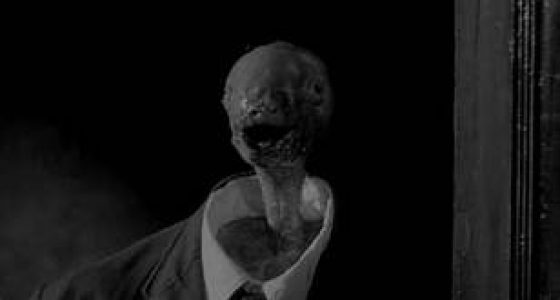
I must be honest in saying that I’m not sure exactly what I want to say about Cure, only that I want it to be something.
Kiyoshi Kurosawa (of no relation to Akira, for the uninitiated) has fascinated me ever since I watched his terrifying 2001 film Pulse a while back. His construction of horror is completely unique, narratively grounded in a similar sort of J-horror modality as Ringu (ghosts in the TV here replaced with ghosts in the computer), but distinguished by a quiet, eventually overwhelming dread that manifests itself in spots on the wall, images in the background, low drones on the soundtrack. It’s maximalist lo-fi filmmaking — Kurosawa’s craft is so impeccable it both its attention to detail and attention to eschewing that detail behind a lingering question of importance. Pulse unnerves in imagery as much as it unnerves in the entropic malaise that bathes the images. You are lost in it, forced to confront things you’re not prepared for without any reassurance that you should be unprepared. There are no jump scares or pure moments of terror, there is simply the viewer and the horror.
Kurosawa would go on to apply these conventions to melodrama with Tokyo Sonata, my second encounter with his work. That film unfolds with all the same anguish and devastation without the presence of the supernatural or any horror elements whatsoever. It’s an important film in understanding Kurosawa’s horror work, I feel — the idea that horror’s use in his form is to dig at the indescribable and the universal at once is best exemplified by his ability to remove horror from the equation.
Understanding Cure is not exactly what I have come here to do. Neither is understanding what it feels like to watch it, although that comes closer. I would describe it as catharsis, if anything. A natural response to the film, in the sense that it exists to produce a reaction. Cure was released in 1997, 4 years before Pulse, and 11 before Tokyo Sonata. It represented Kurosawa’s international breakthrough, as much as he ever had one. It is, for context, a mystery-thriller drawing narratively from Se7en, and blazing the trail for the territory later occupied by Memories of Murder and Zodiac in its depiction of losing oneself in pursuit of answers to the question of why evil persists in the world. The invocation of these other films only takes you to a base level with Cure, which goes further with its conceit in its dedication to embodying that evil. The later films would ruminate on its presence with the conclusion that it is fundamentally unknowable, Cure says that we all already know it.
There is a scene, probably about halfway in, where the central detective is growing increasingly frustrated in his attempts to question a witness. All of his questions are being turned back on him, an interrogation aimed not at anything specific, but on him personally. At one point he exclaims something to the effect of “I’m asking you questions”, seemingly having forgotten that it has been a long time since he has done so. And he definitely doesn’t realize the significance of this, the power he has now afforded his subject. This is what it is like to watch Cure. You’re aware you’re losing control, and yet you’re not all the way sure of the full extent of it. You will see the film’s most outwardly horrifying images when you close your eyes: violence and blood and humans enacting biblical reckoning upon other humans with a nihilist shrug in the way of justification. And you will see these things interspersed with shots of a waitress’s uniform or a phonograph or a lighter, and they will chill you to your bones at the same level. Cure is a masterpiece in its ability to make you feel unsafe to the point of fearing the very essence of the world around you. I have not included any images in this post, for I feel they would do very little good on their own. It is one of the most deeply unsettling films I have ever seen, yet not even the most conventionally upsetting shots would do that justice. There is no way to do it justice. There is nothing I can do to communicate why I felt such a need to discuss it. There is nothing.

 The Movie Files
One thought on “A Word on Kiyoshi Kurosawa’s ‘Cure’”