Movement. Constant, plunging, almost nauseating forward movement. As if you’re being thrust into the void. It’s not a sensation that is, by any means, pleasant. Yet in the utterly entrancing films of Takashi Ito, it’s what you’re confronted with. His short works have been described as horror and surrealism, blending disembodied images, eerie sounds, and avant-garde editing techniques to create an atmosphere of discomfort in the viewer. In films like Spacy, Ito seems to be actively trying to torture his audience, issuing a bombardment of totally nonsensical visuals of familiar objects and places, strung together in an absolute fury to create a sensory overload. But more than anything, what he’s trying to do is show us something. You can see it in all of his films, the way he shoots everyday spaces as liminal and even dangerous, the way he presents human beings as apparitions, the way he appeals to all of our senses in a way nobody would think to. There is a method to this madness.
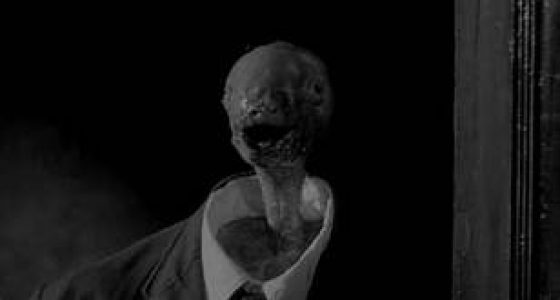
Like all great experimental filmmakers, Ito’s images are given emotional power through their individual construction and meaning through their juxtaposition with other seemingly meaningless images. When we see a human face projected like a ghost onto a dark wall in Thunder, we’re not sure what to make of it, but we know it stirs us. This is the feeling Ito dwells in. He can create a defamiliarizing feeling within a still frame with ease: Zone feels made up almost entirely of these, invoking a sense of seeing something you’re not supposed to be seeing even though it may appear normal on the surface. Ito is a master at giving something just the right unsettling tweak to land here. But his real genius comes not in the creation of these images, but in his editing. Ito was a student of Toshio Matsumoto, the iconic experimental filmmaker behind the likes of Atman, a fifteen-minute short in which a Noh theater demon is shot from several different angles to give the impression of constant, rapid rotation. Like Ito’s work, Atman’s unique movement is used to disorient the viewer: it’s easy to see Matsumoto’s influence. Also like Ito’s work, the film is explicitly centered on movement while drawing power from an image designed to burn itself into your brain:

This is a combination of factors that Ito has used to incredible effect in communicating his grand design. What does he want to show us? His world, a wide, wonderful, horrifying world of empty spaces, between physical objects, human rituals, emotions, spirits. His world is, of course, our world, with a few differences. The key to his work lies in whether or not you view those differences as major. Ito will show us a world stripped away of recognizable humanity and littered only with signifiers of such, and thinking rationally, it makes sense to believe the signifiers are a replacement, a break from reality. The disembodied floating head in Thunder is not a fully formed human being. But Ito doesn’t want us to think rationally. And thinking of a part with Ito’s danse macabre of unrecognizable trivialities, you can start to talk yourself into the idea that what he’s presenting is not meant to represent the space between what we perceive as reality, but the empty space cluttering up that reality itself.
In my view, Ito can best be viewed as a documentary filmmaker. His break from narrative suggests abstraction, but that doesn’t mean it suggests a fictionalization or even anything beyond a thinly-veiled allegory. Ito shoots, habitually, the real world. Spacy‘s visuals, endless looping shots of the same blue-tinted school gymnasium, are clearly intentionally alien, yet created with no foreign elements. What Ito is presenting is normal, it’s the specifics of his presentation that create confusion on that front. But this is not isolated to one film: Ghost specifically seems preoccupied with an exploration of spaces we take for granted, and Grim takes this further as an extension of that concept. Ito himself referred to his goal in these two films as “peeling only the skin from various objects in the room, floating the skins in midair and then sticking them on different objects”. He’s deconstructing reality, yet there’s something very real to be said for the fact that the medium in which he chose to work is so explicitly plain reality. In Ghost especially, the idea of innocuous images taking on the role of individually-constructed powerful ones stands out. In presenting them in the unsettling, disorienting way that he does, Ito communicates the idea that everyday life is terrifying in its mundanity, that the reason these things are scary is because of how much they are expected to be accepted without question.
It’s a joke formulation, “X Outlandish Movie is a documentary”. It sounds almost unserious, as both a commentary on the work and the real world. Yet Ito’s work, fitting all sort of qualifiers for that type of “out-there art”, undeniably courts analysis as a presentation of these things rather than a formation of them. The fact that Ito is forming images of his own doesn’t contradict the idea that he’s mainly working with the natural world. If he is to be seen as a documentary filmmaker, he certainly can’t be classified as an objective, unobtrusive, fly-on-the-wall one. He’s something closer to Orson Welles in F For Fake mode, telling a story with his own authorial stamp, style, and embellishments, but still recognizably making a documentary. To accept Ito as a documentarian, you have to allow for room in your interpretations of both Ito’s films and the documentary as a concept. But this is easily doable: the documentary is undeniably malleable, and Ito’s central method centers, however strained, real-world depictions.
Ito’s less reality-grounded works may seem to challenge this. Zone’s procession of images, comparable to Spacy in acting as both an endurance test and a conscious sensory manipulation, may not seem conducive to the view of Ito as a documentarian. Abstraction as a synecdoche within reality can only carry you so far as an actual depiction of reality. Yet in Ito’s work, the surrealism manages to ring true. Think again about Thunder’s floating head, projected on a wall, an image totally divorced from something mundane, something you could conceivably encounter. How does this fit with a conception of Ito as a presenter of reality? Simply put, the image itself is real. Its location is not. In Ghost, much of what he puts forward is assembled in the same way as our world, yet in Thunder this is not the case. But its inherent reality is the same. Ito is assembling reality as he sees it, aligning images in thematic or emotional currents, but he is not altering or changing what is real. There are no characters, there is no dialogue. What he does, in putting forward images with the only context being other such images, rejects narrative or movement towards a concrete thesis. The way he edits, these images crashing and screeching against each other, only reinforces this. Even his most abstract works, he is commenting on our world by shining a light on it through his own perspective. The viewer is left to form their own opinion on what they have seen. To me, this is quintessential documentary filmmaking.
Ito’s unique filmmaking method is relentlessly compelling, forcing its way into your subconscious and nestling there. It can be difficult to pinpoint exactly why this is: of course the fact that there’s nothing quite like the films makes them stand out, but the specific manner in which they are designed to unsettle is elusive. The reason they ring so true is because they are true, and they’re designed so that this isn’t immediately obvious. But for all the lingering strangeness and intangible absurdity, the truth shines through.

 The Movie Files