Through two feature films and several shorts (of varying notability), Ari Aster has shown that he is a really, really good filmmaker. Yes, he’s most notable for his work in the horror genre, but his films transcend that. They’re obviously terrifying and horribly upsetting, but underneath that there are films that work just as well as dramas. Hereditary and The Strange Thing About the Johnsons are horror films, but they’re also melodramas about family and loss. They’re also incredible. Something definitely happened to Aster, but man does he know how to make a movie. And Midsommar is his best one yet.
Midsommar opens on a snowy day in the dead of winter, which is the most badass way to possibly open a movie with (a variation of) the word summer in the title. And then Aster gets down to business, as a double murder/suicide occurs within the first, I don’t know, ten minutes? From there it becomes clear what the movie is about- Dani (Florence Pugh, in an absolutely unbelievable performance) and her boyfriend Christian (Jack Reynor), and their deteriorating relationship. This simple domestic conflict is typical for an Aster film, but two things set it apart from Hereditary quality-wise. These things are as follows: The first is that it’s absolute art. Not that Hereditary isn’t, it’s just that Midsommar is on another level. The second is that it’s totally batsh*t. It’s a bright, colorful nightmare with dementedly brilliant drug trip sequences and the single wildest sex scene in cinematic history. Pawel Pogorzelski’s cinematography is at its best.
I mean, come on. But there’s more to Midsommar than how it looks. The drama created by the relationships between the characters propels the film to greatness (oh by the way, here’s where the spoilers start, so if you intend to see Midsommar, which you should, read no further). I already talked about how the core of the film is Dani and Christian’s relationship. But there’s so much more at play here. Mark (Will Poulter, who provides the movie with most of its shockingly plentiful humor) and his reluctance to have Dani join them on their trip to Sweden, Christian leaching off of Josh’s (William Jackson Harper of The Good Place) thesis topic, and Pelle (Vilhelm Blomgren) trying to bond with Dani over their past experiences of loss. These relationships end, respectively, with death by an unknown cause followed by the removal of his face, death by head trauma on behalf of someone wearing a mask of said face, and the decision to condemn a cheating boyfriend to death by burning while inside of a disemboweled bear carcass. That’s why Midsommar works so well- the events of the film are gloriously over the top and upsetting (I’m not going to talk about the ritual suicide scene except to say this: WHYYYYYYYYYYYY AHH GOD WHY), but it’s all rooted in human conflict and human emotion. This is where Ari Aster shows why he’ll be so successful in whatever genre he decides to work in next. It’s why Midsommar is his best film, one of A24’s (the best movie studio in the world, by the way) best, and the second best film of the year so far (it doesn’t quite reach the level of Us). Midsommar is such a masterpiece because, for all of its horror and fantastical elements, it’s very much of this world.
Before I begin, let me be clear that this is not just going to contain spoilers, but it’s really gonna be about spoilers. If you haven’t seen Enemy, go watch it without knowing anything about it. It’s on Netflix. Go now.
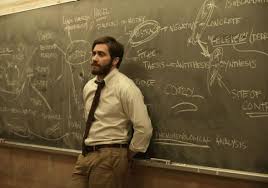
Denis Villeneuve’s 2013 film Enemy is peculiar, to say the least. In it, Jake Gyllenhaal (in maybe his best performance, second only to Nightcrawler) plays a burnt-out history professor who discovers his exact double in the background of a movie. He meets up with said double (also Gyllenhaal), an aspiring actor, who is a jackass who proceeds to blackmail teacher Gyllenhaal into swapping places so actor Gyllenhaal can have sex with teacher Gyllenhaal’s girlfriend. Actor Gyllenhaal and teacher Gyllenhaal’s girlfriend die in a car crash and teacher Gyllenhaal assumes actor Gyllenhaal’s identity. It’s a bizarre plot, and it creates a totally unique atmosphere of unease and confusion. No explanation is given as to any confusing plot elements, and it wraps up as an incredibly well-done thriller with a lot to think about.
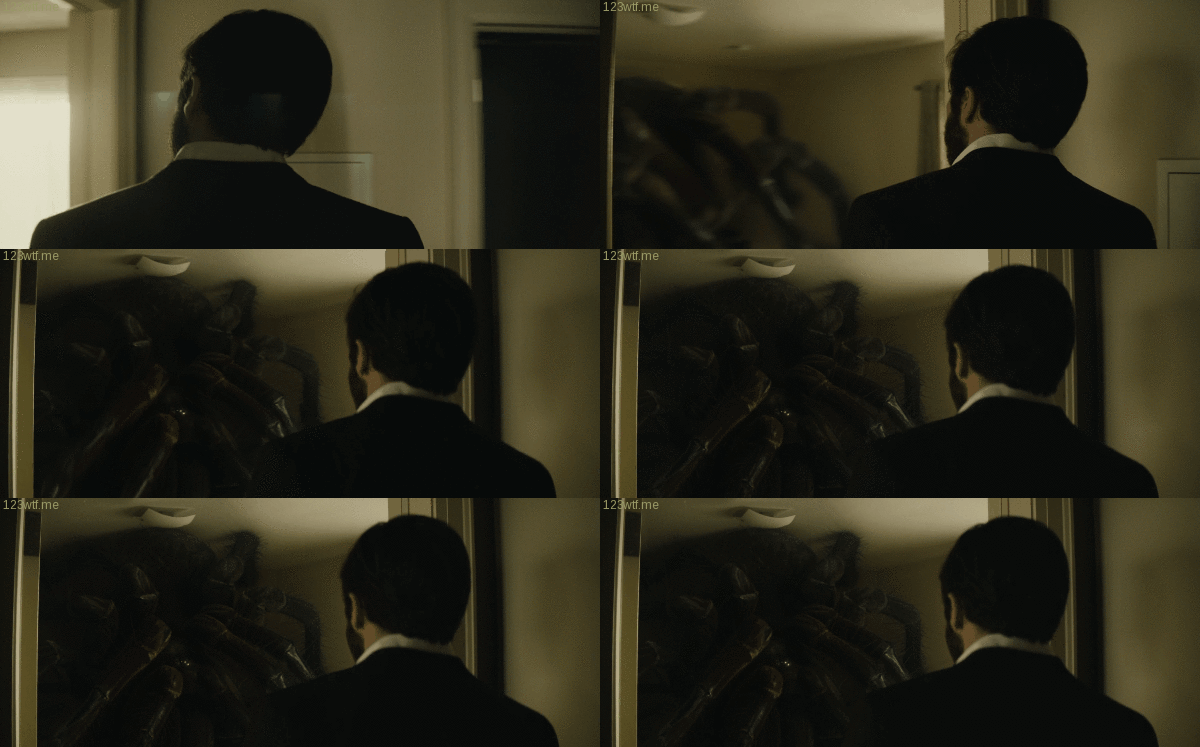
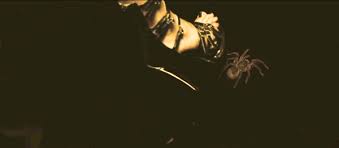
Oh, I forgot one thing: Enemy concludes with teacher Gyllenhaal, having taken on actor Gyllenhaal’s identity, asks his wife (Sarah Gadon, in an unreal performance), if they have anything going on that night, because he needs to go out to his weird spider sex club thing (more on that later). She doesn’t reply, Gyllenhaal goes to check on her and instead finds A GIANT GODDAMN TARANTULA in her place. Fin.
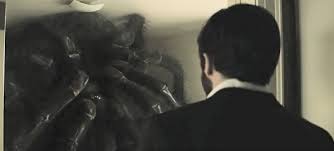
So what I will attempt to discern, in the following series of inane ramblings, is the answer to this simple question: what the actual hell does it all mean? First, some background on the spider: spiders are something of a theme throughout Enemy. The opening scene takes place in a strange place (the aforementioned spider sex club, which I promise I will address in greater detail) in which there is a spider shown (as well as Jake Gyllenhaal). There is a very notable scene in the middle of the film in which a giant spider-like alien thing is shown atop the city of Toronto, the setting of the film (see image below). And in the climactic car crash, the camera slowly zooms towards the windshield, which is prominently cracked in the shape of a spider web. So there is some precedent for the spider at the end, it just isn’t clear what the spiders all represent. Or is it?
Obviously it isn’t. It’s a total nightmare to try to figure out what it all means, but I think I’ve landed on something. There are countless interpretations of the ending, and they all depend on where you stand on one important issue in the film- if teacher Gyllenhaal, named Adam Bell, and actor Gyllenhaal, named Anthony Claire, are two sides of the same person. Adam is the character that is introduced first. His life doesn’t seem to be going too great, he’s shown to be living in a small apartment and working a repetitive job. His apartment is dimly lit and illuminated by a tan-yellowish hue (this is, in fact, important). Adam is timid, and presented as something of a nice guy. Anthony, by contrast, is a brash jerk who spends his time lecturing his wife on the importance of keeping blueberries in the house (somehow, also important) and driving around on a motorcycle. His apartment is shown to be more spacious and, notably, better lit. The lighting of Adam’s apartment is the shade in which most of the movie is shot, except for the scenes in Anthony’s apartment- with a few exceptions. I’ll get back to that, as the main concern right now is if Adam and Anthony are the same person. In my opinion, they are, and here’s why.
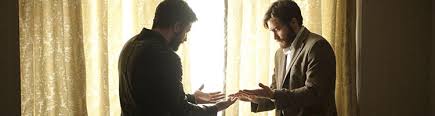
Personality-wise, Adam and Anthony are polar opposites, yet physically they are the exact same, down to identically placed scars and, oddly, the same exact style of beard. One could make the argument that they are separated twins, but two things disprove this. The first is the beard- it’s the exact same. That would be a huge coincidence if they were just twins. The second is the better evidence. Towards the end of Enemy, Anthony goes to meet with his mother (Isabella Rossellini) who adamantly debunks the idea that he had a twin or even a brother. This conversation also yields a few more interesting things: Anthony has historically had trouble committing to women (SUPER important), that she’s proud of his good job, and that she disapproves of his “dreams of becoming a third rate actor”. So obviously, being an actor is not his primary job. But being a professor could be. This is pretty good evidence that they’re two sides of the same person, but there is a lot more. In every scene in which they are seen together, there are no other characters present. The only exception is when Adam is driving away from their first actual meeting and Anthony drives past him on his motorcycle… with a helmet on. Additionally, in the scene where Anthony’s wife Helen goes to see Adam at his work, Anthony picks up her call immediately after Adam disappears from view. Finally, after Adam and Anthony switch places, Helen asks Adam the question “How was school?”. Now this is a tricky one, as there is a case to be made that Helen realized that they had switched and, not caring, targeted the question at Adam. While this makes sense, there is also a different (and super long) explanation.
My theory as to what happens in the movie (up to the spider part) goes like this: Adam is the real person. It’s Anthony’s life that’s real, and Anthony is his actual name, but Adam is his actual conscience. He teaches history at a local college and on the side aspires to be an actor. He cheats on his wife, runs spider sex clubs (soon, I promise) and is just generally a bad person. His wife gets pregnant and, whether it’s out of a fear of commitment or a realization that he’s probably unfit to be a father, creates an alter-ego (Adam). In Adam’s life, he cheats on his wife with another woman and totally rejects his career as an actor (hence Adam saying that he doesn’t really like movies). It is stated that he has been absent from his talent agency for six months, the same amount of time Helen has been pregnant. His actual life, as Anthony, disgusts his Adam persona, who attempts to reject everything about Anthony (he doesn’t like blueberries, which Anthony is shown to love, as well as the movie thing). Helen, concerned, goes to see him at work and is shaken up, not because Adam looks exactly like Anthony, but because Anthony doesn’t recognize her. Eventually, Adam realizes that he can’t run from his life any more and slips back into his actual role. The car crash represents the killing of one split personality (the Anthony half) as well as the end of his relationships with other women, as his girlfriend is also killed in the crash. When Adam returns home, an important thing happens. Anthony’s apartment takes on the lighting that had been previously confined to Adam’s apartment for the duration of the movie. Why does this happen? Look at Anthony’s fear of commitment. While he’s Adam, his apartment takes on that shade to represent the sleaziness of what he’s doing (in abandoning his wife and cheating on her). Anthony’s apartment is more appealing, as it’s where he’s being faithful to his wife and doing what he should be. So why does the apartment take on this quality? He intends to return to his old ways. And this is where the spider sex club comes into play.
An unfortunate disclaimer- I cannot provide any guesses as to what exactly goes on in what I’m referring to as the spider sex club, but it feels like a safe guess to say that it involves the nouns in the title. What he do know is that Anthony runs this club. He is seen there during its only actual appearance in the opening scene, and his landlord makes a reference to needing to get back because he couldn’t stop thinking about it. The landlord also mentions that the key has been thrown out. In the final scene, Anthony opens a package that contains a new key. He promptly decides to reopen the club that night, leaving Helen alone (“I have to go out”). The club represents his failure to stay faithful to Helen, as right after he decides to reopen it, she turns into a giant spider. Or at least, I originally thought she turned into a giant spider. In my first interpretation of the ending of the film, the spider represents his fear of commitment. He sighs when confronted with it because he knows that, now that he has returned to his life, he has to face this fear. This isn’t far off from what I believe now, but it also differs in two major ways. The way I see it now, she doesn’t turn into the spider, she is eaten by it. And the spider doesn’t represent Anthony’s fear of commitment, it represents Anthony. So to summarize- the spider, representing Anthony, eats Helen following Anthony’s decision to return to his life as an underground club operator behind her back. This represents Anthony sacrificing Helen to pursue his own interests, and also his reluctance to commit to her. Anthony sighs after seeing the spider, because he realizes that he has to face what it represents: himself. He comes face to face with himself. Sound familiar?
In conclusion, Enemy is nuts. If you’ve seen it, I hope this makes it a bit clearer (even though it almost definitely won’t). If you haven’t, come on. My instructions were so clear. Watch it anyway, because it rules. Join me next week, or whenever I’ve gained the required energy (probably never), when I tackle Mulholland Drive. Also Jake Gyllenhaal is one of the greatest actors of his generation. Now to end this post the only way it could possibly end:



 The Movie Files