It’s entirely possible that there’s no better track record in recent cinematic history than Paul Thomas Anderson’s, and just because that’s been said a million times doesn’t mean it isn’t true. 8 films over the last 24 years, and not one of them is less than “very good”. And most of them end up falling in the “masterpiece” range. How has he pulled it off? How is it possible that I went into the last few of his movies saying to myself “maybe this is the one that won’t be great” and it never happened? The answer is simple: talent. From his first feature in 1996, PTA has displayed a level of pure skill behind the camera and with his actors on par with the greatest filmmakers in history. He’s become one of the most exciting working directors- these rankings are subject to change whenever in the (hopefully near) he releases his next film. But for now, here are all 8 of his feature films, ranked.
8- Hard Eight (1996)

Something has to be last. On this list, as on most such lists, it’s PTA’s 1996 debut, one of his shortest and smallest in scope, and certainly his messiest. It’s his only film that never feels like it knows exactly what it’s doing, and there are moments where you can tell he just wanted to show off. But those moments can be as glorious as the rest of the showy moments in his filmography: it’s clear he had his skill in constructing long takes from the very beginning. This is an indispensable film in Anderson’s body of work for three reasons: 1 is that it’s his first, and those are always fun to watch to see where it all started. 2 is that it’s the initial appearance of one of his central themes, which is oddball outcasts finding solace in a morally gray group of other misfits. He would expand on this concept spectacularly the next year in Boogie Nights, before cruelly inverting it a decade and a half later with The Master. The third reason this can’t be ignored is that it’s actually a really good movie. The performances are brilliant: Philip Baker Hall has never been better (save maybe for Seinfeld) as the sorrowful, pensive center of the film, Gwyneth Paltrow and John C Reilly impress in supporting roles, and Samuel L Jackson is outstanding as always. There are barely any moments where this plays like a first film. It carries itself with immense confidence and backs it up with high-quality execution. It’s as sleek and entertaining as the best of his work, only occasionally faltering or losing its footing. However, those occasions sink Hard Eight into the eighth spot on this list, restoring the poetic justice of The Hateful Eight being in last on the Tarantino list before Once Upon a Time in Hollywood blew that whole thing up.
7- Inherent Vice (2014)
![Inherent Vice – FILMGRAB [ • ]](https://film-grab.com/wp-content/uploads/2015/04/0460.jpg)
Inherent Vice is probably the most “love it or hate it” work of Anderson’s career. Personally, I love it, although (as you can tell by the placement) not as much as some of its most dedicated believers. To attempt to describe the plot would be impossible and useless, as it’s not of much concern to anyone watching the film. This is a movie that you have to get swept up in the mood of or get left behind. Joaquin Phoenix does typically tremendous work as confused and perennially stoned PI Doc Sportello, who’s surrounded by a cast of bizarre and wildly entertaining characters who serve only to further complicate things. Highlights include Josh Brolin’s uptight and angry cop Bigfoot Bjornsen, whose weed-eating meltdown in the final scenes might just be the best moment in the whole thing, as well as Martin Short as a certifiably insane dentist and Katherine Waterson as Sportello’s ex-girlfriend who seems to be at the center of the whole thing. This is dense, impossible to follow, and just absolutely delightful to watch. Cinematographer Robert Elswit does possibly his best ever work, creating an early-70s L.A. that fits the world of the film perfectly. This is a singular experience like nothing else on this list, and it has to get major points for that. I can see it sliding up higher on repeat viewings. If you haven’t seen this one, just don’t go in expecting a standard crime yarn and you’ll be fine.
6- The Master (2012)

It just doesn’t feel right to have something as great as The Master this low on this list. But, like I’ve said, this is an atypical filmography to sort through. The selling point here is that it features the greatest performances in the careers of two of the greatest modern actors: Joaquin Phoenix and Philip Seymour Hoffman have never topped their grandstanding yet deeply emotionally wounded roles in this film. The scene that stands out the most from The Master is the famed “processing”, which is pretty much just those two talking back and forth. It’s among the best things PTA has ever filmed. The rest of it isn’t half bad either, although I’d be hard pressed to explain what exactly that is. It’s a story of power dynamics, of control, of the need for a sense of belonging, all of which have come up at other points in Anderson’s work (Phantom Thread, There Will Be Blood, literally all of it, respectively). But this feels darker and more unsettlingly off than any of those. Anderson loves to train his camera on broken individuals, but rarely does he depict people this messed up. This is an intoxicating attempt to get behind the psychology of cult membership, but it’s also designed to make the viewer confront their own inner workings. The actions depicted within are alien and disturbing, but Anderson’s goal is to make you wonder if you could ever fall for something like this. Lancaster Dodd is a con artist, a fraud, but you end up wondering if he has a point in his musings on our relationship to society. The Master is PTA’s hardest film to watch, both in that it’s not particularly fast paced and it’s darker thematically than almost anything else he’s done. This is a movie that’s designed to stick with you, which it undeniably does.
5- Phantom Thread (2017)

I understand the gravity of this statement, given the two previous entries that I’ve gone over, but I do believe the following to be true: Phantom Thread is Paul Thomas Anderson’s weirdest film. It’s grounded firmly within the real world, yes, but there’s an otherworldly quality to the way the characters behave and the conclusions they end up reaching about their lives. When this wraps up, nothing especially strange has happened, yet you’re left wondering what on earth you just watched. It builds up a world of intricate exactitude and then begins to slowly wither it away, culminating in a film that defies easy categorization in its constant self-upheaval- it’s not a comedy, although it’s quite funny at times and inhabits a reality of decided absurdity. For those reasons, it’s not a drama, despite the dramatic machinations at play. And it’s definitely, in my opinion, not a romance, despite the fact that it charts the rise, fall, and rebuilding of a romantic relationship. The overall statement doesn’t hit until the very end, and it recontextualizes the entire film to reflect a perverse yet oddly endearing view of reality. I guarantee you, it’s more fun than I’m making it sound. No period piece outside of The Favourite has a right to be this entertaining, but how many of them feature Daniel Day-Lewis in the mode he’s in here? There isn’t much else to say about DDL, in this or in general, but he hasn’t been this elegant since The Age of Innocence and he hasn’t snapped this well since There Will Be Blood. A winning combination. Vicky Krieps hangs with him the entire way, and Lesley Manville steals every scene she’s in. It’s also secretly a horror movie- the driving in this is agony-inducing.
4- Punch-Drunk Love (2002)
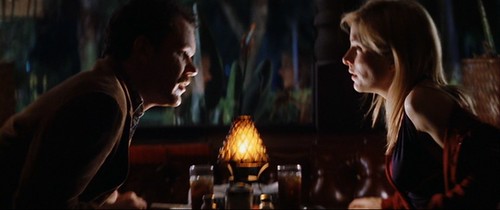
When Uncut Gems was unleashed upon the world in December of last year, there was a collective wave of thought that “woah, Adam Sandler can act“. While it’s great to see this finally recognized, and it’s great that people liked Gems so much, it’s mildly frustrating, because a lot of us already knew that. 2002, 17 whole years before Howard Ratner, brought the first glimpse of Sandler crossing over from generational comedic talent to generational dramatic talent. Yes, there’s an argument to be made that he’s just playing a Sandler character here, but in this film he’s tasked with embodying an existential melancholy foreign to the likes of The Waterboy. This movie hits on an emotional level that wouldn’t be possible without Sandler’s positively brilliant work, and while he may have surpassed this performance in Uncut Gems, this role shouldn’t be forgotten. Outside of that, the rest of the movie is pretty astonishing too. There’s an ethereal, dreamlike feel to it, to the point where the rage feels adequately subdued due to uselessness and the ecstasy is similarly reined in due to a feeling that it can’t last. Punch-Drunk Love offers up a man devoid of any reason to feel emotion and then gives him one. It watches him work to capitalize on the first shot he’s ever been given to make something out of his life, and it ends up the warmest and most cathartic thing in PTA’s work. OH and remember that thing I said earlier about Philip Seymour Hoffman never being better than in The Master? That’s still true, but shoutout to his profanity-laced revelation of a role in this. He’s only in two or three scenes, but take a look at this:
3- Magnolia (1999)
Magnolia is impossible to describe, but so are Inherent Vice, The Master, and Phantom Thread, and I’ve managed some writing on them, so let’s see. First off, this is a massive film. I’m not even talking about the 189-minute runtime or the gargantuan cast of characters, I’m talking about the broader philosophical aspirations of Magnolia. At times it can feel like it’s lost track of what it’s trying to say and is just vaguely galavanting around shouting “LONELINESS” and “INTERCONNECTEDNESS”, but that’s also really the point. This has points it wants to make, but it never allows them to become the whole movie. The characters and their lives and struggles come first, and through them we see what Anderson’s gesturing at. Three hours is a long time to fill if you’re trying to make a moral lecture about the insanity of human interaction, but it whizzes by when it’s more of an attempt to depict such a concept rather than make a statement on it. That’s really what Magnolia is- it’s a translation of the vast highs and lows of human follies and triumphs to the screen. It’s remarkable that Anderson manages to pull it off: it could’ve been unwatchable nonsense like Crash (the Best Picture winner, not the Cronenberg one) or marred by its pretentiousness like The Tree of Life (I do like this one, but it’s so damn high on itself that I’m not as in love with it as everyone else is). His talent as a filmmaker makes Magnolia not only in defiance of its sky-high aspirations but genuinely affecting. Plaudits for this also go heavily to the ensemble cast. Every actor is outstanding in their own way. It’s hard to pick a best performance, well, actually, it’s Tom Cruise, but maybe my favorite after removing him from the equation is Melora Walters. She sells the overwhelming brokenness better than anyone else, and every time she’s on the screen she’s equally heartbreaking and compelling to watch. Or is John C Reilly the MVP? This is the best of his early-career dramatic outings, all of which are underrated, but none of which are as memorable as this one. Or is it an obvious answer, like eternal acting gods Julianne Moore and Philip Seymour Hoffman? I know I’ve said this about a lot of these movies, but there’s no other cinematic experience that feels like watching Magnolia. It’s a bona fide masterpiece, and it can’t crack the top 2 on this list.
2- Boogie Nights (1997)

Boogie Nights has required a reputation as “the porn movie”. And yes, it is the porn movie, but it’s also about family, and about finding acceptance. The real porn… was the friends we made along the way. It’s also a brilliant stylistic showcase for Anderson, who pulls out all the stops and creates his showiest film. The first of PTA’s “big” movies (pun very much intended), followed immediately by the even more ambitious Magnolia. This, like that film, is broad in scope and in character count, and it leaves none of them behind. Every person here gets their moment, their interior conflict, their depth. Everything here is expanded upon to the point of an abundance of riches. When the bombast cools off and the second half rolls around, it makes sure we watch everyone hit their low point before starting them on the path towards redemption. As always, the performances are terrific, but the standout is Burt Reynolds as porn producer Jack Horner. It’s an unbelievable and unforgettable turn, one that almost overshadows the career work done by familiar names such as Moore, Hoffman, and Reilly, as well as Mark Wahlberg, who would only match this level of performance once again (The Departed). For a movie made so notorious by its subject matter, it’s a shock how human it is. It’s my favorite PTA film, and it contains my favorite PTA scene:
Impossible to hear Sister Christian or Jessie’s Girl the same way after that. Or watch Spider-Man 2.
1- There Will Be Blood (2007)

Recently it occurred to me that I remember very few plot details from There Will Be Blood, despite the fact that I’ve seen it multiple times and consider it maybe the defining masterpiece of 21st century American film. I then realized that this was yet another mark of the genius of this movie: most of the details of the plot are pretty much totally inconsequential and yet you still come away getting exactly the point the movie wants you to get. It’s like The Wolf of Wall Street in that regard: the oversaturation is the point. The sensual assault is the point. This is a movie that wants to hit you over the head with what it’s saying because it’s talking about things that bypass the realm of subtlety. This is as astonishing a portrait of individual greed as has ever graced the screen, and it really needs to rub in the evil of its central figure simply because he’s a figure that so relishes in rubbing it in. Blood drips excess because it needs you to emerge from the viewing experience exhausted, because it wants to drain you as if it’s Daniel Plainview and you’re oil-rich land. Nothing is left in Plainview’s path of destruction, not even his own humanity. You could argue Blood as a horror movie, because the monster at its center is terrifying enough. Sure, it helps that Day-Lewis turns in literally the greatest performance in film history, but the ambition of the story alone creates a larger-than life figure. Daniel Plainview is a seminal character in American fiction: he’s the 21st century Charles Foster Kane or Jay Gatsby, only without any sheen of high society. There Will Be Blood is an unforgettable accomplishment- from Jonny Greenwood’s world-altering score to Robert Elswit’s haunting cinematography. Every so often I find myself thinking about it, about random scenes. Maybe it’s Day-Lewis screaming about abandoning his child or about drainage (DRRRRRAAAAAAIIIIIIIINNNAAAAAAAGGGE), or maybe it’s something quieter, like those wordless opening 15 minutes. Either way, There Will Be Blood is hard to shake, and it’s Paul Thomas Anderson’s greatest masterpiece.
 The Movie Files