Today, August 17th, is the 76th birthday of one of the greatest actors of all time. His career spans his early work with Martin Scorsese in the 70s to his more recent supporting turns in David O. Russell’s films. His roles have become iconic- lines, scenes, and moments have become so indelible that they’ve etched themselves into popular culture permanently. He needs no introduction, and yet I’ve given him one anyway because that’s just how great of an actor he is. So here are the top ten performances of the one and only Robert De Niro.
10- Jackie Brown (1997)
My initial feelings on De Niro’s role as Louis Gara in Jackie Brown (and the movie in general) were lukewarm. the further removed I get from it, however, the more I appreciate it. In ways similar to Casino (not on this list. That movie sucks.), Jackie Brown features De Niro in an against-type performance. His character here is more timid than you typically get from him. Louis is a unique character in the film for that reason. Every other character is a typically Tarantino-esque, suave, smooth talker that’s always thinking ahead. Louis is pretty much a loser. He’s responsible for many of the best and most shocking moments in the film (parking lot scene, above) that don’t belong to Samuel L Jackson’s character. He’s a welcome presence in the film, and an interesting part of De Niro’s career.
9- The Godfather part II (1974)
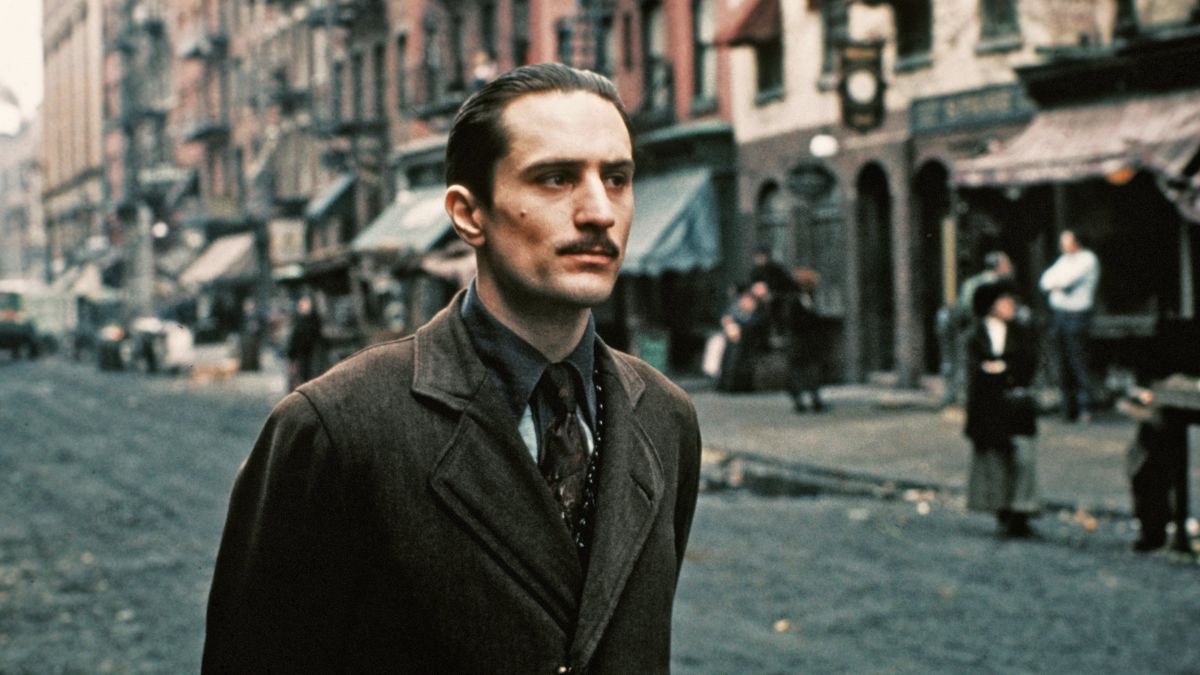
If the thing that sets the first Godfather movie apart is the presence of Marlon Brando, the thing that helps its sequel is De Niro (in the same role, fittingly enough). He won his first Oscar for his portrayal of Vito Corleone in his younger years. The most impressive thing about this part, in my opinion at least, is that almost all of his lines are in Italian. Additionally, he does a truly excellent job of maintaining the character that Brando established in the first film. Whenever he’s on screen, the film revolves around him. It takes skill to build on such an iconic character and make it your own, and that’s what De Niro does here.
8- The Untouchables (1987)
Enthusiasms, enthusiasms. What are mine? What draws my admiration? What is that which gives me joy? That would be De Niro’s brilliantly over the top performance as Al Capone in Brian De Palma’s crime classic. He’s unfortunately not in the film that much, but when he is the quality skyrockets. Which is saying a lot considering how great it is. De Niro delivers every line with an insane bravado that completely makes the movie and creates several classic scenes (I wanna go there in the middle of the night AND PISS ON HIS ASHES, etc.). There may be more nuanced performances in De Niro’s filmography, but I’m not sure if there are any that are this fun.
7- Mean Streets (1973)
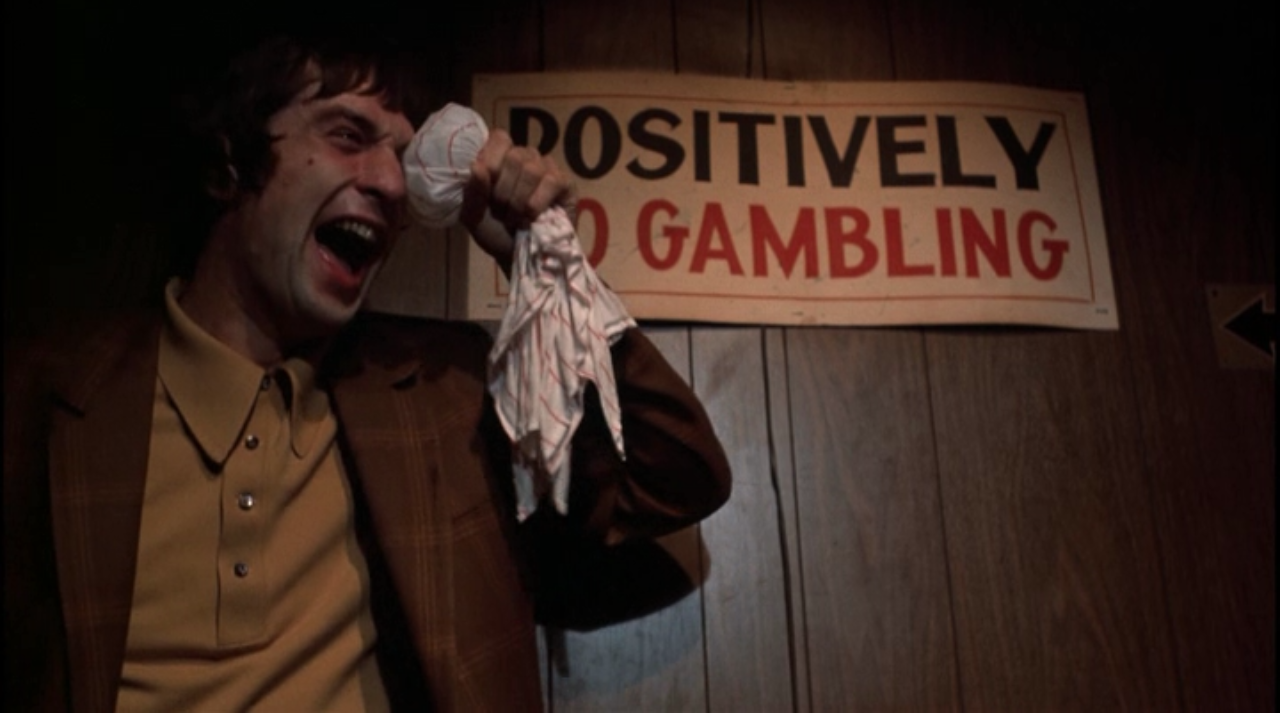
Harvey Keitel may be the star of Scorsese’s early masterwork Mean Streets, but De Niro steals the film with this completely bonkers turn. Here he plays a lunatic that doesn’t quite resemble his later roles in The King of Comedy and The Untouchables, but possesses an air of sheer madness that might make you think he’d make a good Joker. This film served as the starting point for his career and a stunning breeding ground for talent (David Proval, Richie Aprile on The Sopranos, is here, as is David Carradine) that remains fascinating to watch today, especially because of De Niro.
6- The Deer hunter (1978)
The Deer Hunter is a staggering, massive, emotional epic that is sure to resonate deeply with any viewer. Everyone here is in top form. Christopher Walken gives his best performance ever (the Pulp Fiction fan in me hates to say that, as does the Annie Hall fan in me), John Savage is tremendously and impeccably broken, and Meryl Streep is Meryl Streep. De Niro is the center of it all. He’s responsible for the most intense moments the film has to offer (russian roulette with more bullets), some of the most resonant (his return home from the war), and some of the saddest (NICKYYYY). He displays a brilliant range over the course of one film. He undergoes one of the greatest transformations in cinematic history (maybe even the second best in the movie). It’s an epic performance that perfectly suits the epic film.
5- Cape Fear (1991)
Never in his career has De Niro simply been this scary. He brings a palpable menace to every scene, even when he’s being outwardly friendly. His scene with Juliette Lewis, where he poses as her drama teacher, is one of the best scenes of his career. The above scene in the movie theater is a classic. He’s the second best thing about one of the best remakes in cinematic history (the best being the Simpsons episode that parodies it, obviously). He simultaneously oozes evil and charisma in a way he’s never typically done. Similar to the way he expands upon Brando’s Don Corleone in Godfather 2, he builds his own character on top of Robert Mitchum’s in the original.
4- Goodfellas (1990)
That is all.
3- The King of Comedy (1983)
There are elements of Travis Bickle in Rupert Pupkin, De Niro’s unhinged title character. In fact, it could be said that he’s the anti-Bickle. Whereas Bickle’s worldview is dark and nihilistic, Pupkin is an eternal and relentless optimist and opportunist. Bickle’s obsession is with (as he sees it) making the world a better place, Pupkin sees the world as a perfect place already: he wrongly views it as a world where anyone, himself included, can make it. In this way, The King of Comedy is maybe a more cynical film than Taxi Driver. It’s occurring to me that this would be better as a full-length post, so I’m gonna stop for now. De Niro absolutely owns in this movie, and that’s really all there is to it.
2- Raging Bull (1980)
In Raging Bull, De Niro creates a character so repulsive and awful that it’s incredible just how empathetic you become with him. We revel in LaMotta’s victories and suffer with his lows. De Niro creates a character with so much depth, but whose only emotion at all times is rage. This is what drives his every action, his every explosion, his every fight. Raging Bull is a boxing movie in two ways- there’s the actual boxing, and there’s LaMotta’s tragic and constant fight with everyone in his life. De Niro here is a person who is constantly fighting, that’s his nature, that’s all he can do. And De Niro does it so well that it completely makes the movie.
1- Taxi Driver
When I started this post, it occurred to me that I’d have to pick between Raging Bull and Taxi Driver for the top spot. I thought I’d go with Raging Bull, but when I thought about it, I decided that Taxi Driver was the true number one. Travis Bickle is one of the greatest characters in the history of American fiction, and he couldn’t have been without De Niro (who improvised his most iconic scene). This role singlehandedly created an entirely new character archetype- “God’s lonely man”, which has been seen in the likes of last year’s terrific First Reformed and Jake Gyllenhaal’s character in Nightcrawler. But nobody (although Gyllenhaal and Hawke are both fantastic) has pulled it off quite like De Niro. His insanity here is not below the surface and malicious, it’s well-intended and right there for the world to see. This is a man who has nothing to lose. This is a character of unbridled depth and a performance of unparalleled skill. This is De Niro’s greatest contribution to film, to art, and to the world as a whole. Decades later, it’s the crowning achievement of one of the best careers in film history.
His films are brutally violent and insanely profane. His influences are mainly films that the average person has never heard of, and he borrows from every last one of them. His dialogue-driven films stand out in an era when box office titans are comprised of explosions and chase scenes (although Tarantino can do that well, too). A major component of his body of work is including songs that nobody’s ever heard of. He shouldn’t have any sort of mass following.
Yet he does. He’s one of the only auteur directors that still drives people to the theater in droves. And with good reason. His films are flashy and alluring, he attracts major talent (Samuel L. Jackson, Brad Pitt, Leonardo DiCaprio, etc.), and he’s just a straight-up cinematic genius. All of the aforementioned songs nobody has heard never of immediately become super popular. Individual moments, lines, and images from his filmography have become imbedded into popular culture. He deserves his fame simply because he’s just that good. He’s so good, in fact, that he’s never made a bad film. And that is where we begin in this ranking of all 9 Quentin Tarantino films. (Only counting directed films, so no True Romance or From Dusk Till Dawn. Kill Bill counts as one film. Spoilers ahead).
9- The Hateful Eight
Again, there’s no bad Tarantino film. There’s a bad half of one, however. The first half of The Hateful Eight serves one purpose, and it’s to get all of its characters into one place. That’s it. That’s half of a close to three hour movie. Now, that’s not to say that the first half is a total failure. It looks fantastic, and it’s incredibly well acted, especially on behalf of Samuel L Jackson, Kurt Russell, Jennifer Jason Leigh, and Bruce Dern. The reason that the movie itself isn’t bad is the second half. From the halfway point on, The Hateful Eight is so great that you almost forget how slow the first half is. Characters die at an alarming rate and every death comes out of nowhere. The tension built up in the first half pays off big time as everything comes to a head in a masterwork of tension. Most importantly, it’s an essentially Tarantinoesque film. It’s very dialogue driven and features almost all of his recurring actors, such as Jackson, Michael Madsen, Tim Roth, and Zoe Bell, among others. And Ennio freakin’ Morricone did the score! But still, something had to be last.
8- Death Proof
It is perhaps my most unpopular opinion on Tarantino’s films that Death Proof is actually really good. It’s especially good for what it is, which is an intentionally cheap and sleazy tribute to the grindhouse movies of the seventies. And it works absolutely perfectly as that. It’s sleazy as hell and twice as gritty. It’s brutally violent and super cheap (which, again, is by design). It all comes together perfectly as a brilliant storm of pure cinematic bliss. The key to the whole thing, however, is Kurt Russell in one of his career best performances. His psychotic Stuntman Mike is one of the greatest villains in the Tarantino canon, and he’s the reason that what otherwise wouldn’t work works. It’s one of the greatest performances in all of Tarantino’s movies, and it’s so much fun (but also really guilt-inspiring) to watch him exact works of sheer evil and psychosis spanning both parts of the movie, the only thing tying both acts together. Both car scenes are masterful. The first, at the conclusion of the first half, is a brilliant scene, combining Tarantinoesque tension and elements of slasher horror to create something so brutal yet so utterly fantastic. The second, the climactic chase scene that runs for pretty much the entire fourth quarter of the film, is a work of pure technical precision. Tarantino directs the chase masterfully, and it’s fun to see him work outside of his typical comfort zone in trying (and succeeding) to craft an action sequence. Death Proof is not without its shortcomings, though. The third quarter of the film is just kinda nothing, and the premise really limits what it can be by design. Not a masterpiece, but it’s truly great and likely his most underrated film.
7- Jackie Brown
Tarantino’s films are their own genre, but yet they all seem to pay tribute to others. Reservoir Dogs is a heist movie, Pulp Fiction is an homage to the titular works, Django Unchained and The Hateful Eight are westerns, Inglourious Basterds is a war movie, Kill Bill is like 19 different ones and Death Proof is a grindhouse film. Jackie Brown is Tarantino’s contribution to the early-70s blaxploitation genre, even going so far as to cast the biggest star of the movement in the title role. Pam Grier is phenomenal, but Jackie Brown (the film) is complicated enough that she’s not really the main character. Samuel L Jackson’s charismatic gun nut Ordell Robbie steals the show, Robert DeNiro’s (!) depraved, burnt-out Louis and Bridget Fonda’s sardonic Melanie play major roles, and Michael Keaton’s agent Ray Nicolette is… there. And of course, there’s Robert Forster (who earned Jackie Brown’s only oscar nomination for this role) as bail bondsman Max Cherry, who delivers the fifth best performance in this movie. The issue with this film isn’t that there’s too much going on, it’s that it isn’t handled well. Tarantino is adapting here, from Elmore Leonard’s novel Rum Punch. Watching Jackie Brown, it’s visible that it’s not entirely his work. It’s definitely a Tarantino film, but it’s not all there. Nevertheless, Jackie Brown can be fantastic at times. Jackson’s car-trunk assassination of one of his henchmen is a stellar scene, and his AK-47 monologue is so much fun. The plot is delightfully twisty and complex, and it has the vague feel of an Ocean’s 11-type heist thriller. It runs a little long and, unlike Pulp Fiction (which shares the runtime down to the minute), feels like it. Jackie Brown falls short of masterpiece status, but it’s still pretty great.
6- Django Unchained
We’re in the truly great stuff now. Everything from this point on, including Django, is a masterpiece, and it’s ridiculous that a film of this quality, a film that features Christoph Waltz as a bounty hunting dentist, falls on the bottom half of this list. Jamie Foxx’s fantastic lead role as the title character is overshadowed by some of the best performances in any Tarantino movie, on behalf of Waltz, Samuel L Jackson, and Leonardo DiCaprio (more on that one in a little bit). It’s a brilliant redemption story, and it contains one of the finest (and bloodiest) scenes in Tarantino’s filmography in the Candieland Massacre. It’s nothing short of an epic, something that might’ve been made by Sergio Leone or David Lean if they were buried in the pet sematary and came back more disturbed and violent. It’s also far more exhilarating and fun than any movie about slavery has any right to be, in kind of an Inglourious Basterds-type way. As for DiCaprio’s role, it’s one of his career best and it’s a shame he wasn’t even nominated for an oscar for it. His vindictive plantation owner, Calvin Candie, is nothing short of terrifying as he menaces over every single frame he’s in with conniving faux-properness. Django’s quest is probably the most compelling Tarantino has ever crafted, as the audience is with him all the way in the quest to find his wife. Django Unchained comes together in the kind of way that all of Tarantino’s best films do, and it’s certainly one of them.
5- Kill Bill
It’s one film. This is not negotiable. It’s one story and Vol. 2 picks up at the conclusion of Vol.1. It works best as a complete, glorious, 4-hour whole. The Bride is the second best Tarantino character (the best has yet to come on this list), and she’s played with masterful determination and sorrow by Uma Thurman. None of the main villains aren’t fleshed out (especially the eponymous one). In a feat incredibly rare for something of its length, not a single scene feels out of place. The house of blue leaves scene is one of my absolute favorite scenes in cinematic history, and Bill’s death is one of the greatest death scenes ever constructed. It’s a first-order epic, and everyone either loves or hates it. I’m a full-on devotee to the “love” side. It spans pretty much every genre, zigzagging from a Samurai film to anime to a western to a sort of exploitation horror-type thing (the box). The cliffhanger at the end of volume 1 is one of the best, and it’s scientifically impossible to watch it without immediately watching volume 2 (trust me, I know science and stuff). It’s impeccable, awesome, and brilliant. It’s the film that Quentin Tarantino would make if given an infinite budget and access to any actor he could want. How Thurman and David Carradine didn’t get oscar consideration baffles me.
4- Reservoir Dogs
Where it all started. Reservoir Dogs launched a half-dozen careers (including QT’s), revitalized a couple more (Harvey Keitel and Lawrence Tierney) and firmly entrenched itself into cinematic history. It’s one of the all time greatest independent films, and it’s an independent film to its very core (although it doesn’t really feel like it). It’s so famously low-budget that the iconic suits were provided for free by a crime film fan and the other clothes worn by the characters were the actors’ own. There’s so many iconic scenes, such as the opening diner scene (Like a Virgin and Steve Buscemi’s tipping monologue in the same scene), the slow-mo opening credits scene (one of the greatest opening credits sequences ever) and of course, that one. Michael Madsen’s psychotic lunatic torturing a cop to Stealer’s Wheel’s Stuck in the Middle with You is many things, including the greatest needle drop ever, possibly Tarantino’s finest scene, and the beginning of one of the greatest filmmaking careers of the modern era because, let’s face it, without it the film wouldn’t have been as big of a success. Reservoir Dogs is another one that just comes together perfectly, combining stellar performances, spectacular writing, and tension that you can cut with a knife on every single watch. Reservoir Dogs is a pop culture landmark and a cinematic masterwork, and it doesn’t even manage to crack Quentin Tarantino’s top 3 films.
3- Once Upon a Time… In Hollywood
Tarantino’s latest is one of his absolute best, which is odd considering how much it diverges from his other work. It’s far less urgent and tense, it progresses slowly, and it takes a far more humane and tender approach to its characters. (What could be construable as spoilers approaching) Its revisionism is done with glee, similar to Basterds and Django, but there’s a softer edge to it. These characters, for all of their outward projections of toughness and machismo, care about each other. But yet for all of Hollywood’s rarities, it couldn’t have been made by anyone else. It meanders and often stands still, but it contains sequences of tension unparalleled even in his own filmography. The Spahn Ranch sequence is one of his absolute best- it felt to me reminiscent of Basterds’ basement bar scene. And the climax is as shocking, violent, and brilliant as anything he’s ever done. Overall, Once Upon a Time in Hollywood is essential Tarantino. It’s a completely unforgettable masterpiece. The further removed I am from my first viewing, the more I feel that this placement is right. Who knows? After further viewings, it might be even higher.
This was unbelievably close to taking the top spot. It’s another one of Tarantino’s latter-career revisionist history epics, an oddly specific genre he would return to for Django Unchained and The Hateful Eight (and, as it turns out, Once Upon a time in Hollywood). Basterds seems to get better with every rewatch, as every one of the aspects that makes it great holds up. Brad Pitt is at his best, Michael Fassbender is ridiculous in his two or three (not so brief) scenes, Christoph Waltz (duh) turns in an all time performance, and god it’s so much fun to watch Hitler’s skin slide off of his head. The climactic theater scene is incredible and it’s still not the best scene in the film. The half hour basement bar scene is possibly the greatest thing Tarantino has ever done, and it’s a masterclass in screenwriting, acting, and tension (soooo much tension). It’s so much fun, brilliant on a technical level, and unexpectedly funny (Hugo. Stiglitz.). It’s worth noting that Mike Myers is in it, and also Winston Churchill is played by Rod Taylor, who happens to be the male lead in Hitchcock’s The Birds (this isn’t necessary information, I just want as many people to know as possible). And now the time has come to talk about Waltz. His Nazi Hans Landa is disarmingly courteous and sophisticated, and he views his work as just that: work. He’s conniving, he’s terrifying, and worst of all- he’s charming. He’s Tarantino’s greatest character, period. He’s an all time great villain, and the secret to the whole thing. The opening scene at the farmhouse is one of the best acted ever, and it would work as a short film on an oscar-worthy level. Inglourious Basterds is perfect. It just might be Tarantino’s masterpiece.
1- Pulp Fiction
Shocker, right? There’s a reason that Pulp Fiction is consistently hailed as Tarantino’s masterpiece, and it’s that it’s simply one of the greatest films ever made. Endlessly rewatchable and quotable, Pulp Fiction is another one that has totally ingrained itself into pop culture. It features one of the all time best death scenes (Aw man, I shot Marvin in the face), is absolutely hilarious, (He hid this uncomfortable hunk of metal up his ass…, also Marvin’s aforementioned demise). It’s Christopher Walken at his absolute best, if only for one scene (similar to his role in Annie Hall). Harvey Keitel is at a similar best in his iconic turn as The Wolf. Any number of scenes have become iconic, from the jackrabbit slim’s twist contest to the scene in Brent’s apartment (try to pick a favorite between “SAY WHAT AGAIN” and “ENGLISH, MOTHERF***ER”). Bruce Willis is in peak form, as are (obviously) Samuel L Jackson and John Travolta. The final scene in the diner stands out as one of the most well-written in all of Tarantino’s films. Don’t even get me started on the theory that the briefcase contains Marsellus Wallace’s soul. There’s too much to talk about with Pulp Fiction and most of it has been said already, so suffice it to say that it’s a masterwork that works ceaselessly throughout its entire runtime. As close as Inglourious Basterds may be, this is the obvious number one. In the 25 years since its release, Tarantino has never topped it, nor has anyone else (with the exception of maybe Barry Jenkins with Moonlight). Tarantino’s career is as illustrious as anyone’s, and this is the film that epitomizes that. I’ve been writing for two hours now, so if you’ll excuse me I’m going to go home and have a heart attack.





:no_upscale()/cdn.vox-cdn.com/uploads/chorus_asset/file/13167865/king_of_comedy.jpg)


 The Movie Files