I’m Thinking of Ending Things Review

I'm Thinking of Ending Things Trailer Reveals Charlie Kaufman Netflix Pic |  Collider

I would love to say that my review of I’m Thinking of Ending Things, Charlie Kaufman’s latest, is so late because I’ve only just now figured the film out. This would be a lie for two reasons- one is that the reason I haven’t had time to write it is due to the return of school and all that brings. The other is that it implies I’ve figured it out at all. The latest directorial effort from the writer of Being John Malkovich and Eternal Sunshine of the Spotless Mind hit Netflix earlier this month, after months of silence from the streaming giant on a movie initially supposed to hit in early 2020, and the announcement of a release date immediately stirred fans of Kaufman’s particular brand of surrealism into a frenzy. Counting myself as one of those fans, I can assure you that the phrase “Charlie Kaufman does a psychological horror movie” is extraordinarily exciting. Kaufman is one of our greatest cinematic weirdos, and his totally singular view of the human psyche seemed like a natural fit for the psychological horror genre.

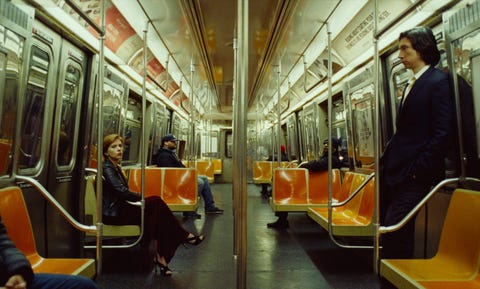
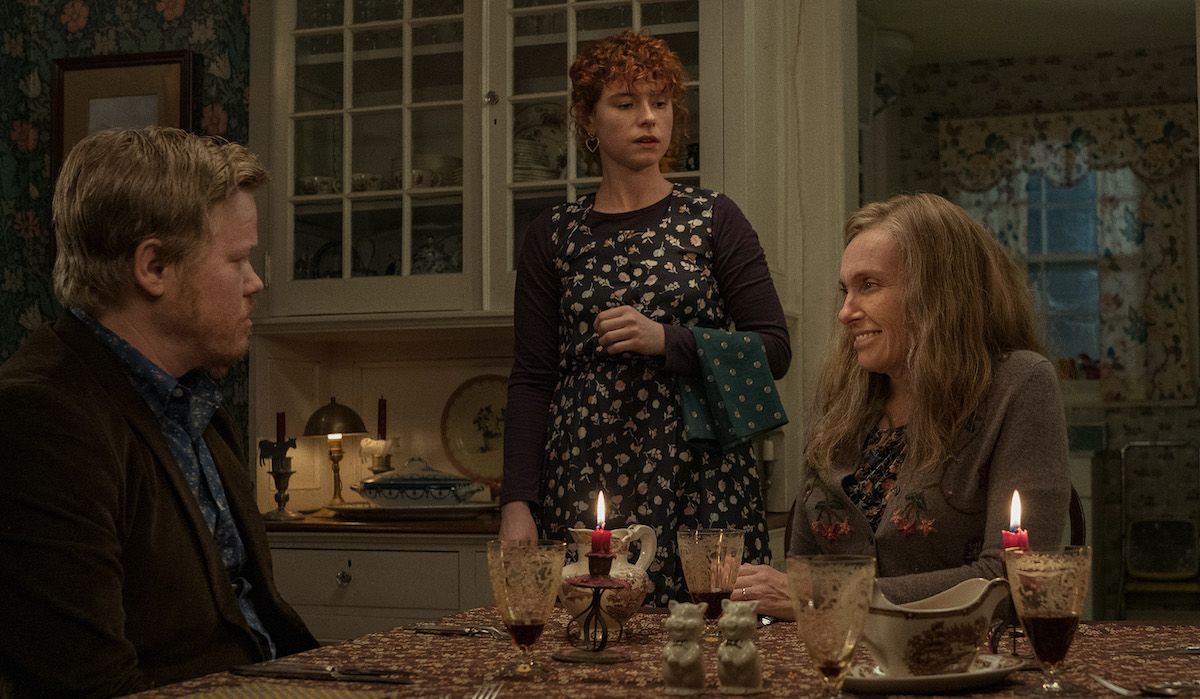
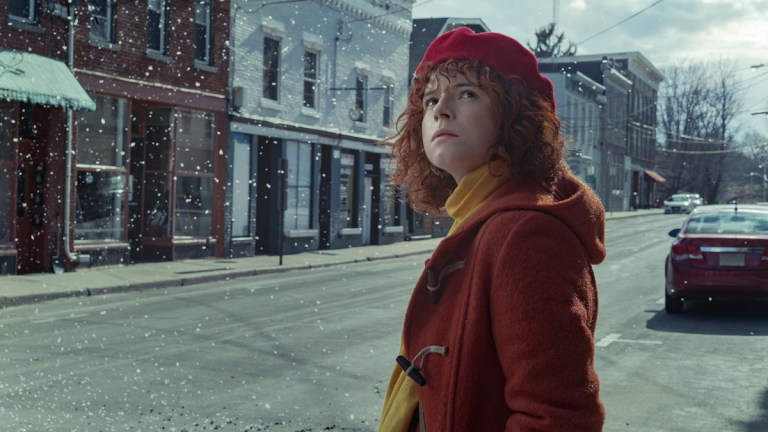
It was. Of course, it’s not exactly that simple. I’m Thinking of Ending Things is a horror film much in the same way Lynch’s Eraserhead is: it’s not exactly tangibly “scary” per se, but it’s so deeply wrong and upsetting that any other characterization would feel ill-fitting. Based on Iain Reid’s book of the same name, I’m Thinking of Ending Things delves into the mind of a woman (Jessie Buckley) who is dissatisfied in her relationship with Jake (Jesse Plemons) and is, uh, considering ceasing the relationship. The film concerns a road trip the two take to meet Jake’s parents (masterful lunatic actors Toni Collette and David Thewlis, perfectly cast). To describe the plot as it proceeds from here would be both useless and impossible, so let’s just skip that and talk about what the thing feels like to watch. Cinematographer Lukasz Zal (noted for his Oscar nominated collaborations with Pawel Pawlikowski, Ida and Cold War) bathes the film in snow and wintry aesthetics, and the vibe of the film is decidedly a wintry one. It is, no two ways about it, a dark movie- it quickly becomes clear that it possesses a fascination with aging and death, and the coldness throughout it really perpetuates this. Those seeking the humor of something like Being John Malkovich are out of luck with this one. But Kaufman obsessives will absolutely find plenty to love here- the best way I can put it is that if you haven’t already seen it while you’re reading this, it may not be for you. Personally, I marked September 4th on my phone calendar and watched the movie as soon as I woke up. If you felt a similar anticipation, then you’d probably love the film. If not, either stay away or immerse yourself into Kaufman’s films a bit first.

Charlie Kaufman Aches for More Time In I'm Thinking of Ending Things | Film  Review | Consequence of Sound

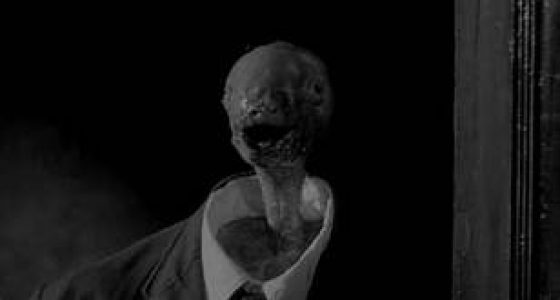
If you are, in fact, in this for the standard Kaufman oddities, Thinking of Ending Things has you covered. The central performance by Buckley is the obvious standout, a titanic feat of repressed melancholia by which the film lives and dies. When she’s not on screen, the film is worse off for it. But in terms of purely entertaining bizarro stuff, I have to direct you in the direction of Thewlis and Collette’s aforementioned gonzo turns. They play Jake’s parents throughout the duration of a mammoth dinner scene in the center of the film. I mentioned Eraserhead earlier as a tonal comparison, and this is where it really conjures up that film, specifically its early dinner sequence. No manmade chickens in this one, but you get that same deranged vibe from the parents. Collette and Thewlis sell it beautifully, alternating between unnerving and deeply sad. In the home stretch, Kaufman goes full-tilt crazy, descending the film into a disorienting array of farm animals and naked old people that can only be described as “day-ruining”. This is stuff that stays with you, and in the kind of way where you know it’s going to as soon as you see it.

So what does it all mean? Like I said earlier, I can’t claim to know. It’s as if it’s designed to be as impenetrable as possible, every potential revealing plot development overshadowed by misdirection and cascading cultural references. Everything is layered on top of everything else, conversations debating the ethics of “Baby it’s cold outside” collide with fake ice cream jingles before you can even recover from bizarre jabs at Robert Zemeckis. It gets to the point where it’s impossible to distinguish what’s important and the answer ends up seeming like “everything and nothing”.
How I'm Thinking of Ending Things Book and Film Differences Make For  Perfect Complements | Den of Geek

Where I’ve arrived is the idea that trying to figure it out is pointless. With I’m Thinking of Ending Things, the best way to go is to let it wash over you, to commit to the feeling of the film above all else. And that feeling is the film’s best asset. It makes you feel so uneasy yet so satisfied, so shaken yet so mystified and compelled. There’s not much like it. It’s a masterpiece, something so remarkable to watch that I feel bad to encourage people not to watch it. But unfortunately that’s what I have to do- this is decidedly not for everyone, and one of the biggest senses I got while watching it was that people would watch it just because it’s on Netflix and absolutely hate it. But for a certain type of viewer, I’m Thinking of Ending Things will resonate. If you think, based on all this, that you might be that, you probably are, and in that case, go check out one of the most beguiling and indelible films in recent memory. If not, you’re probably making a good call. Either way, one thing is for sure about I’m Thinking of Ending Things: it’s a real movie that actually exists. That’s about it.

Rating: 4.5/5

Da 5 Bloods Review: Apocalypse Then, Now, and Later

From 'Apocalypse Now' to 'Da 5 Bloods,' a war that never really ended

The most persistent thing I’ve seen said about Spike Lee’s latest film is that it couldn’t have come out at a better time. And sure, with the heightened attention to racial issues currently sweeping the nation and the world, the moment is right to hear from America’s most important filmmaker on the subject. But to say that Da 5 Bloods “lucked” into the perfect time to release is to miss the point of the movie. Sure, the remarkably current setting plays a huge role- Delroy Lindo’s character’s MAGA hat becomes a plot point and major symbol- but the assertion of the film is that nothing differs from one cultural moment to the next when it comes to treatment of Black people in the United States. The civil rights movement was not the final frontier in racial equality, the assassination of Martin Luther King Jr. was not a lone atrocity perpetrated against the fight for justice. Some things never change, and Lee’s film laments this in a way that rings true in the aftermath of George Floyd’s death, but unfortunately has seen this before far too many times.

Lee’s opening montage takes the viewer through the turbulent end of the 60s in America, touching on the civil rights movement, Neil Armstrong’s landing on “Da Moon”, and of course, the Vietnam war. It’s not too long into the subsequent present-day scenes until these images are called into doubt through modern perspectives: war vet Paul (Delroy Lindo) has been driven away from his generation’s revolutionary spirit into voting for Trump. People party in front of a neon Apocalypse Now sign. We hear Vietnamese characters refer to the conflict as “The American War”. It’s this last one that hits the hardest, solidifying the aims of the film to present its audience with wider points of view that challenge common opinion. Vietnam in America might be viewed as a cultural moment, but in reality it was a war, a senseless one that had lasting impacts. And although those impacts may be overlooked in America, in Vietnam they haven’t been forgotten. Lee quickly settles down from the initial setting up of thematic concerns to put his story in the spotlight, but this thread never dissipates. There are still Vietnamese people who lost family members. There are still cultural wounds that haven’t healed. There are still active landmines in the jungles.

Four of the titular five (played by Lindo, Clarke Peters, Isiah Whitlock Jr, and Norm Lewis) have returned to Vietnam 50 years later to locate and retrieve the remains of their squad commander (Chadwick Boseman), as well as millions of dollars in gold that they stashed during the war. They set up a deal with a Frenchman (Jean Reno) to launder the gold for them. Paul’s son (Jonathan Majors) arrives with the intention of helping to find the gold and to make sure his troubled father is okay returning to Vietnam for the first time. So with their mission laid out for them, and their personnel finalized, they head into the jungle to confront their past.

Lindo, Peters, Whitlock, and Lewis stand in for the Vietnam generation, a lost group searching for some semblance of peace with their past. Majors, as well as the group of landmine disarmers he meets along the way (played by Melanie Thierry, Paul Walter Hauser, and Jasper Paakkonen) represent the next generation, one forced to clean up the sins of their parents. Thierry’s character comes from a family made wealthy through weapons dealing, and she decides that it’s her responsibility to help prevent further harm coming from her family’s legacy of destruction. Majors knows and resents the fact that his father fought in Vietnam and voted for Trump, and he sees it as his responsibility to put a more palatable face forward. One of the many themes of Da 5 Bloods is people held responsible for the actions of others: generations forced to atone for their parents’ shortcomings, but also those very same people being forced into a war they wanted no part of by a government that paid no individual price. It’s an endless cycle.

It continues. A landmine from the war claims the life of Lewis’s character and almost does the same to Majors. Lindo’s descent into madness endangers the lives of every other character. The soldiers are forced to defend their recently seized gold bounty from an armed Vietnamese group aided by Jean Reno’s character. Every inch in this film has to be fought for. Any time anyone sees anything as rightfully theirs, someone will disagree. The war ended a long, long time ago, but it lives on through an inability to leave it in the past. Vietnamese/American aggression persists, PTSD haunts these men every moment. Take an early scene, when the veterans leaving a club are taunted with firecrackers thrown in their direction by a vietnamese teenager. If Da 5 Bloods wants you to understand one thing, it’s that the legacy of the Vietnam war isn’t a legacy so much as a continuation.

Da 5 Bloods (2020) Review | CGMagazine

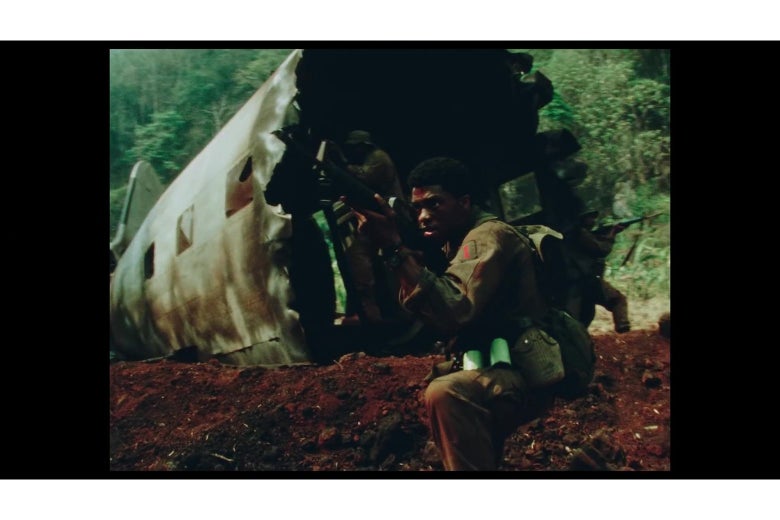
So the socio-political aspects of the film are myriad and endlessly thought-provoking, because come on, it’s Spike Lee. So the next question has to be- is it any good? Yes. It really, really is. Come on, it’s Spike Lee. Let’s start with the technical stuff: Terence Blanchard’s score is among his best work, which is saying a lot considering he’s one of the great American film composers of all time. The script, written by Lee and Kevin Willmott, is typically barbed and entertaining. And Newton Thomas Sigel’s cinematography… oh man. I’m going to rant about that for a second. The film looks great during the present day scenes, comprising the majority of the film, but the flashbacks back to Vietnam combat are so brilliantly shot that it almost wills the film to work on its own. Let’s have a look, shall we:

Da 5 Bloods' four aspect ratios, explained: the new Spike Lee ...

Okay that’s not a great picture of it but you have to trust me on how it looks in the film. In motion. The greens are so green, the shadows are so dark, the grain is trance inducing. I’m reminded of the Clockwork Orange quote about how colors don’t quite seem real until you see them on a screen. It’s almost a flaw of the film. The flashbacks are so important to the plot and characters, yet at times it almost got hard for me to focus because of how cool it looked. Okay so moving past the cinematography to the main event, the piece de resistance, the highlight of the whole thing: the acting. Clarke Peters needs to be in more things and only Spike Lee recognizes this. Jonathan Majors, who delivered one of 2019’s most unsung brilliant turns in The Last Black Man in San Francisco, continues to be just absolutely remarkable. Isiah Whitlock is good throughout, but obviously his moment comes with his eagerly-anticipated “shiiiiiiiieeeeeeet” that occurs deep into the film. Chadwick Boseman finally gets to go nuts in a legit movie, albeit with limited screentime, and nails it. And then, of course, there’s Delroy Lindo, the subject of all the critical adoration directed at the film. He lives up to the hype. If the film is to be taken as a modern update on Apocalypse Now‘s examination of the ravages of war, Lindo’s Paul is clearly positioned as its Kurtz. He’s haunted by demons and ghosts from the onset, and free falls into madness as the jungle begins to take its toll. He’s simply indelible, and his monologue towards the camera near the end is, in my mind, an Oscar clinching moment if there ever was one.

Spike’s style is on full display as well, with all of his traditional hallmarks showing up. Explicit pop culture references (a Treasure of the Sierra Madre shoutout may elicit groans from some), incorporation of real footage to prove his social points (creating a Brechtian effect that reminds the viewer that they’re not in store for idle entertainment), and yes, it’s probably overstuffed and messy. But the film uses this to its advantage in a strange way by containing its chaos: every plot point that initially feels tacked on comes back to play a part, every seemingly unnecessary stretch puts the viewer further into the minds of these characters. It’s not fun, but Da 5 Bloods leaves the audience sunburnt and delirious. I’m not making this sound enjoyable, because it’s not supposed to be, but it’s not exactly torture either. You can’t separate the politics from the film here, but it manages to work as a movie extraordinarily well. Even the scenes where nothing really happens feel gripping, and the two and a half hour runtime doesn’t wear out its welcome. Yes, it’s a social responsibility to watch Da 5 Bloods, but it absolutely isn’t a chore. This is Spike Lee at his most socially relevant and his most artistically brilliant, and it’s quite something to watch. If you haven’t already, I can’t stress this enough: watch this movie.

Rating: 4.5/5

The Two Popes review: An Uneven, But Ultimately Successful Acting Showcase

The Two Popes doesn’t deliver what you’d expect from a biopic about some of the most powerful men in the Catholic Church. That much is clear from the moment ABBA’s Dancing Queen makes an appearance over the onset of the process to vote for the next Pope. It’s an almost surreal moment, and a hilarious one. It’s by far the most memorable part of the movie, and it’s one of my favorite moments from any movie this year. It’s a gutsy call, and it’s the kind of thing the movie does a lot. For the most part, it leans into being something of a comedy. For these parts, it’s glorious, a brilliant display of the power of its stars. Jonathan Pryce is in top form, and Anthony Hopkins is with him every step of the way (I can’t really say he’s in top form, because come on, he’s Anthony Hopkins). Yet on occasion, it forgets that it’s an offbeat comedy-drama and begins to take itself too seriously, in these segments it drags and threatens to fall apart completely. But overall, it works, if only barely.

The movie begins at a time of great sadness for the Catholic Church. Pope John Paul II has died, and the search for his replacement has come down to Cardinals Bergoglio (Pryce) and Ratzinger (Hopkins). Bergoglio is a progressive reformer, while Ratzinger is a conservative who is disgusted by Bergoglio’s ideas. Ratzinger is elected by the College of Cardinals in a spellbinding scene (that begins, as I said, with Dancing Queen), and proceeds to rule as Pope Benedict XVI. Benedict’s term is riddled with controversy, and causes the disillusionment of both himself and Bergoglio. Bergoglio has decided that he can’t effect change under the conservative leadership, and requests permission to retire to a career of a simple priest. Benedict has lost touch with God, and faces a crisis, questioning his position of leadership. He also proves unpopular, with his German origin serving as a jumping off point for his critics to label him a Nazi. He flies Bergoglio to his summer house, ostensibly to discuss his retirement. So begins the point of the film where Hopkins and Pryce interact. The two deliver some of the best performances of the year, playing off each other in an endlessly watchable way. Bergoglio seems determined to bring some sort of joy into Benedict’s life, while Benedict aspires to figure out what exactly makes Bergoglio tick. Pryce plays the role with contagious enthusiasm, while Hopkins is a supremely entertaining curmudgeon (think Al Pacino in The Irishman, with the bombast of that role substituted for the grumpy-old-man-ness of some of that film’s other characters). The film is shot with a handheld effect that feels unnecessary and at times distracting, but the cinematography also sometimes produces gorgeous results. As the two men spend more time together, they form a bond, an unlikely one given their polar opposite world views. The interplay between the two is delightful, both hilarious and a magnificent show of acting power. Then the film is transported to Rome due to a controversy that requires Benedict’s presence, and it becomes… interesting.

Benedict tells Bergoglio that he won’t permit his retirement. He cites the fact that it would look bad for the church, although it’s clear that he has ulterior motives. Bergoglio spends the night in Rome, heading into a sports bar to watch his Argentinian national soccer team play. After an Argentinian goal, Bergoglio begins a prayer that, although initially well received by the man besides him, is rejected once he gets to Benedict. The man says that Benedict is a Nazi, which causes melancholia in Bergoglio that makes him leave the bar (Pryce’s devastated line reading of “No” in response to the Nazi remark is one of the film’s most indelible moments). The next day, Bergoglio and Benedict have a long discussion in the Sistine Chapel, one that features both brilliant acting and the threat of demise of the film.

Benedict states his desire to resign from the Papacy, citing his physical state and the disarray of the Church under him. He tells Bergoglio he can’t resign because he wants him to become the next pope. Bergoglio tells him that he could never be. The two mull their options, including having them rule simultaneously, which is dismissed due to the sheer insanity and lack of precedent (I mean, there was a time where there were multiple Popes simultaneously and the film just kinda ignores this, but that’s because it didn’t go great and I don’t think that Church officials like talking about it). When pressed as to why he could never be pope, Bergoglio launches into some backstory. The film takes way too long here, for several reasons. The cardinal (pun intended) sin of this section is that it takes us away from Hopkins and Pryce. The flashback scene utilizes a far younger actor, (who is actually pretty good, but he’s no Pryce) and it uses him for too long. At this point, it forgets its lighthearted tone and launches into full-blown Oscar-bait-y historical drama, and it suuuuucks. The movie completely kills all its momentum, taking what feels like 45 minutes (I have no idea how long it actually was, I don’t care enough to go back and check) on a backstory that honestly doesn’t really seem to matter. Cutting it down to a fraction of its size would’ve helped the movie immensely, and in fact, nixing it entirely couldn’t have hurt. But it miraculously comes back from the dead, returning at long last to the main characters. The interplay is back as if nothing happened, and the film works again. Later, after Bergoglio’s return to Argentina, Benedict retires, and is called back to Rome to select the next Pope. He is chosen, and becomes Pope Francis. As Pope, he gets right to work doing what he sees as good, while Benedict watches on like a proud parent of sorts. As it reaches its conclusion, the film becomes cathartic, a depiction of the triumph that Francis not only achieved as Pope, but achieved in changing Benedict’s worldview. The film ends with the German Benedict (indifferent to sports) and Argentinian Francis (massive soccer fan) watch the FIFA World Cup Final between their two nations.

Overall, the film is shockingly close to a buddy comedy in tone, and it works (its biggest detour from this formula costs it dearly). Ultimately, despite the fact that the film is fun, odd, and refreshing overall, its unfortunate dip into historical biopic territory prevents it from being a truly great film. But the acting is some of the year’s best, and ultimately it saves it. Are there better things you could be doing with your time than watching The Two Popes? Of course, Netflix’s other two titanic originals The Irishman and Marriage Story are better films. But if you’ve seen those and are looking for something different, The Two Popes might just be your thing.

Rating: 4/5

Marriage Story review: a fantastic portrait of people at their worst

There are many things about Marriage Story that you’d have to be insane not to love- watching Adam Driver act, watching Scarlett Johansson act, watching Laura Dern, Alan Alda, Ray Liotta, et al. act, and hearing Noah Baumbach’s dialogue. So it stands to reason that watching Adam Driver, Scarlett Johansson, Laura Dern and others perform Baumbach’s dialogue would make for a truly excellent film. Marriage Story is funny, as you’d expect it to be based on its pedigree, it’s well acted, as you’d expect from that cast, but the overwhelming aspect of the movie is a sobering weight that occupies every scene. The funniest moments are complicated due to their accompanying heaviness, the saddest moments are exacerbated by this sensation, the angriest moments communicate a feeling like no other based on the darkly intoxicating fusion of anger and pervasive grief. Marriage Story invites you to wallow in this noxious sludge of emotions, and treats you to some of the finest performances of the year along the way.

Marriage Story opens on the main characters, Driver’s Charlie and Johansson’s Nicole, reading voiceover descriptions of what they love about each other over footage of their relationship. It then cuts to a separation counselor instructing them to read what they read to each other. From this moment, Marriage Story lets you know it will pull no punches. The next two hours chronicle their divorce as it progresses from an amiable affair to a bitter street fight involving ruthless, expensive L.A. lawyers, the public revelation of private information, and shouting matches based around emotion so raw you run the risk of salmonella just watching. The film tells a cohesive story, yet it’s first and foremost a collection of these moments, these primal expressions of anger and sadness and pain. Driver and Johansson sell these moments with the skill of the best actors in the world, which is because they are. Despite Driver being best known for Star Wars and Johansson being best known for the Marvel movies, they’re brilliant actors, more thespians than superstars here. This film will be most people’s introduction to the full extent of Driver’s brilliance (those who didn’t see Inside Llewyn Davis), and that’s fine, he’s at his career best here. This is an acting-based film, despite its brilliant screenplay, direction, and technical aspects. And while, going into it, you can expect to be crushed by an overwhelming tidal wave of emotion, a rewatch based just around focusing on the acting would be interesting.

This will get Driver his first Lead Actor Oscar nod (he was nominated for supporting last year for Blackkklansman), it remains to be seen whether or not he can win. It will also hopefully be Laura Dern’s Oscar, although there is substantial chatter for her Little Women performance, not to mention Jennifer Lopez in Hustlers. Johansson appears to be the only plausible challenge to Renee Zellweger in Judy, yet she’d still feel like a miracle winner at this point. The film is a major Oscar contender, and (in my mind), the likely winner of the big one (although 1917 could still blow the whole thing up). And like most of the current awards contenders right now, this one wouldn’t be a bad winner.

Everything here is firing on all cylinders. Driver and Johansson reach every extreme of emotion. These are people going through the worst experience of their life, and they sell it. One absolutely breathtaking sequence begins as a routine argument between the two and devolves into a shouting match of epic proportions, and features the best acting in the film on both ends. Another brilliant scene involving a knife features top notch work from Driver, who communicates the absolute disarray of Charlie’s life so perfectly. Johansson’s work is less explosive, with fewer signature moments and less bombast, but she’s equally powerful, giving a performance of quiet devastation and anguish that makes it impossible to dislike her despite the emotional attachment Driver’s performance requires you to give him. The scene early on where Johansson cries in the office of Laura Dern’s divorce lawyer Nora comes to mind as an example of her acting at her best.

Dern and Ray Liotta, opposing divorce lawyers, serve as foils to Charlie and Nicole. While the separating couple clearly have severe personal issues, they try their best to remain civil throughout the process of divorce. Dern and Liotta, prior to their courtroom showdown, interact completely amiably, showing that they clearly have no personal issues with each other. Then they have to do their jobs, and they’re at each other’s throats. And so are Nicole and Charlie, by proxy. The whole process is depicted as a circle of hell Dante never dreamed of, and its total insanity is best portrayed by the lawyers. Not just Dern and Liotta, however- Alan Alda’s kind older lawyer, who Charlie works with at the start, represents a kinder side to the process, one who’s optimistic and sensitive to Charlie’s wants. But he proves ineffective in the face of Nora’s tenacity and is let go. The message is clear, there’s no room for reason, no room for sanity, no room for kindness. Only malevolence and pain remain.

And then you have the Being Alive scene. The scene, in which Driver’s defeated Charlie belts out the song (from the conclusion, I believe, of Stephen Sondheim’s famous 1970 musical Company) in a bar quickly became the most talked-about moment in the film upon its festival premiere months ago. Now, a day after its wide release via Netflix, it’s been so talked about and dissected that we’ve reached the point in the Take cycle where people are talking about how it’s overrated to the point that it’s now underrated. The scene is fantastic, it’s Charlie laying bare his soul (maybe I’m just a big fan of Baumbach musical moments, Frances Ha‘s “Modern Love” scene is one of my favorite cinematic moments of the decade). Charlie has lost everything, his wife, his Broadway play, really his son. Now, when he’s already lost his life, he decides that it’s time to start living. And you feel for him, despite the fact that he’s been in the wrong the entire time. The dissolution of the marriage is clearly his fault, he’s shown to be an insensitive and at times deeply jealous husband and father. Yet the film avoids taking sides by a) portraying both characters as, at some level, wrong, and b) making you empathize deeply with both of them. These are complicated people: Charlie is self-centered and manipulative, but he’s facing down an unfair system designed to hurt him, and he still really does love Nicole and his son. Nicole is overly ruthless and cruel during the divorce, but she still cares for Charlie and doesn’t want to split their time with their son 55/45 in her favor because she still believes their situation should be amicable. In the end, the characters want nothing more than to be alive. Whether they succeed or not is debatable.

Rating: 4.5/5

The Irishman review: Scorsese does it again, but not in a way you’ve seen before

You wouldn’t be crazy to assume that Martin Scorsese’s latest foray into the world of organized crime, a world practically synonymous with the man at this point, would be a lot like his previous such efforts, such as Goodfellas, Casino, and The Departed. Those films are all fast-paced, exciting, relentlessly entertaining, universally appealing (well, except for Casino, which isn’t very good but maybe needs a rewatch. I addressed this in my Scorsese ranking article, which has been updated to include this film). The Irishman, while on the surface the same sort of movie as those, strikes a very different tone. And it does it masterfully, as great as the legendary director has been in a long time.

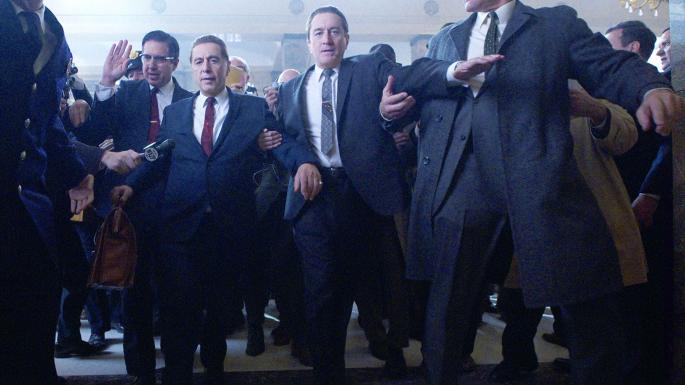
Let’s start with where The Irishman is the same as Scorsese’s prior gangster efforts. Robert De Niro and Joe Pesci are here, with both of them giving stunning and haunting performances (although the MVP of the film has yet to come). The film spans decades, is accompanied by voiceover narration, and contains lots and lots of violence. As you probably already know, it’s of certifiably epic length (3 and a half hours), which is a category none of its counterparts can touch it in. But that’s where the similarities pretty much end. The Irishman eliminates the atmosphere of excitement and action that defines Goodfellas and The Departed and the like. Instead, we’re treated to a mood of quiet reflection and the overarching theme of aging. In that sense, The Irishman isn’t a story about gangsters rising to and falling from grace, it’s a story about humans coming to terms with their own mortality and whether or not the lives they led were worth it.

The film opens with a tracking shot through the halls of a retirement home. The camera lands on Frank Sheeran (De Niro), who begins to recount a road trip he and crime boss Russell Buffalino (Pesci) took to a wedding. From the road trip framing device, we enter the story of Sheeran’s youth, and how he got acquainted with Buffalino. It began when he started allowing the meat truck he drove to be hijacked by mobsters, a charge he beat with the help of mob lawyer Bill Buffalino (a shockingly good Ray Romano). Bill introduces him to his cousin, Russell, who takes an interest in Sheeran immediately. Frank begins to take care of things for Buffalino and the mob, including several notable hits. Frank continues to rise in Buffalino’s opinion, while he also becomes more enamored with the mob lifestyle. In a critical early scene, Frank finds out his daughter, Peggy (Lucy Gallina as a child, Anna Paquin as an adult), has been hit by a grocer. Frank makes Peggy come and watch as he brutally beats the man, which visibly shakes Peggy. This begins a complicated relationship between the two of them that adds immeasurably to the film.

Frank’s relationship with Russell eventually results in his recommendation to take on the position of a bodyguard of sorts to Jimmy Hoffa. Hoffa is played by Al Pacino, who owns the thing from the moment he shows up. It’s a brilliant performance, equal parts typical recent-Pacino shouting and nuanced acting that’s better than he’s been in decades. His Hoffa is a creation of pure charisma without whom the film probably wouldn’t work.

Hoffa also strikes up a great relationship with Frank’s daughter Peggy- she’s closer to him than she is to her father (and much closer than she is with Russell, who she detests, despite her father’s protests). Hoffa takes complete control of the rest of the film, offering up some of its best moments, such as his nonchalant reaction to JFK’s assassination and his subsequent refusal to fly the flag atop the International Brotherhood of Teamsters headquarters at half mast. His confrontation with Anthony “Tony Pro” Provenzano (Stephen Graham, also excellent) will ensure you’re never late for a meeting (well, maybe a little late, if you account for traffic).

Frank, meanwhile, embarks on what has been (accurately) described as something of a mobster Forrest Gump. He’s present at several important moments in mafia history, claiming responsibility for notable killings such as that of “Crazy Joe” Gallo. De Niro plays these moments with alternating coolness and bravado that a lesser actor wouldn’t be able to muster at this point in their career. Pesci, meanwhile, is silent but deadly, in a role that could be considered against type due to his subdued nature. The film rolls along with typical Scorsese-an flourishes; for instance, at nearly every introduction of a minor character, a block of text appears with their name and the date and cause of their death. It’s funny, trust me. The de-aging effects don’t intrude at all, and while they may not be as effective as they should be, they get the job done.

So, if you have not yet seen The Irishman, maybe duck out here. I personally don’t think it matters all that much, but it’s your call and if I were in your position I’d probably stop reading. Your call. You’ve been warned.

The climactic event of the film is Frank’s killing of Hoffa, who, up to that point, had been maybe his closest friend. It’s built up to masterfully: Pesci turns his quiet demeanor into a frightening weapon to make it clear to Frank that he has no choice in the matter. Jesse Plemons fields unimportant questions about the logistics of a fish he transported in the back seat of his car recently (again, you have to trust me that it’s funny. Unless you’ve seen the film, in which case you know how funny it is). And then they’re alone. Frank and Jimmy walk into a house- we know what’s about to happen, Frank knows what’s about to happen, Hoffa is clueless. They enter, Hoffa sees it’s empty (a brilliant visual reference to Tommy’s whacking in Goodfellas, by the way), and he turns to leave. Frank shoots him twice in the back of the head.

The scene is heartbreaking for two reasons. The first is De Niro- Frank performs the killing with such resignation. He doesn’t hesitate for a second, he doesn’t try to say any last words to his friend, he just shoots him, like it’s business. Because, of course, it is. The second is Pacino. His portrayal of Hoffa is so masterful until the bitter end. His realization of his fate is accompanied by the directive to Frank that they should get out of there. It’s delivered in a perfect way- he can’t believe that his friend would do this to him, he doesn’t believe that he would, but yet it’s the only rational explanation. In Pacino’s voice, you can detect a sliver of doubt, of the thought that maybe Frank would turn on him. But mainly he really believes that Frank’s leaving with him, and that he’s leaving at all. It’s a masterclass in one line, and it’s a perfect finale to an epic performance.

After Hoffa’s killing, Frank’s relationship with Peggy ends. Of course, he doesn’t admit the crime to anyone, even comforting Hoffa’s wife (Welker White, superstitious babysitter Lois Byrd in Goodfellas) and telling her that he’ll turn up at some point. Oscar winner Anna Paquin notably doesn’t speak at all in her role as adult Peggy, save for in one scene (and even then, barely). She simply asks her father why he hasn’t called Hoffa’s wife yet. It’s a seemingly simple question, but everything about it- Paquin’s delivery, the emphasis on the character’s silence throughout the film- suggests that she knows exactly why. She knows what her father has done for a living for decades, and she knows that killing Hoffa is absolutely something he could’ve been ordered to do. There’s clearly no doubt in her mind that he did it. Despite this being the only scene in the film where she speaks, the character of Peggy is an essential one. Throughout, she casts knowing glances at her father, expressing emotions of deep anguish and sorrow at his intrinsic violence. His lifestyle fundamentally upsets her, and so she fears him. Yet she loves Hoffa. She has from her childhood, when he was the only one of Frank’s friends she would talk to, and to her adulthood, when she dances with him multiple times at a dinner honoring Frank. The camera focuses on her often, as if to exemplify her silent, contemptuous stares and her joy at Hoffa’s presence. It’s through Peggy that Frank realizes that what he’s done is wrong, and only after he loses her that he starts to look back and regret.

The ending of The Irishman echoes the endings of other Scorsese gangster films in a fascinating way. The film concludes with an elderly Frank Sheeran, alone in a nursing home, presumably on his last night alive. He asks the visiting priest if, on his way out, he could leave the door slightly open. The final shot is of Sheeran, sitting alone, viewed through the crack in the doorway. By this point, all of his friends and associates are dead, he’s been abandoned by his daughter, and he has nothing left. The message here is a new, and much darker, one for Scorsese. At the end of Goodfellas, Henry Hill laments the fact that he’s had to leave behind life in the mob, that he has to “live the rest of his life like a schnook”. Casino finishes with Ace Rothstein musing that Las Vegas isn’t what it used to be, comparing it to an adult version of Disneyland. Both of these men, Hill and Rothstein, miss their ideals of the Good Old Days, including the bloodshed that came with them. In The Irishman, Sheeran doesn’t look back on his past with fondness or loss, his overwhelming emotion is regret. The finale of the film, detailing Sheeran’s elderly life, drives this point home- that Frank regrets it all. He regrets his alienation of his daughter Peggy, he regrets the killing of his friend, he regrets all of his life choices. The difference between Frank’s perspective and those of Hill and Rothstein is that the latter two had merely finished their careers in the mob. Sheeran is at the end of his life. This perspective allows him to see the futility of it all. And that’s the takeaway from The Irishman: no matter who you are, and how you lived, it won’t matter once you get to the end. While Scorsese certainly hasn’t come to the end, of his career or his life, his observation gives his film a profound depth that he hasn’t achieved in his past similar work. That’s what makes The Irishman so different, and that’s what makes it so great.

Score: 5/5