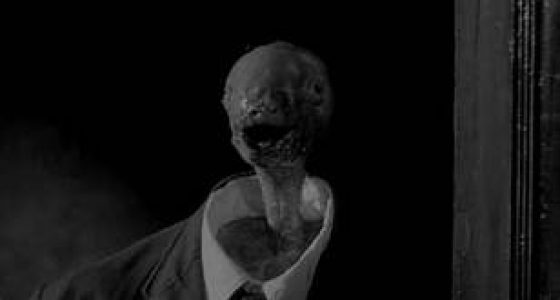
The Irishman review: Scorsese does it again, but not in a way you’ve seen before

You wouldn’t be crazy to assume that Martin Scorsese’s latest foray into the world of organized crime, a world practically synonymous with the man at this point, would be a lot like his previous such efforts, such as Goodfellas, Casino, and The Departed. Those films are all fast-paced, exciting, relentlessly entertaining, universally appealing (well, except for Casino, which isn’t very good but maybe needs a rewatch. I addressed this in my Scorsese ranking article, which has been updated to include this film). The Irishman, while on the surface the same sort of movie as those, strikes a very different tone. And it does it masterfully, as great as the legendary director has been in a long time.
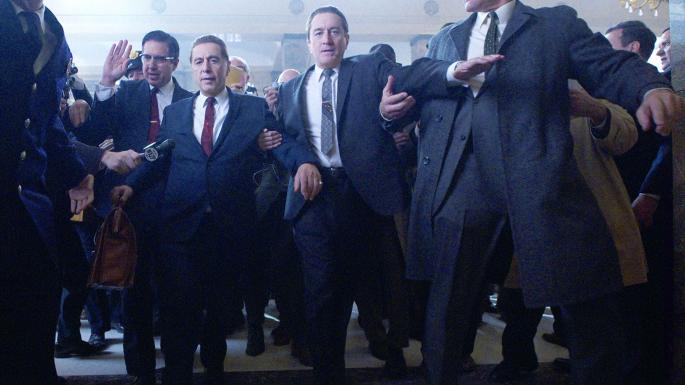
Let’s start with where The Irishman is the same as Scorsese’s prior gangster efforts. Robert De Niro and Joe Pesci are here, with both of them giving stunning and haunting performances (although the MVP of the film has yet to come). The film spans decades, is accompanied by voiceover narration, and contains lots and lots of violence. As you probably already know, it’s of certifiably epic length (3 and a half hours), which is a category none of its counterparts can touch it in. But that’s where the similarities pretty much end. The Irishman eliminates the atmosphere of excitement and action that defines Goodfellas and The Departed and the like. Instead, we’re treated to a mood of quiet reflection and the overarching theme of aging. In that sense, The Irishman isn’t a story about gangsters rising to and falling from grace, it’s a story about humans coming to terms with their own mortality and whether or not the lives they led were worth it.

The film opens with a tracking shot through the halls of a retirement home. The camera lands on Frank Sheeran (De Niro), who begins to recount a road trip he and crime boss Russell Buffalino (Pesci) took to a wedding. From the road trip framing device, we enter the story of Sheeran’s youth, and how he got acquainted with Buffalino. It began when he started allowing the meat truck he drove to be hijacked by mobsters, a charge he beat with the help of mob lawyer Bill Buffalino (a shockingly good Ray Romano). Bill introduces him to his cousin, Russell, who takes an interest in Sheeran immediately. Frank begins to take care of things for Buffalino and the mob, including several notable hits. Frank continues to rise in Buffalino’s opinion, while he also becomes more enamored with the mob lifestyle. In a critical early scene, Frank finds out his daughter, Peggy (Lucy Gallina as a child, Anna Paquin as an adult), has been hit by a grocer. Frank makes Peggy come and watch as he brutally beats the man, which visibly shakes Peggy. This begins a complicated relationship between the two of them that adds immeasurably to the film.

Frank’s relationship with Russell eventually results in his recommendation to take on the position of a bodyguard of sorts to Jimmy Hoffa. Hoffa is played by Al Pacino, who owns the thing from the moment he shows up. It’s a brilliant performance, equal parts typical recent-Pacino shouting and nuanced acting that’s better than he’s been in decades. His Hoffa is a creation of pure charisma without whom the film probably wouldn’t work.

Hoffa also strikes up a great relationship with Frank’s daughter Peggy- she’s closer to him than she is to her father (and much closer than she is with Russell, who she detests, despite her father’s protests). Hoffa takes complete control of the rest of the film, offering up some of its best moments, such as his nonchalant reaction to JFK’s assassination and his subsequent refusal to fly the flag atop the International Brotherhood of Teamsters headquarters at half mast. His confrontation with Anthony “Tony Pro” Provenzano (Stephen Graham, also excellent) will ensure you’re never late for a meeting (well, maybe a little late, if you account for traffic).

Frank, meanwhile, embarks on what has been (accurately) described as something of a mobster Forrest Gump. He’s present at several important moments in mafia history, claiming responsibility for notable killings such as that of “Crazy Joe” Gallo. De Niro plays these moments with alternating coolness and bravado that a lesser actor wouldn’t be able to muster at this point in their career. Pesci, meanwhile, is silent but deadly, in a role that could be considered against type due to his subdued nature. The film rolls along with typical Scorsese-an flourishes; for instance, at nearly every introduction of a minor character, a block of text appears with their name and the date and cause of their death. It’s funny, trust me. The de-aging effects don’t intrude at all, and while they may not be as effective as they should be, they get the job done.

So, if you have not yet seen The Irishman, maybe duck out here. I personally don’t think it matters all that much, but it’s your call and if I were in your position I’d probably stop reading. Your call. You’ve been warned.

The climactic event of the film is Frank’s killing of Hoffa, who, up to that point, had been maybe his closest friend. It’s built up to masterfully: Pesci turns his quiet demeanor into a frightening weapon to make it clear to Frank that he has no choice in the matter. Jesse Plemons fields unimportant questions about the logistics of a fish he transported in the back seat of his car recently (again, you have to trust me that it’s funny. Unless you’ve seen the film, in which case you know how funny it is). And then they’re alone. Frank and Jimmy walk into a house- we know what’s about to happen, Frank knows what’s about to happen, Hoffa is clueless. They enter, Hoffa sees it’s empty (a brilliant visual reference to Tommy’s whacking in Goodfellas, by the way), and he turns to leave. Frank shoots him twice in the back of the head.

The scene is heartbreaking for two reasons. The first is De Niro- Frank performs the killing with such resignation. He doesn’t hesitate for a second, he doesn’t try to say any last words to his friend, he just shoots him, like it’s business. Because, of course, it is. The second is Pacino. His portrayal of Hoffa is so masterful until the bitter end. His realization of his fate is accompanied by the directive to Frank that they should get out of there. It’s delivered in a perfect way- he can’t believe that his friend would do this to him, he doesn’t believe that he would, but yet it’s the only rational explanation. In Pacino’s voice, you can detect a sliver of doubt, of the thought that maybe Frank would turn on him. But mainly he really believes that Frank’s leaving with him, and that he’s leaving at all. It’s a masterclass in one line, and it’s a perfect finale to an epic performance.

After Hoffa’s killing, Frank’s relationship with Peggy ends. Of course, he doesn’t admit the crime to anyone, even comforting Hoffa’s wife (Welker White, superstitious babysitter Lois Byrd in Goodfellas) and telling her that he’ll turn up at some point. Oscar winner Anna Paquin notably doesn’t speak at all in her role as adult Peggy, save for in one scene (and even then, barely). She simply asks her father why he hasn’t called Hoffa’s wife yet. It’s a seemingly simple question, but everything about it- Paquin’s delivery, the emphasis on the character’s silence throughout the film- suggests that she knows exactly why. She knows what her father has done for a living for decades, and she knows that killing Hoffa is absolutely something he could’ve been ordered to do. There’s clearly no doubt in her mind that he did it. Despite this being the only scene in the film where she speaks, the character of Peggy is an essential one. Throughout, she casts knowing glances at her father, expressing emotions of deep anguish and sorrow at his intrinsic violence. His lifestyle fundamentally upsets her, and so she fears him. Yet she loves Hoffa. She has from her childhood, when he was the only one of Frank’s friends she would talk to, and to her adulthood, when she dances with him multiple times at a dinner honoring Frank. The camera focuses on her often, as if to exemplify her silent, contemptuous stares and her joy at Hoffa’s presence. It’s through Peggy that Frank realizes that what he’s done is wrong, and only after he loses her that he starts to look back and regret.

The ending of The Irishman echoes the endings of other Scorsese gangster films in a fascinating way. The film concludes with an elderly Frank Sheeran, alone in a nursing home, presumably on his last night alive. He asks the visiting priest if, on his way out, he could leave the door slightly open. The final shot is of Sheeran, sitting alone, viewed through the crack in the doorway. By this point, all of his friends and associates are dead, he’s been abandoned by his daughter, and he has nothing left. The message here is a new, and much darker, one for Scorsese. At the end of Goodfellas, Henry Hill laments the fact that he’s had to leave behind life in the mob, that he has to “live the rest of his life like a schnook”. Casino finishes with Ace Rothstein musing that Las Vegas isn’t what it used to be, comparing it to an adult version of Disneyland. Both of these men, Hill and Rothstein, miss their ideals of the Good Old Days, including the bloodshed that came with them. In The Irishman, Sheeran doesn’t look back on his past with fondness or loss, his overwhelming emotion is regret. The finale of the film, detailing Sheeran’s elderly life, drives this point home- that Frank regrets it all. He regrets his alienation of his daughter Peggy, he regrets the killing of his friend, he regrets all of his life choices. The difference between Frank’s perspective and those of Hill and Rothstein is that the latter two had merely finished their careers in the mob. Sheeran is at the end of his life. This perspective allows him to see the futility of it all. And that’s the takeaway from The Irishman: no matter who you are, and how you lived, it won’t matter once you get to the end. While Scorsese certainly hasn’t come to the end, of his career or his life, his observation gives his film a profound depth that he hasn’t achieved in his past similar work. That’s what makes The Irishman so different, and that’s what makes it so great.

Score: 5/5

The best Robert De Niro performances, ranked

Today, August 17th, is the 76th birthday of one of the greatest actors of all time. His career spans his early work with Martin Scorsese in the 70s to his more recent supporting turns in David O. Russell’s films. His roles have become iconic- lines, scenes, and moments have become so indelible that they’ve etched themselves into popular culture permanently. He needs no introduction, and yet I’ve given him one anyway because that’s just how great of an actor he is. So here are the top ten performances of the one and only Robert De Niro.

10- Jackie Brown (1997)

My initial feelings on De Niro’s role as Louis Gara in Jackie Brown (and the movie in general) were lukewarm. the further removed I get from it, however, the more I appreciate it. In ways similar to Casino (not on this list. That movie sucks.), Jackie Brown features De Niro in an against-type performance. His character here is more timid than you typically get from him. Louis is a unique character in the film for that reason. Every other character is a typically Tarantino-esque, suave, smooth talker that’s always thinking ahead. Louis is pretty much a loser. He’s responsible for many of the best and most shocking moments in the film (parking lot scene, above) that don’t belong to Samuel L Jackson’s character. He’s a welcome presence in the film, and an interesting part of De Niro’s career.

9- The Godfather part II (1974)

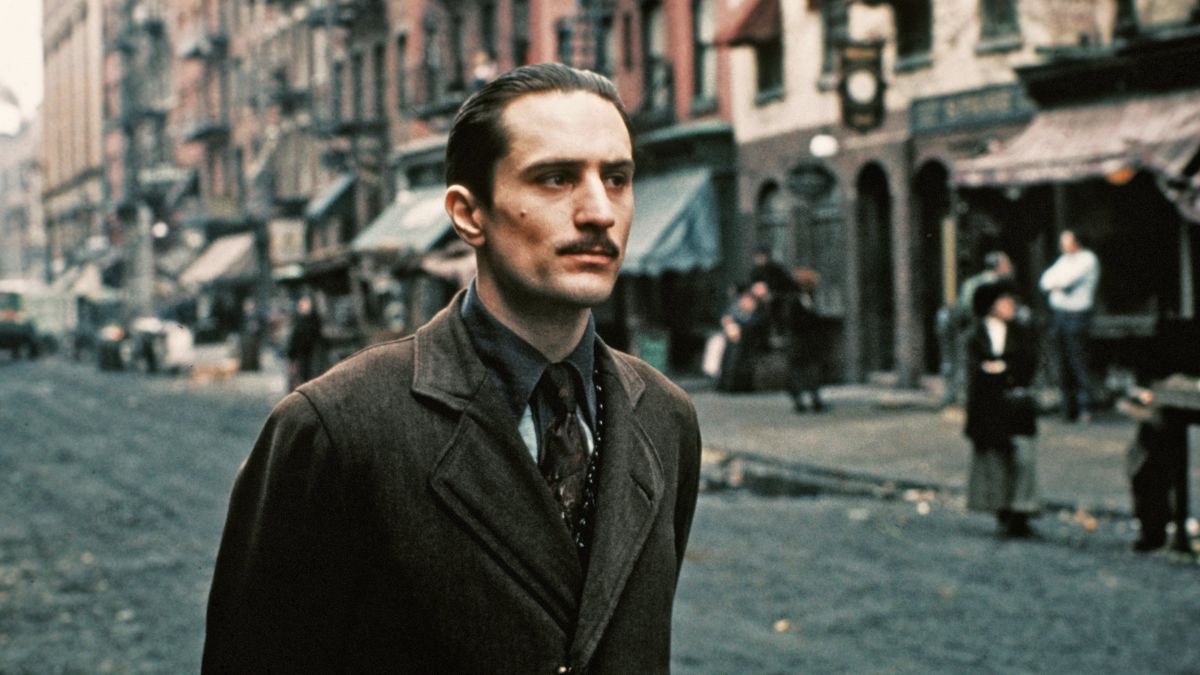
If the thing that sets the first Godfather movie apart is the presence of Marlon Brando, the thing that helps its sequel is De Niro (in the same role, fittingly enough). He won his first Oscar for his portrayal of Vito Corleone in his younger years. The most impressive thing about this part, in my opinion at least, is that almost all of his lines are in Italian. Additionally, he does a truly excellent job of maintaining the character that Brando established in the first film. Whenever he’s on screen, the film revolves around him. It takes skill to build on such an iconic character and make it your own, and that’s what De Niro does here.

8- The Untouchables (1987)

Enthusiasms, enthusiasms. What are mine? What draws my admiration? What is that which gives me joy? That would be De Niro’s brilliantly over the top performance as Al Capone in Brian De Palma’s crime classic. He’s unfortunately not in the film that much, but when he is the quality skyrockets. Which is saying a lot considering how great it is. De Niro delivers every line with an insane bravado that completely makes the movie and creates several classic scenes (I wanna go there in the middle of the night AND PISS ON HIS ASHES, etc.). There may be more nuanced performances in De Niro’s filmography, but I’m not sure if there are any that are this fun.

7- Mean Streets (1973)

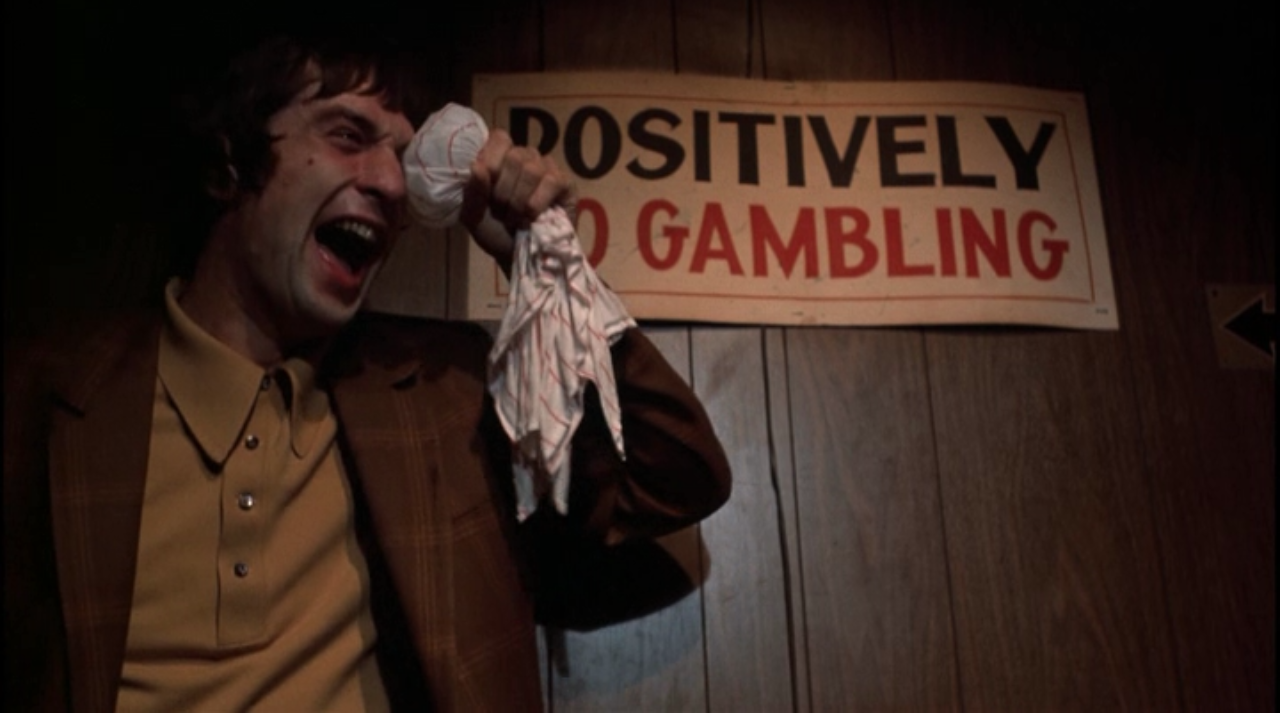
Harvey Keitel may be the star of Scorsese’s early masterwork Mean Streets, but De Niro steals the film with this completely bonkers turn. Here he plays a lunatic that doesn’t quite resemble his later roles in The King of Comedy and The Untouchables, but possesses an air of sheer madness that might make you think he’d make a good Joker. This film served as the starting point for his career and a stunning breeding ground for talent (David Proval, Richie Aprile on The Sopranos, is here, as is David Carradine) that remains fascinating to watch today, especially because of De Niro.

6- The Deer hunter (1978)

The Deer Hunter is a staggering, massive, emotional epic that is sure to resonate deeply with any viewer. Everyone here is in top form. Christopher Walken gives his best performance ever (the Pulp Fiction fan in me hates to say that, as does the Annie Hall fan in me), John Savage is tremendously and impeccably broken, and Meryl Streep is Meryl Streep. De Niro is the center of it all. He’s responsible for the most intense moments the film has to offer (russian roulette with more bullets), some of the most resonant (his return home from the war), and some of the saddest (NICKYYYY). He displays a brilliant range over the course of one film. He undergoes one of the greatest transformations in cinematic history (maybe even the second best in the movie). It’s an epic performance that perfectly suits the epic film.

5- Cape Fear (1991)

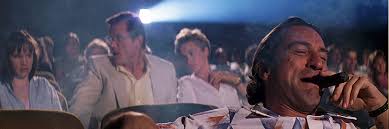
Never in his career has De Niro simply been this scary. He brings a palpable menace to every scene, even when he’s being outwardly friendly. His scene with Juliette Lewis, where he poses as her drama teacher, is one of the best scenes of his career. The above scene in the movie theater is a classic. He’s the second best thing about one of the best remakes in cinematic history (the best being the Simpsons episode that parodies it, obviously). He simultaneously oozes evil and charisma in a way he’s never typically done. Similar to the way he expands upon Brando’s Don Corleone in Godfather 2, he builds his own character on top of Robert Mitchum’s in the original.

4- Goodfellas (1990)

That is all.

3- The King of Comedy (1983)

There are elements of Travis Bickle in Rupert Pupkin, De Niro’s unhinged title character. In fact, it could be said that he’s the anti-Bickle. Whereas Bickle’s worldview is dark and nihilistic, Pupkin is an eternal and relentless optimist and opportunist. Bickle’s obsession is with (as he sees it) making the world a better place, Pupkin sees the world as a perfect place already: he wrongly views it as a world where anyone, himself included, can make it. In this way, The King of Comedy is maybe a more cynical film than Taxi Driver. It’s occurring to me that this would be better as a full-length post, so I’m gonna stop for now. De Niro absolutely owns in this movie, and that’s really all there is to it.

2- Raging Bull (1980)

In Raging Bull, De Niro creates a character so repulsive and awful that it’s incredible just how empathetic you become with him. We revel in LaMotta’s victories and suffer with his lows. De Niro creates a character with so much depth, but whose only emotion at all times is rage. This is what drives his every action, his every explosion, his every fight. Raging Bull is a boxing movie in two ways- there’s the actual boxing, and there’s LaMotta’s tragic and constant fight with everyone in his life. De Niro here is a person who is constantly fighting, that’s his nature, that’s all he can do. And De Niro does it so well that it completely makes the movie.

1- Taxi Driver

When I started this post, it occurred to me that I’d have to pick between Raging Bull and Taxi Driver for the top spot. I thought I’d go with Raging Bull, but when I thought about it, I decided that Taxi Driver was the true number one. Travis Bickle is one of the greatest characters in the history of American fiction, and he couldn’t have been without De Niro (who improvised his most iconic scene). This role singlehandedly created an entirely new character archetype- “God’s lonely man”, which has been seen in the likes of last year’s terrific First Reformed and Jake Gyllenhaal’s character in Nightcrawler. But nobody (although Gyllenhaal and Hawke are both fantastic) has pulled it off quite like De Niro. His insanity here is not below the surface and malicious, it’s well-intended and right there for the world to see. This is a man who has nothing to lose. This is a character of unbridled depth and a performance of unparalleled skill. This is De Niro’s greatest contribution to film, to art, and to the world as a whole. Decades later, it’s the crowning achievement of one of the best careers in film history.

\\

Every Martin Scorsese movie (that I’ve seen), ranked

I need a few more days to fully come to terms with Midsommar before I write about it, and the thing I’ve been planning to write for a while about the films of Claire Denis isn’t all the way there yet, so in the interim I’m gonna rank some stuff. Namely, (most of) the filmography of one of my absolute favorite filmmakers: Martin Scorsese. When I say most of, I mean I haven’t seen all of his films. The ones that will not be appearing on this list are- Who’s That Knocking at my Door, Boxcar Bertha, Alice Doesn’t Live here Anymore, New York, New York, The Color of Money, The Last Temptation of Christ, The Age of Innocence, Kundun, Bringing Out the Dead, The Aviator, and Silence. Which, now that I write it all out, seems like too much to leave out. But I’ve already written all this, so away we go. Also, only narrative feature films. So no New York Stories, Shine a Light, The Rolling Thunder Revue, The Last Waltz, etc. This list will be updated as I watch more of Scorsese’s films. Anyway for real now let’s go.

Honorable mention- Quiz Show

I’d like to use this opportunity as a reminder of two things- Martin Scorsese is in Quiz Show, and Quiz Show rules. I promise the list is about to start.

14- Casino (1995)

Blech. I don’t understand what people love about this movie. I mean, it has its moments. Joe Pesci’s narration cutting out mid-sentence because of his character’s death is straight-up brilliant. The blueberries scene is good. There’s a Saul Bass title sequence. And that’s it. Casino isn’t exactly a Goodfellas retread, but it isn’t not. Everything great about Goodfellas is duller and more mediocre here. The narration is overdone. De Niro is more subdued, less dynamic. Pesci is playing the same character but… less. It’s just less than Goodfellas. It’s also too long and weirdly boring. It’s like a predictive text Scorsese movie, and that’s not a good thing.

13- Hugo (2011)

I gotta be honest- I don’t really remember this one. Which, while it’s true that I saw it when I was very young, probably isn’t that good. What I do remember isn’t spectacular. The feeling I got kinda reminds me now of a 2010s Spielberg movie- not bad by any measure, but really unremarkable (shoutout to Bridge of Spies, however, that movie owns). It gets a pass over Casino because Casino sucks. Hugo, in my memory, is unremarkable at worst. Everything above here is phenomenal, so there’s nowhere else it could’ve been.

12- The King of Comedy (1983)

11 out of the 13 films on this list are masterpieces, this one is just the least amazing. It’s De Niro’s best against-type performance, and the story remains extremely relevant. The King of Comedy was what Scorsese settled on when De Niro expressed his desire to do a lighter film, after the two had collaborated on Mean Streets, Taxi Driver, and Raging Bull, among other things. The King of Comedy is as dark as any of them. But much funnier.

11- Cape Fear (1991)

Robert De Niro being one of the greatest actors in the history of film is a common theme on this list (part of why Casino is so bad is because his performance really isn’t that good). But taking on a role made iconic by Robert Mitchum, another of history’s greatest actors and improving on it (I won’t get into that now but there’s an argument to be made either way)? That’s an achievement on an impressive level. De Niro’s tour de force here powers Cape Fear to the status of one of the greatest remakes of a classic film ever, but the film succeeds for other reasons too. Nick Nolte is fantastic, and the neo-noir atmosphere is just so much fun. It’s a perfect follow-up to Goodfellas– scaled down and not trying to top it. And in doing so, it creates something of its own, something fantastic and brilliant.

10- Gangs of New York (2002)

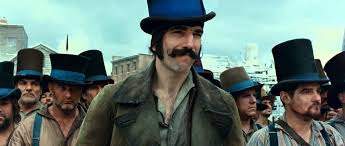
We interrupt this Robert De Niro appreciation-fest to bring you Daniel Day-Lewis. Day-Lewis dominates the film so much as the diabolical gangster Bill “the butcher” Cutting that he received an oscar nomination for Best Lead Actor (it’s totally a supporting role. A big one, but still a supporting one). It’s a career highlight that clearly laid the groundwork for his absolute best role in There Will be Blood. Outside of Day-Lewis, there’s still a lot in this one. Gangs is an epic film that was the start of Scorsese’s collaboration with Leonardo DiCaprio. It also features turns from Cameron Diaz, John C. Reilly, Liam Neeson, and Brendan Gleeson, all of whom are various degrees of great. It’s visually brilliant, which is even more impressive when you find out that there’s exactly one piece of CGI: the elephant (which they wanted to do practically!). At its worst, Gangs of New York drags a little. At its best, it’s a masterwork, an odyssey of redemption and honor that serves as maybe the most integral part of Scorsese’s chronicles of New York besides Taxi Driver. Scorsese is the best New York filmmaker, by the way. Sorry Woody Allen. Also, Gangs of New York is one of the most nominated films in oscar history to not receive a single award (It had 10 nods. True Grit in 2010 and American Hustle in 2013 also had 10, while the record is shared by The Turning Point in 1977 and The Color Purple in 1985).

9- Shutter Island (2010)

Image result for shutter island

Mysterious, eerie, and dark as hell, this period stunner wouldn’t work as well as it does in the hands of a lesser filmmaker. While Scorsese’s films aren’t typically this genre-specific, he kills it with this one. Gorgeously shot by Tarantino regular Robert Richardson, Shutter Island is entirely atmospheric. And WOW what an atmosphere. I first saw this one knowing nothing about it except that it was directed by Scorsese and it had a great twist (it does). I wasn’t expecting the masterpiece of a slow burn thriller I proceeded to experience. It was after watching this that I first realized that DiCaprio is one of the greatest actors of all time (this was before having seen The Wolf of Wall Street and The Revenant). Mark Ruffalo is great as usual, as is Ben Kingsley. And MAX VON SYDOW is in it. It’s a perfect movie. Also, it’s almost a shame to mention this because it takes away from what a gloriously brilliant achievement the film is, but the twist is all-time. Up there with Fight Club and The Sixth Sense.

8- Mean Streets (1973)

Eighth place feels incredibly low for the movie that, in one scene, invented both movies and music. Seriously, watch it.

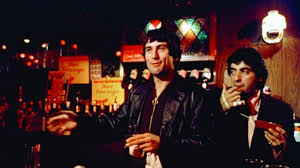
Oh, and also it was Martin Scorsese’s first commercial success and it launched the career of Robert De Niro. Richie Aprile from The Sopranos is in it. I’m not sure I have to say any more, but I’m gonna. It features a brilliant opening scene (below), one of Harvey Keitel’s greatest performance (although he is outdone by De Niro to the point that Scorsese replaced Keitel as his leading man in the next movie he did). It features brilliant examinations of some of Scorsese’s most important themes, such as masculinity and Catholic guilt. And it’s seventh on this list. That should tell you something.

7- After Hours (1985)

Is this the most underrated film of all time? Considering it’s directed by a legendary auteur and is solidly well-known, probably not, but it’s up there simply because it’s SO GOOD. The true essence of a midnight movie, this one works best when watched at night (In my experience, Eraserhead and Kill Bill are other great midnight movies, if you’re looking for recommendations). The brilliance of After Hours is that it’s absolutely nuts. Guy meets girl, guy goes to girl’s apartment to buy magnet, guy is wrongfully blamed for girl’s death, guy spends the night on the run, guy gets built into a sculpture that is then stolen. Not exactly a classic story. Directed by Scorsese, but you would never know it. He’s having fun here- you can see it in the camera angles (think the falling keys), in the general absurdity of the comedy, and in the fact that it’s focused on entertaining before making a broad statement about human nature. In this case, that isn’t a problem. There’s truly nothing like it.

6- The Wolf of Wall Street (2013)

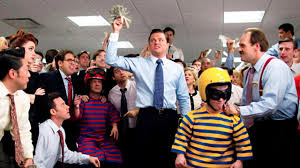
This list has been going through masterpieces since the 11 spot, but this is where it gets real. The Wolf of Wall Street is many things, which is only fitting because it’s a film that deals entirely in excess. The sex, the drugs, the length, the language (record for uses of “f**k” in a movie that isn’t about swearing), they all serve one purpose: to further the theme of excess. Jordan Belfort’s lifestyle isn’t presented this way by Scorsese just because, it’s to tell the story accurately. The story is one of American greed in its purest form. How quickly greed takes over and the kind of things it does to people. It’s like Goodfellas, if the violence were traded in for financial scams. Also, DiCaprio has never been as good and Jonah Hill is revelatory. The Wolf of Wall Street is a glorious, phenomenal sensory overload of a movie. One of the greatest films of the 2010s. And it only gets better from here.

5- The Irishman (2019)

Scorsese’s latest is clearly one of his masterpieces. It earns every second of its titanic length with brilliant performances across the board (Pacino is a god), masterful storytelling, and a brilliant commentary on human mortality. It’s a late-career work in every sense, but that doesn’t mean he’s slowed down. The Irishman could probably be ranked below Wolf of Wall Street, but it could also be one or even two spots higher. It’s a breathtaking feat of cinematic excellence, the kind of thing that Scorsese does far more often than he has any right to. Reviewed in greater depth here.

4- The Departed (2006)

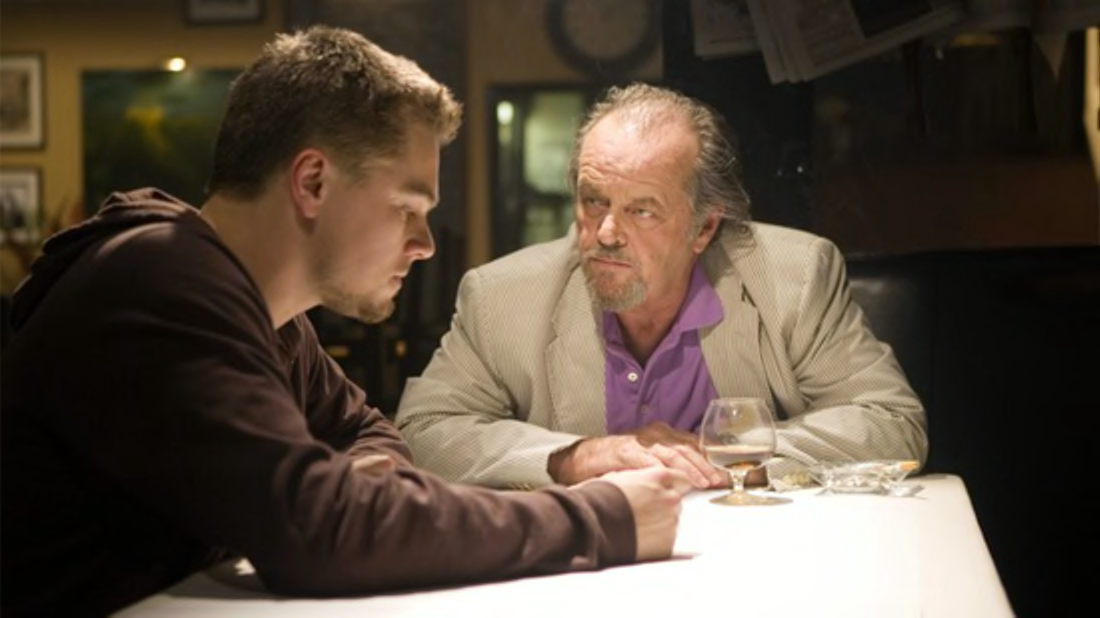
*Insert depahted joke*. Now that that’s out of the way, let’s talk about this, my second favorite Scorsese movie. The plot is so genius, complex, and Scorsese-an that it’s crazy that Scorsese didn’t think of it (for those uninitiated, it’s a remake of Infernal Affairs, a 2002 Hong Kong film). With the combination of director and plot, the least The Departed could’ve been was only slightly great. Instead, it’s an all timer. Matt Damon and Leonardo DiCaprio are equally brilliant as the gangster inside the cops and the cop inside the mob, respectively. Mark Wahlberg is awesome. For real, the only other place the guy is this good is Boogie Nights (another of my favorite films. Huh.), and you could argue that he should’ve won the oscar for supporting actor over Alan Arkin for Little Miss Sunshine (but damn is Arkin great in that). But the true best performance goes to the one and only Jack Nicholson (this has become a rundown of the greatest actors ever. All that’s missing is Brando). Nicholson is so unbelievably entertaining, over the top, and just plain great. I’ve seen it said that he tanks the movie and isn’t good. To that I simply say no. It’s one of the best performances of his career, and I understand the gravity of that statement. Also, in the last like 20 minutes it devolves into a Shakespearean tragedy. Huge plus.

3- Raging Bull (1980)

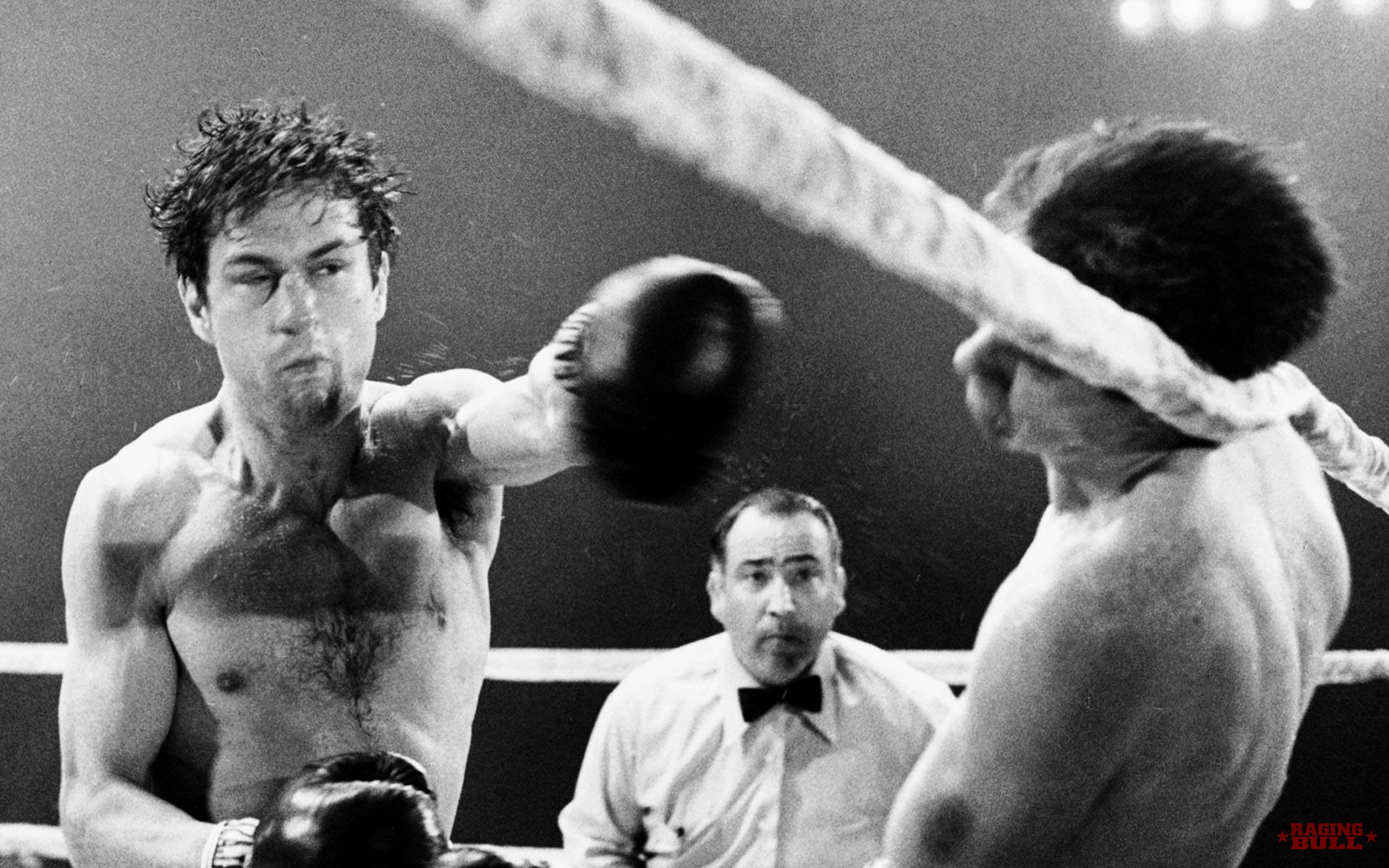
The greatest sports movie of all time. The (tied) greatest ever De Niro performance (I can never decide between this and Taxi Driver so I’ll call it a tie). The greatest study of self ruination that Scorsese ever accomplished (the two films above this are studies of ruination by other things). Raging Bull‘s one-two punch (sorry) of De Niro and technical wizardry (commonly referred to as the best edited film of all time. In my opinion, that’s probably correct, but Thelma Schoonmaker’s best work is the Sunday, May 11th sequence in Goodfellas. Rant over) cements it as a legendary work. It’s a boxing movie on multiple levels- sure, it deals with Jake LaMotta’s career inside the ring, but it’s also the story of his fight outside of it. And the technical genius of all involved elevate it into a masterpiece (in a way quite similar to the 2009 Claire Denis film White Material, which I will be discussing in a later post. Yeah I’m plugging my own stuff, so what?).

2- Taxi Driver (1976)

A visionary exploration of madness unlike any other. There’s so much going on within Taxi Driver: the film is simultaneously an indictment of the Vietnam war, the vigilante mindset, politics, and child prostitution. And yet it’s an indictment of none of these things. It presents them not positively or negatively, they are. Is Travis Bickle a hero, as he believes himself to be, or is he a violent psychopath? Is he actually lauded for his crimes, or is he imagining this reality as he dies? The film not only refuses to answer these questions, but it doesn’t provide a way to feel about it. It’s a film so important to cinematic history that anything else would feel like piling on. Peter Boyle, who plays “Wizard” in this, is the monster from Young Frankenstein.

1- Goodfellas (1990)

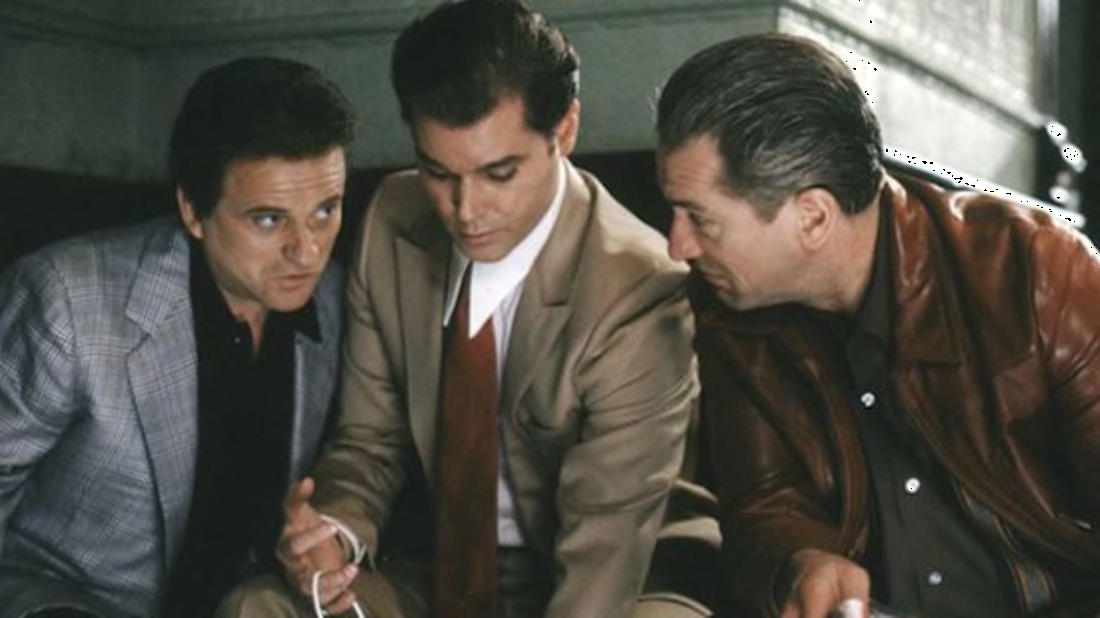
Full disclosure: this is my absolute single favorite film of all time. Nothing else comes close. So it was impossible for me to rank the films of Martin Scorsese with total objectivity. Even so, I have to feel that this would come in first if I could. It’s perfect in every way: Schoonmaker’s aforementioned editing is at its peak, Scorsese’s direction is as good as it’s ever been, the acting all around is brilliant. Liotta, Pesci, Bracco, and Sorvino turn in career bests and De Niro is amazing too. His facial acting in the bar when he decides to whack Morrie is completely incredible. That scene is a microcosm of why the film is so great- it’s the epitome of Scorsese’s cinematic sensibilities. That acting combined with the brilliance of the Sunshine of your Love needle drop and the use of slo-mo is a perfect example of the singular style that propels it into the annals of all time greatness. I could go on listing moments for days- Billy Batts’ death, the tracking shot through the Copacabana, the May 11th sequence, the opening scene, the third wall break, the Layla montage- but the point is already made. The film is perfect, and it’s the summation of Scorsese’s career and the highest peak he’s ever reached. And now we wait for The Irishman.