
Over the last few months, John Carpenter has rapidly become one of my favorite directors. Prior to last halloween, I had only seen two of his films. Then I watched The Fog and ventured into a rabbit hole of horror, action, and Kurt Russell. 10 movies later, I have surrendered to my natural impulses and ranked them all before I’ve finished his entire body of work (which I intend to do rapidly and will update this accordingly). So far, of all the movies of his I’ve seen, exactly zero are anywhere close to bad, and- to some degree- I love all of these. So enjoy as I attempt to fashion a coherent list out of these incredible movies.
12- Dark Star (1974)
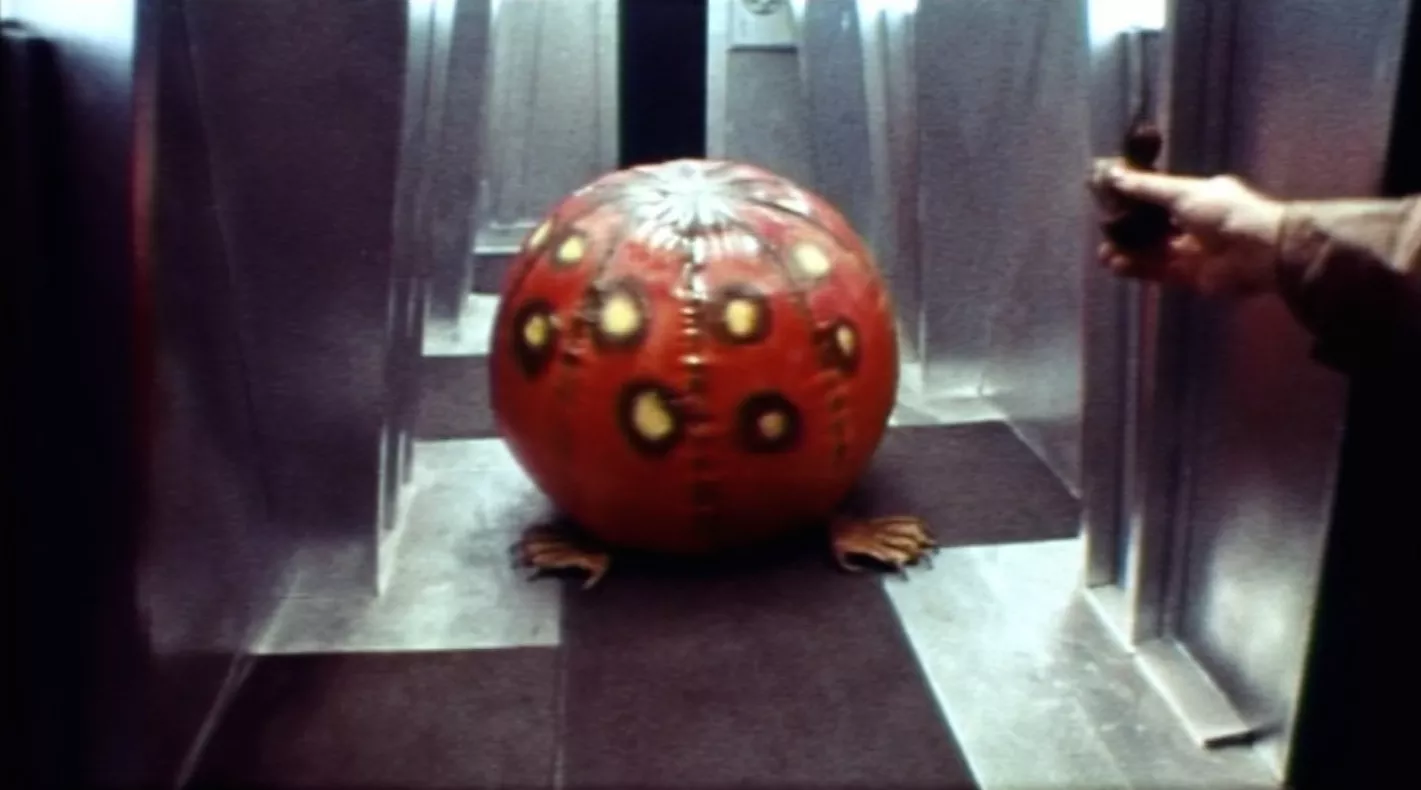
I have a really big soft spot for Dark Star, Carpenter’s ugly, half-baked debut. Objectively speaking, it’s almost definitely a bad movie, and as such I really can’t justify putting it higher simply to prove a point. But MAN it is JUST SO WEIRD. Carpenter and screenwriter Dan O’Bannon (who would go on to write a little film called Alien) fashion an utterly bizarre response to the cultural craze for space movies. Pictured above is the alien antagonist of the film (quite obviously massively superior to the equivalent creature in O’Bannon’s later masterwork), and yes, it is a red beach ball with feet. It wreaks havoc on the titular ship, which basically amounts to mildly annoying the bored crew until they kill it. Then the movie just proceeds on to the next thing. There’s no real plot so much as there is a collection of ideas, reminiscent a bit of the Monty Python movies. There’s a talking bomb with an existential crisis (truly one of the best characters in Carpenter’s vast oeuvre), O’Bannon himself plays a member of the crew who’s not supposed to be there (outstandingly, I might add), and there’s a pervasive malaise that haunts over the whole thing and distinguishes it from its contemporaries. It’s also ridiculously quotable (“Now it’s time to go sleepy-bye, you worthless piece of garbage”, “How are the Dodgers doing”, “Teach it… p h e n o m e n o l o g y“). At least, it is if you have a terrible sense of humor and an extreme dedication to randomly quoting movies. Also, Benson, Arizona, the film’s theme song, is impossible to fully drive from your head. There’s just so much here to obsess over, and it’s a massive shame that it hasn’t become the cult classic it deserves to be. I love it so much. If only it were better.
11- Escape From New York (1981)

Here’s a controversial ranking. Like I said, I love all of these, it’s just that this is one of the ones I love least. It certainly gets points for being the coolest conceptually: the idea of Manhattan being turned into a maximum security prison is a fascinating idea (and one that is expanded upon sufficiently in this film without ever going overboard), and Snake Plissken’s (Kurt Russell) quest is constructed for maximum tension. The film maintains a truly intense atmosphere despite its total insanity: this is a film where Isaac Hayes, playing the “Duke of New York”, drives around in a car with chandeliers on its hood, and Donald Pleasance plays the President of the United States with a British accent- and somehow makes it work. Everyone performs with the required aplomb. Lee Van Cleef (!) menaces around the screen in the style that built him a career. Harry Dean Stanton (!!!!!) applies his trademark neuroticism to great effect. And of course there’s Kurt Russell. Russell’s Snake Plissken (what a name) is one of his most iconic characters (although in my opinion he’s the weakest of his three Carpenter antiheroes, behind Burton and MacReady). The film’s top selling point, however, is how fully fleshed out the world of New York is. The song “Everybody’s Coming to New York”, sung early on with delirious and ironic glee by a group of prisoners, exemplifies this: it shows how these people live, their need for entertainment, their thoughts on their current situation, and how much time they have on their hands to effectively craft a theme song for their prison state. Escape From New York is excellent, so why is it so low? The other films on this list just happen to be more excellent.
10- They Live (1988)

What could’ve been a ridiculous B-movie with a ridiculous premise, starring a pro wrestler, and featuring some of the cheesiest one liners ever put to film is… actually just that. Except that ridiculous premise is translated into still-relevant social commentary, said pro wrestler gives an amazing performance, and the one liners are AWESOME (“all out of bubblegum” gets all the attention, and deservedly so, but don’t sleep on “life’s a bitch, and she’s back in heat”). There are many things that make They Live work: several specific scenes still stand out, such as the epic six-minute back alley brawl scene between Roddy Piper and Keith David, and the scene where Piper puts the glasses on for the first time. Although not a particularly subtle movie, its frustration with the world and the way the system works makes it fascinating to watch today. It’s told with the economy of time and efficiency of storytelling and exposition that Carpenter is better at than anyone ever. Plus, it all concludes with the absolute funniest five or so seconds of possibly any movie (or at least any horror/horror adjacent movie).
(It’s worth noting that this is the only movie on this list that I’ve gotten blocked on twitter by an idiot over. 10/10 would do again.)
9- In the Mouth of Madness (1994)

The final chapter of Carpenter’s “Apocalypse Trilogy” is its weakest, although it isn’t by any means a weak film. It features a brilliant Sam Neill as an insurance investigator drawn into a web of paranormal occurrences surrounding the disappearance of a massively popular horror author. This writer, named Sutter Cane, has been known to create work that drives its readers insane, and his latest could have potentially disastrous ramifications. Your mileage on In the Mouth of Madness will vary- it’s one of the most polarizing Carpenter films. In my mind, it all comes down to how you feel about the “Did I ever tell you my favorite color was blue?” scene:
If you find the scene to be ridiculous and nonsensical, you may not like the film (although it does work better in context). If you (correctly) find it to be brilliant, demonstrating the power of Cane in an original visually inventive way, you’ll love this movie. As you should. The rapid deterioration of the plot into total lunacy (literally) is something to behold, the acting is excellent, and it’s scary! Really, honestly scary! The guy on the bike! The inescapable portal back to Hobb’s End! The scenes at the church! It’s all so good. Also, the final scene is just unbelievable. Carpenter’s films routinely have great last scenes or shots, and this is absolutely no exception.
8- Starman (1984)

Starman is completely unlike any other film on this list, which is both its greatest strength and most unavoidable weakness. Carpenter here is outside of his comfort zone, abandoning high-concept scifi/action/horror for… well it’s a high concept scifi film, but not in any sort of recognizable way beyond the premise. It concerns an alien (Jeff Bridges, excellent) who comes to earth and takes the form of the recently deceased husband of a woman (Karen Allen, equally if not more excellent), who he then essentially holds captive and forces her to drive him to Arizona so he can get back home. Along the way, however, she finds herself drawn to him. Maybe it’s because of his total foreignness, or maybe she’s just working through her grief. It’s probably both. The film is a rich examination into this character and her inner workings, and ends up as an indelible meditation on loss that just happens to be a solidly cheesy 80s movie. But it’s not as egregiously offensive as say, Big Trouble in Little China (much much higher on this list) in the 80s cheese department, and once you strip away the thin layer of dairy there’s an emotional goldmine in Starman.
7- The Fog (1980)
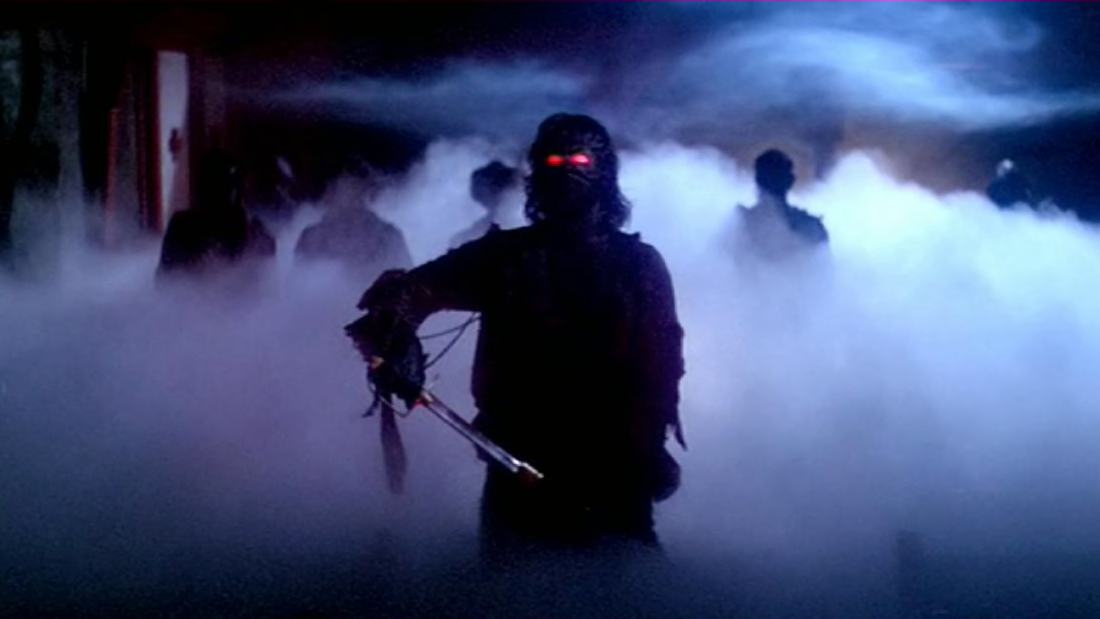
This one’s a personal favorite of mine, and it does hurt not to be able to rank it higher. The Fog is just under 90 minutes of pure B-horror glory, elevated to something brilliant by Carpenter’s mastery. The visual prowess of cinematographer Dean Cundey (specifically the shots of the ocean) combined with Carpenter’s horror direction at its peak create an experience that, although not altogether unique, is relentlessly entertaining and pretty scary. The genius lies in the monsters, however. The ghost pirates terrorizing the residents of Antonio Bay are kept deliberately shrouded in the titular fog, and it creates a truly spooky film. Plus there’s a fascinating political subtext and one of the greatest final shots in existence. Overall there are far greater films on this list, but there are few that are just this good.
6- Assault on Precinct 13 (1976)

Most of Carpenter’s films have an element of fun. It’s not exactly that they’re lighthearted films- take Halloween or The Thing, both deeply serious films that are elevated to exhilarating by their total insanity. There is none of that in Assault on Precinct 13. This is a disturbingly down-to-earth film filled with brutal violence. From the moment you witness the nonchalant shooting of a little girl, you recognize that this is not your typical John Carpenter movie. Ostensibly an action film (based off a western, which gives it some of those qualities), this comes closer to a horror movie in a lot of ways. The gang members invading the eponymous police precinct resemble zombies in the way that they just keep coming, laying waste to their target with no regard for their own well-being. This is a gritty, bleak movie, and a lot of its excellence lies in the ability of Carpenter to communicate that. The deft handling of racial tension here is impressive, especially for 1976. It’s clearly a political statement, yet like most of Carpenter’s work, it can be reveled in without paying any mind to that subtext. The acting is impressive, the direction is stellar (especially once the characters are trapped in a single location for the back half of the film), and the runtime (91 minutes) is tight enough that it never drags. Also, one of the prisoners is played by Tony Burton, best known for his pained plea to “throw the damn towel” in Rocky IV (well, really his entire role in those movies, but there’s no moment more memorable than that).
5- Prince of Darkness (1987)

Scarier than any movie about a cylinder of goo that is also Satan has any right to be. You read that correctly- Prince of Darkness is about a priest who finds a giant jar of sludge in the basement of a church and, using the help of a world-renowned professor and his students, determines that it contains the devil himself. Then the Satan Goo starts attacking and possessing people, and the students find themselves trapped inside the church, fighting for their lives. Why are they trapped inside the church, you may ask? Well that’s because a group of seemingly schizophrenic homeless people are waiting outside, ready to kill anyone who tries to leave. Also their leader is played by Alice Cooper. This movie rules. Dennis Dun, Wang in Big Trouble in Little China, brings the charisma of that role to this one, firing off witty one liners (“Anyone ever tell you you could pass for Asian?”) to provide some much-needed comic relief in the face of impending doom. This is a film where insects crawl out of people’s bodies, people are stabbed with bicycle parts, and characters are transformed into subhuman monsters before our eyes. It’s a truly frightening and upsetting film, and a total masterpiece in a way that nobody but John Carpenter could accomplish.
4- Christine (1983)

This film is an oddity in Carpenter’s body of work, as it isn’t really his story. It’s a Stephen King adaptation, and as such King’s fingerprints are all over it. The characters are King characters, the premise is a King premise, and the themes are King themes. Yet none of it would work without Carpenter. It may be King’s story, but it’s Carpenter’s film. One of the two major things that shocked me about Christine was just how much Carpenter put into it: the direction has a million little subtleties and minor decisions that make it work. In fact, it might be his best-directed film. The other major thing that shocked me about Christine? It’s a masterpiece. It could’ve been a run of the mill early-80s King adaptation, a cheesy story about a haunted car that goes around killing people. It could’ve easily done that. But instead it’s a brilliant odyssey of teenage anger and human self-destruction. These characters are real people who go through real changes and experience real emotion. This movie is profound, it’s raw, it makes you feel more than a movie about an evil car has any right to. This is an incredible film, and one of the best Stephen King adaptations ever.
3- Big Trouble in Little China (1986)
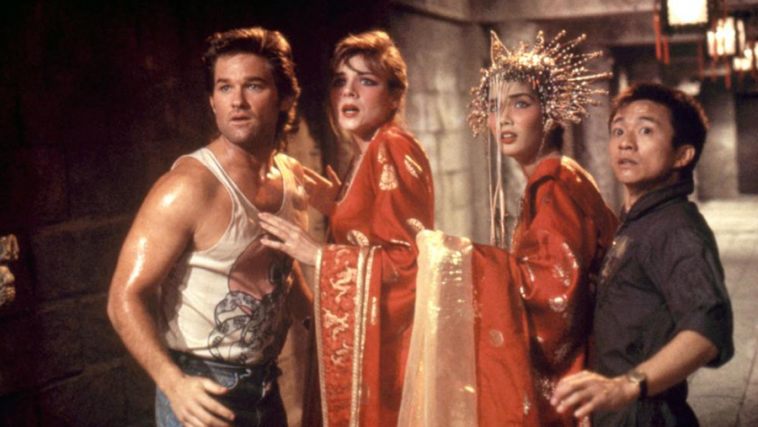
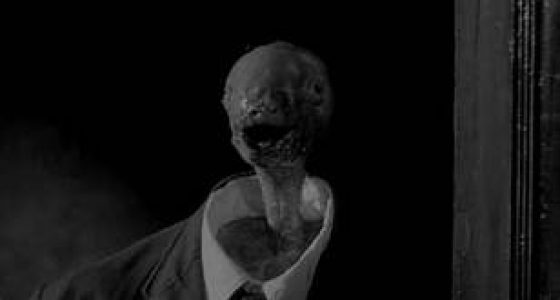
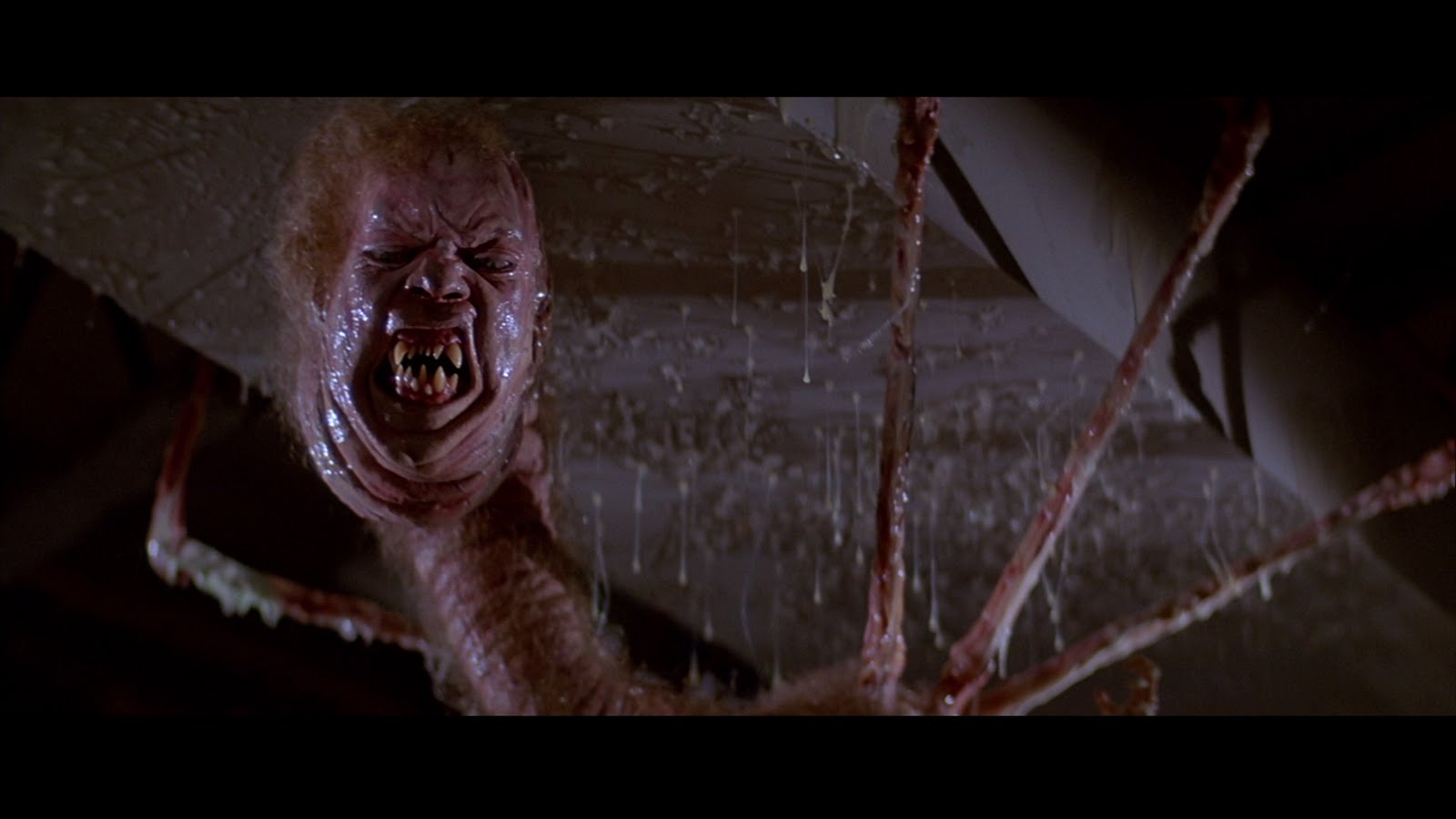
We come now to my personal favorite film of Carpenter’s. Big Trouble in Little China is the Carpenter-iest of all Carpenter movies, the midnight movie-est of all midnight movies, the craziest of all crazy movies. To attempt to describe the plot would be insanity, so in the spirit of the film, here I go: Jack Burton (Kurt Russell, in his greatest role), a trucker, takes some time to gamble with his friend Wang (Dennis Dun, also his greatest role). Jack wins big, and Wang tells him that he can only get him his money if Jack goes with him to pick up his fiancee from the airport. At the airport, Wang’s fiancee is kidnapped by a gang, which prompts Jack and Wang to go looking for her with the aid of a lawyer, Gracie Law (Kim Cattrall, in her greatest role), which leads to a bizarre web of Chinese magic and the struggle by ghost wizard (?) Lo Pan (James Hong, in his greatest role) to regain his mortal form. Aided by a tour bus driver (Victor Wong, take a wild guess where this ranks among his roles) and several others of various usefulness, Jack, Wang, and Gracie face off against seemingly unstoppable magicians and whatever the hell this thing is:
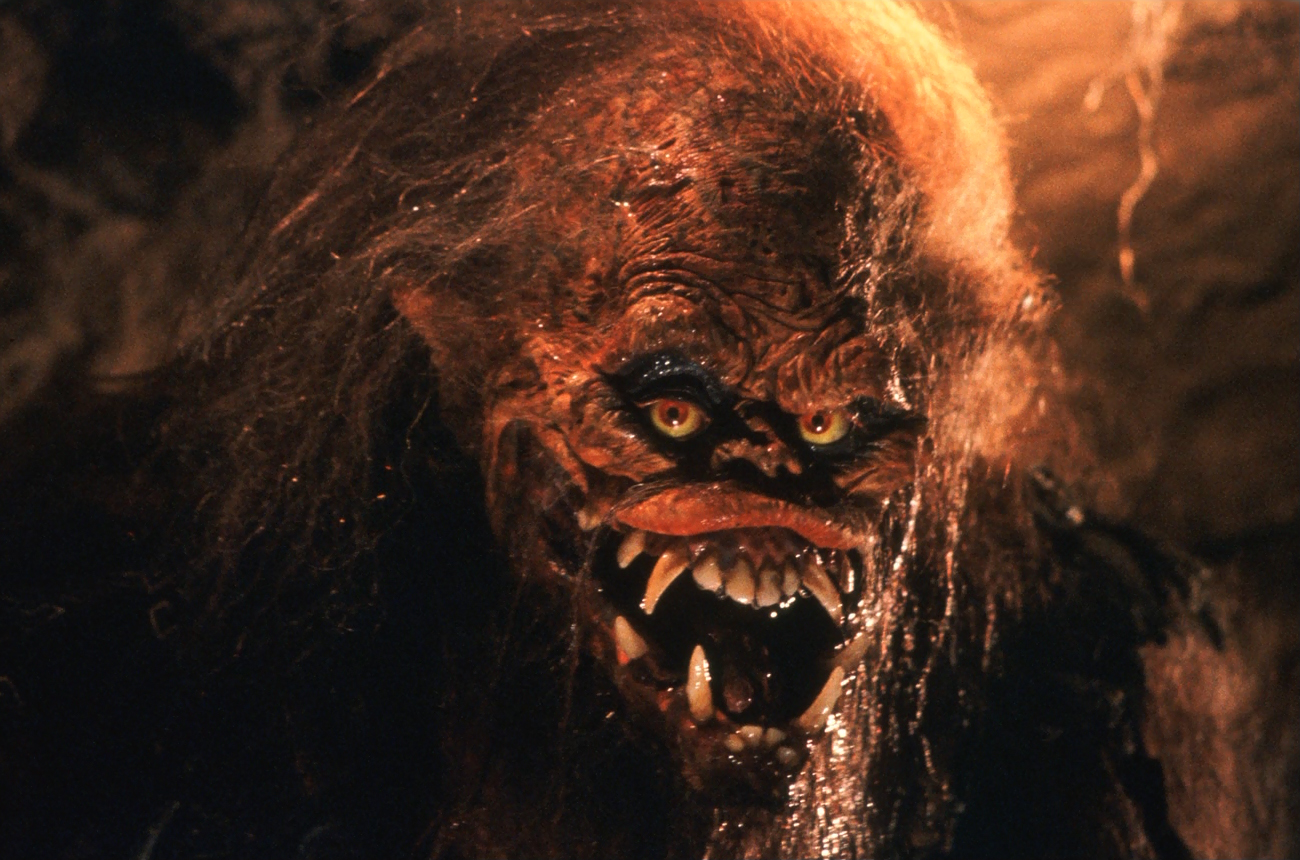
Big Trouble in Little China is an action movie, it’s a comedy (the cut back to Jack out cold on the ground during the climactic fight scene is gold), it’s kind of a horror film (see above), it’s a love story (“You’re not even going to kiss her?” “Nope.”). It’s a busy movie, and with a runtime of an hour and 39 minutes, the fact that it never gets too busy is impressive. Big Trouble is unlike anything you’ve ever seen. It’s nonstop fun that also functions as glorious, expectation-subverting art. No frame of this movie could be replaced, nothing could be added, nothing could be cut. This is a movie that became one of my all-time favorites as soon as the credits rolled. This is a movie that will remind anyone who loves movies exactly why they do. This is a movie that I’m going to go watch again right now.
2- The Thing (1982)

Carpenter never shied away from single-setting movies. Assault on Precinct 13 and Prince of Darkness are both great examples of that. But no film of his (or maybe of anyone’s) invokes as much paralyzing claustrophobia as The Thing. Everything is designed to make you feel as utterly hopeless as possible: the antarctic setting, the unpredictability of the monster, the viscerally upsetting body horror. You feel the fear of the characters so much because the film gives you no choice- anyone could be the thing. This movie famously did terrible upon its release, both in terms of box office and critical reception. A lot of that is attributable to a movie that came out 2 weeks prior: E.T. the Extra-Terrestrial. The film found a following over the years, and has now come to be seen as a classic. The Thing is scary, it’s disturbing, it’s indelible. It sears itself into your brain through unforgettable imagery and a sense of pervasive futility that you can’t quite shake. It also features the greatest of Carpenter’s many great endings. On another note, antarctic researchers watch this film routinely, which is a level of masochism that I would never dream of, despite how much I love this film.
1- Halloween (1978)

“Everyone’s entitled to one good scare.”
These words are spoken by Carpenter regular Charles Cyphers early in Halloween, John Carpenter’s best film. Both the film and its director eventually blow well past one, as the seminal horror film shocks until its conclusion and Carpenter didn’t slow down in its wake (although he would never experience another success as great as this one). Halloween builds something extraordinary from ordinary circumstances: its now-iconic villain is just a guy in a plain white mask, its heroine was then-unknown actress Jaime Lee Curtis, and its premise of “guy goes around killing teenagers” is pretty simple. So why did it become a stone cold classic and touchpoint for generations of lesser re-imaginings and ripoffs (hello, original Friday the 13th)? It’s so good. Just so, so good. Every moment is creepy and electric, every scare works, it’s infinitely entertaining and rewatchable. It’s the definitive watch for an entire season, it has come to define an entire holiday. It may not have actually created the slasher subgenre, but for all intents and purposes it did. It’s an achievement that no number of sequels and reboots can possibly dull. It’s John Carpenter’s crowning moment, and as such it’s an essential piece of cinematic history.









/cdn.vox-cdn.com/uploads/chorus_image/image/63209648/US_1.0.jpg)








 The Movie Files