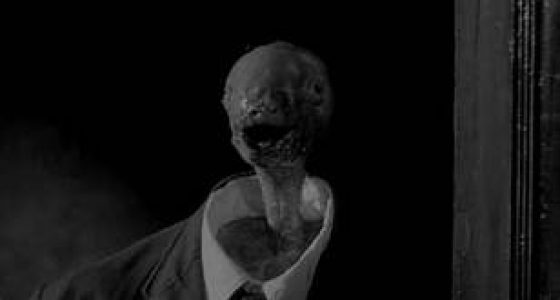
What is The Lighthouse? After finishing Robert Eggers’ follow-up to his 2015 horror sensation The Witch (or The VVitch), a viewer could not be blamed for asking that question. Going into the film, you’d likely have a better grip on it than when you come out. Is it a horror film? It’s scary enough at points, at times even going so far as to invoke The Shining, yet as a whole it never reaches the plateau of total terror that is emblematic of horror movies. It begins in an uneasy, uncomfortable state, and finishes there. Is it a comedy? It’s certainly funny, with enough farts to make Blazing Saddles impressed. Is it a romance? Absolutely not, but there are enough homoerotic undertones (and one, uhh, interesting subplot involving a mermaid) to make you at least slightly convinced. The Lighthouse defies easy categorization, instead belonging to a genre of its own, one that seems to have arrived from some other dimension. It reminds one of horror movies from the 60s, when they were just starting to figure out what the genre was, such as Carnival of Souls, or going back even further, Nosferatu (a remake of which Eggers has been rumored to be attached to). Yet despite the fact that it feels like a movie made 50 years ago, nobody has ever come close to making anything like this. The Lighthouse is a true original, and this makes it an absolute marvel to behold.
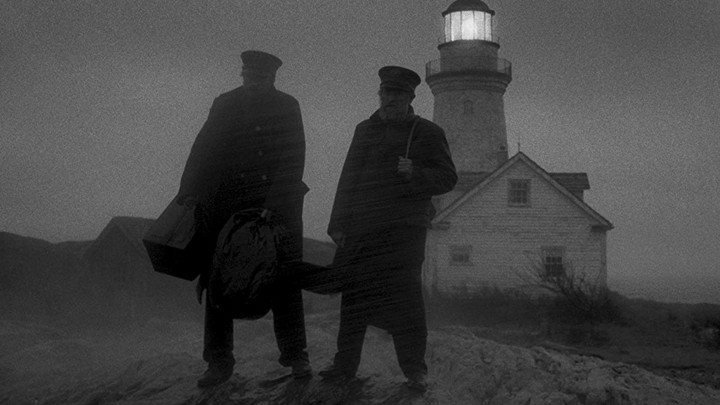
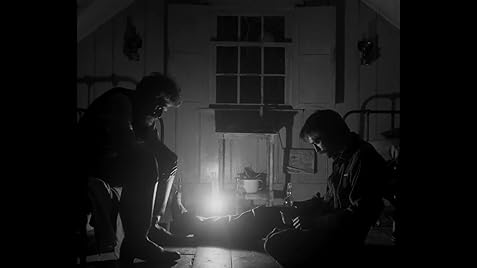
The Lighthouse opens with Robert Pattinson and Willem Dafoe arriving at the titular structure. It is there that they will spend the rest of the film, alone with only each other, some really mean seagulls, and their rapidly deteriorating mental states. Dafoe quickly establishes to Pattinson that he’s the one in charge, and the two squabble over who gets to tend to the light up in the lighthouse. Pattinson insists that they should alternate, while Dafoe maintains that it belongs to him. So begins the central conflict between the two, a struggle for power and dominion over the light. Dafoe controls the light, and so he controls everything. The light takes the form of a savior, a source of divinity and enlightenment that allows Dafoe to rule absolutely while Pattinson toils, performing menial labor, suffering debilitating injuries, and subjecting himself to subservience. The two have a love-hate relationship from the start. Dafoe’s insistence on his power puts Pattinson off, and the young Pattinson’s arrogance appalls Dafoe. They bicker over everything, access to the light, the quality of the food (one particularly spellbinding and hilarious sequence features Dafoe ranting deliriously after Pattinson admits his distaste for the lobster he cooks). The master/servant dynamic comes in and out like the tide, with the two setting aside their differences to get drunk, sing and dance, and “spill their beans”, a term Dafoe uses to refer to the unwarranted telling of personal secrets. As the weather takes a turn for the worse following Pattinson’s brutal murder of a seagull, the two become stranded on the island longer than they expected to be, and their grips on their sanity dissipate. Pattinson begins to hallucinate a sexual relationship with a mermaid. Dafoe’s alternations in perception of Pattinson become more rapid and more violent. They dance, they sing nonsense, they shout at nothing. They take turns trying to murder each other. Pattinson makes a move to escape, at which point his boat is hacked to pieces by an axe-wielding Dafoe. They maintain a tenuous connection to the outside world by threatening to report each other to the organization they work for, despite the fact that it’s clear to them both that there is functionally no world to either of them besides the rock they inhabit. Pattinson threatens to report Dafoe and Dafoe threatens to dock his pay, but they both know it’s meaningless. This bedlam can clearly only have one conclusion- one of them ends up dead.
At this point there will be spoilers, if that matters to you.
One of them does, or at least comes close to it. Pattinson beats Dafoe within an inch of his life, steals his key to access the light, and leaves him half-buried in a ditch to die. As Pattinson pauses before his final ascent to the light, Dafoe charges at him, with the intent to kill him to prevent someone else from accessing the light. But he’s no match for Pattinson, who overpowers him and brutally kills him with an axe. Now totally alone on the island, he climbs the spiral staircase of the lighthouse.
What follows will probably be hard to describe. Upon reaching the light, which he has shed so much blood and sacrificed so much of his mind for, he has a visceral reaction, the light cleaning the dirt from his face, emanating out of his eyes and mouth, and giving him the appearance of something more than human. It’s as is he’s staring God in the face and not being able to handle what he’s seen (in many ways, the scene echoes the finale of The Witch). He falls down the staircase, back to the ground, away from the light. Where he belongs. He’s a sort of Icarus- he flew too close to the sun. He tempted fate. He killed a seagull.
Early in the film, Dafoe cautions him against violence against the seagulls, despite their persistent assaults on him. Dafoe states that the gulls contain the souls of dead sailors, and killing one would mean bad luck. Yet in a moment of unbridled rage, he grabs one of the creatures and smashes it repeatedly against a rock. The brutality of the act leaves no question about the fate of the seagull, nor does the sight of its pulverized remains in Pattinson’s hand. It is his ultimate act of hubris, of youthful ignorance and disobedience. And it costs him as such. For after it’s been done, the wind changes and a storm begins to roll in.
The final shot of the film sees Dafoe, lying naked on the floor, surrounded by seagulls. He’s in bad shape, to put it nicely. His body has been destroyed. Yet he’s clearly not where he was when we last saw him: he was killed indoors, yet he’s outdoors here, and he was fully clothed. So is he dead? Yes, his soul has left to go join the ranks of the seagulls. Fitting, after he’s spent weeks tormenting Pattinson, he becomes one of the animals he hates the most.
At a technical level, The Lighthouse is aces. Cinematographer Jarin Blaschke, who did phenomenal work on The Witch, one-ups himself here, working in hypnotic black and white and an almost-vertical aspect ratio to create a curious visual stunner. The actors are both unbelievable. Anyone who still sees Pattinson, one of our most versatile contemporary actors, as “the Twilight guy” will be astounded by his work here. Dafoe is somehow maybe better, never faltering from his character’s ridiculous persona and dialect and never going fully over the line into parody. Robert Eggers cements his status as one of the most fascinating young directors, showing off an even better example of his distinct style and unique genre. The Lighthouse is one of the year’s best films, and it comes in under the wire as one of the most essential works of the decade. It’s weird, it’s radical, it demands to be seen and admired.
Rating: 5/5

 The Movie Files