

The most persistent thing I’ve seen said about Spike Lee’s latest film is that it couldn’t have come out at a better time. And sure, with the heightened attention to racial issues currently sweeping the nation and the world, the moment is right to hear from America’s most important filmmaker on the subject. But to say that Da 5 Bloods “lucked” into the perfect time to release is to miss the point of the movie. Sure, the remarkably current setting plays a huge role- Delroy Lindo’s character’s MAGA hat becomes a plot point and major symbol- but the assertion of the film is that nothing differs from one cultural moment to the next when it comes to treatment of Black people in the United States. The civil rights movement was not the final frontier in racial equality, the assassination of Martin Luther King Jr. was not a lone atrocity perpetrated against the fight for justice. Some things never change, and Lee’s film laments this in a way that rings true in the aftermath of George Floyd’s death, but unfortunately has seen this before far too many times.
Lee’s opening montage takes the viewer through the turbulent end of the 60s in America, touching on the civil rights movement, Neil Armstrong’s landing on “Da Moon”, and of course, the Vietnam war. It’s not too long into the subsequent present-day scenes until these images are called into doubt through modern perspectives: war vet Paul (Delroy Lindo) has been driven away from his generation’s revolutionary spirit into voting for Trump. People party in front of a neon Apocalypse Now sign. We hear Vietnamese characters refer to the conflict as “The American War”. It’s this last one that hits the hardest, solidifying the aims of the film to present its audience with wider points of view that challenge common opinion. Vietnam in America might be viewed as a cultural moment, but in reality it was a war, a senseless one that had lasting impacts. And although those impacts may be overlooked in America, in Vietnam they haven’t been forgotten. Lee quickly settles down from the initial setting up of thematic concerns to put his story in the spotlight, but this thread never dissipates. There are still Vietnamese people who lost family members. There are still cultural wounds that haven’t healed. There are still active landmines in the jungles.
Four of the titular five (played by Lindo, Clarke Peters, Isiah Whitlock Jr, and Norm Lewis) have returned to Vietnam 50 years later to locate and retrieve the remains of their squad commander (Chadwick Boseman), as well as millions of dollars in gold that they stashed during the war. They set up a deal with a Frenchman (Jean Reno) to launder the gold for them. Paul’s son (Jonathan Majors) arrives with the intention of helping to find the gold and to make sure his troubled father is okay returning to Vietnam for the first time. So with their mission laid out for them, and their personnel finalized, they head into the jungle to confront their past.
Lindo, Peters, Whitlock, and Lewis stand in for the Vietnam generation, a lost group searching for some semblance of peace with their past. Majors, as well as the group of landmine disarmers he meets along the way (played by Melanie Thierry, Paul Walter Hauser, and Jasper Paakkonen) represent the next generation, one forced to clean up the sins of their parents. Thierry’s character comes from a family made wealthy through weapons dealing, and she decides that it’s her responsibility to help prevent further harm coming from her family’s legacy of destruction. Majors knows and resents the fact that his father fought in Vietnam and voted for Trump, and he sees it as his responsibility to put a more palatable face forward. One of the many themes of Da 5 Bloods is people held responsible for the actions of others: generations forced to atone for their parents’ shortcomings, but also those very same people being forced into a war they wanted no part of by a government that paid no individual price. It’s an endless cycle.
It continues. A landmine from the war claims the life of Lewis’s character and almost does the same to Majors. Lindo’s descent into madness endangers the lives of every other character. The soldiers are forced to defend their recently seized gold bounty from an armed Vietnamese group aided by Jean Reno’s character. Every inch in this film has to be fought for. Any time anyone sees anything as rightfully theirs, someone will disagree. The war ended a long, long time ago, but it lives on through an inability to leave it in the past. Vietnamese/American aggression persists, PTSD haunts these men every moment. Take an early scene, when the veterans leaving a club are taunted with firecrackers thrown in their direction by a vietnamese teenager. If Da 5 Bloods wants you to understand one thing, it’s that the legacy of the Vietnam war isn’t a legacy so much as a continuation.

So the socio-political aspects of the film are myriad and endlessly thought-provoking, because come on, it’s Spike Lee. So the next question has to be- is it any good? Yes. It really, really is. Come on, it’s Spike Lee. Let’s start with the technical stuff: Terence Blanchard’s score is among his best work, which is saying a lot considering he’s one of the great American film composers of all time. The script, written by Lee and Kevin Willmott, is typically barbed and entertaining. And Newton Thomas Sigel’s cinematography… oh man. I’m going to rant about that for a second. The film looks great during the present day scenes, comprising the majority of the film, but the flashbacks back to Vietnam combat are so brilliantly shot that it almost wills the film to work on its own. Let’s have a look, shall we:
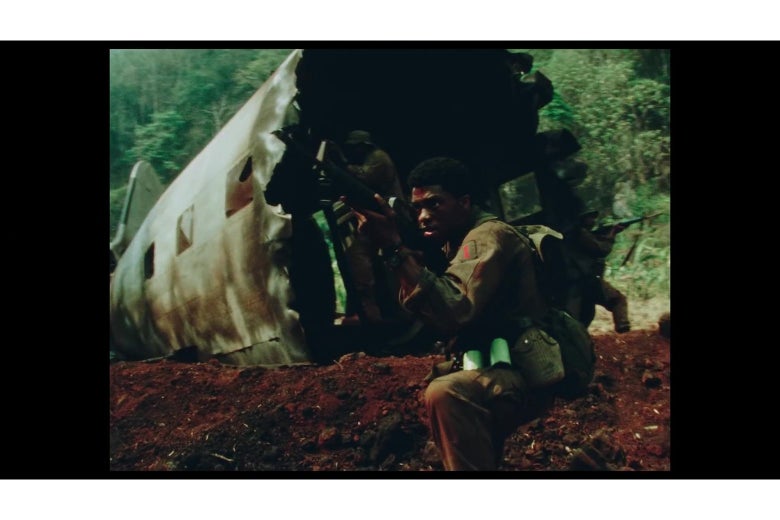
Okay that’s not a great picture of it but you have to trust me on how it looks in the film. In motion. The greens are so green, the shadows are so dark, the grain is trance inducing. I’m reminded of the Clockwork Orange quote about how colors don’t quite seem real until you see them on a screen. It’s almost a flaw of the film. The flashbacks are so important to the plot and characters, yet at times it almost got hard for me to focus because of how cool it looked. Okay so moving past the cinematography to the main event, the piece de resistance, the highlight of the whole thing: the acting. Clarke Peters needs to be in more things and only Spike Lee recognizes this. Jonathan Majors, who delivered one of 2019’s most unsung brilliant turns in The Last Black Man in San Francisco, continues to be just absolutely remarkable. Isiah Whitlock is good throughout, but obviously his moment comes with his eagerly-anticipated “shiiiiiiiieeeeeeet” that occurs deep into the film. Chadwick Boseman finally gets to go nuts in a legit movie, albeit with limited screentime, and nails it. And then, of course, there’s Delroy Lindo, the subject of all the critical adoration directed at the film. He lives up to the hype. If the film is to be taken as a modern update on Apocalypse Now‘s examination of the ravages of war, Lindo’s Paul is clearly positioned as its Kurtz. He’s haunted by demons and ghosts from the onset, and free falls into madness as the jungle begins to take its toll. He’s simply indelible, and his monologue towards the camera near the end is, in my mind, an Oscar clinching moment if there ever was one.
Spike’s style is on full display as well, with all of his traditional hallmarks showing up. Explicit pop culture references (a Treasure of the Sierra Madre shoutout may elicit groans from some), incorporation of real footage to prove his social points (creating a Brechtian effect that reminds the viewer that they’re not in store for idle entertainment), and yes, it’s probably overstuffed and messy. But the film uses this to its advantage in a strange way by containing its chaos: every plot point that initially feels tacked on comes back to play a part, every seemingly unnecessary stretch puts the viewer further into the minds of these characters. It’s not fun, but Da 5 Bloods leaves the audience sunburnt and delirious. I’m not making this sound enjoyable, because it’s not supposed to be, but it’s not exactly torture either. You can’t separate the politics from the film here, but it manages to work as a movie extraordinarily well. Even the scenes where nothing really happens feel gripping, and the two and a half hour runtime doesn’t wear out its welcome. Yes, it’s a social responsibility to watch Da 5 Bloods, but it absolutely isn’t a chore. This is Spike Lee at his most socially relevant and his most artistically brilliant, and it’s quite something to watch. If you haven’t already, I can’t stress this enough: watch this movie.
Rating: 4.5/5

 The Movie Files