Over the past few months, the buzz on Ryusuke Hamaguchi’s Drive My Car among film circles has grown deafening. It’s the kind of thing that reminds me of Parasite’s ascendence through the second half of 2019; Cannes raves built up a hype train, and the film rolled out to wider audiences and blew collective minds, generating a rare (relative) lack of pushback. Drive My Car has now taken Best Picture prizes from both the New York and Los Angeles Film Critics’ Circles, achievements that have led the statue pundit class to designate the film an Oscar contender. It’s an unthinkable fate for the film, a three-hour Haruki Murakami adaptation from the aforementioned Japanese auteur Hamaguchi, a man whose stylings are not exactly crowd-pleasing. And yet here the film finds itself, coasting to popular celebration on the back of its pure, undeniable quality.
Of course, Drive My Car will absolutely not be nominated for Best Picture. Parasite had crossover appeal, the kind of thing that could coast on word of mouth and not let anyone down on its promised insanity. I alluded to Hamaguchi’s lack of that quality earlier: I wouldn’t describe him as slow, but he is deliberate, and he’s more than content to let his characters talk, to the exclusion of, say, the tension Bong Joon-ho imbues his films with. This is not a dig at Hamaguchi’s skill — he’s responsible for two of the year’s finest films in Drive My Car and the delightful omnibus Wheel of Fortune and Fantasy, and stands undoubtedly as one of the most exciting emerging voices in contemporary global cinema. But he’s not going to build the following Bong did. His film will not create the buzzed popular undercurrent of genuine excited recommendations. “Meditative” is not a word you really heard about Parasite. If you really want to go in depth on Drive My Car’s Oscar prospects, you can say that it’s almost a lock to take the International Film category, and if it gets lucky? Yeah, the much-lauded screenplay from Hamaguchi and cowriter Takamasa Oe could find its way into the Best Adapted section. This is a realistic scenario, and one that would probably have to stand as encouraging for popular reception to arthouse films. But it would not constitute popular acceptance thereof. Which is, honestly, fine: Drive My Car may be topping the year-end best-of lists of many people who put above-average time and effort into such things, but the fact that it’s not the type of film to go far beyond that should in no way constitute an indictment, regardless of the nature of the hype train it’s built up.
So, when you start to divorce the film from that, what is Drive My Car? In short, it really is that good, one of the best films in a big comeback year for cinema. It’s a stunning portrait of grief, an intricate commentary on the nature of performance, and a deeply resonant soft-spoken drama that’s been rattling around my brain since I saw it. The praise is all earned. Hamaguchi’s prowess with dialogue and verbal characterization is spectacular. Working with source material from Haruki Murakami certainly helps, but even here Hamaguchi excels in a way that feels singular: ideas Murakami foregrounds and makes explicit from the get in his short story are here fleshes out, made more subtle. Hamaguchi allows his characters to find them as they go, opening up the narrative to ideas about power, performance, and loss as it unfolds. The departures from the text are frequent, if subtle: the key one, in my mind, concerns the story’s protagonist, Yūsuke Kafuku (played here masterfully by Hidetoshi Nishijima) who in the film is a stage actor/director but in the story is only an actor. Kafuku is dealing with the death of his wife, a woman he had a complicated relationship to but whom he loved unreservedly. The thread that dominates the story is Kafuku’s habitual transformation, his tendency to be constantly acting, always putting forward a role, and his regret over how much of his time with his wife he spent in this manner. The film continues this, displaying Kafuku as a man tormented by his inability to escape this status. The film, consistent with the story, sees Kafuku engaged with a production of Chekov’s Uncle Vanya, which he directs in the film and does not intend to take a role in. It is mentioned by a side character that he is widely expected to take the title role, which he has performed in the past, and which he performs in the text. But he seems intent on staying off-stage, directing and passing the performance onto someone else. This is the critical difference from Murakami’s story: Hamaguchi’s Kafuku takes on direction as a means through which to escape his lifestyle of performance and gain a measure of control. His signature directing style in the film, also completely Hamaguchi’s invention, suggest a further renunciation of performance: he has all of his actors perform in their native language, memorizing their cues based on the ends of their castmates’ lines. It’s a gesture of universality, non-conformity, and naturalism, so important to a man whose life has been reduced to pre-ordained motions. It also forces a connection among his cast, another thing that Kafuku, a man who seems to lack a connection to any living person, seems fascinated with.
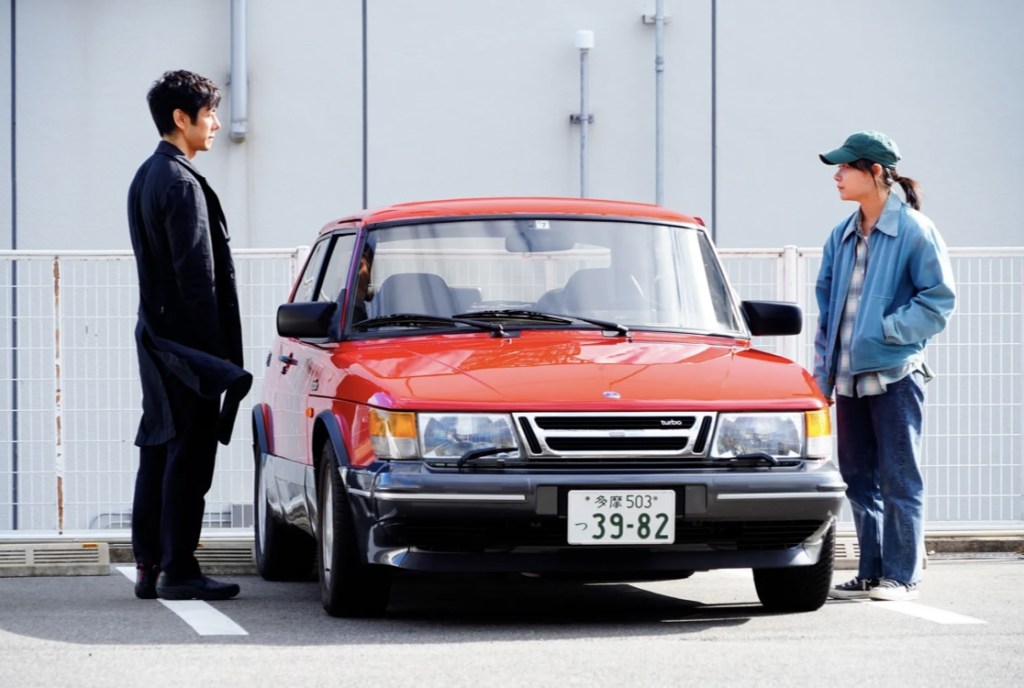
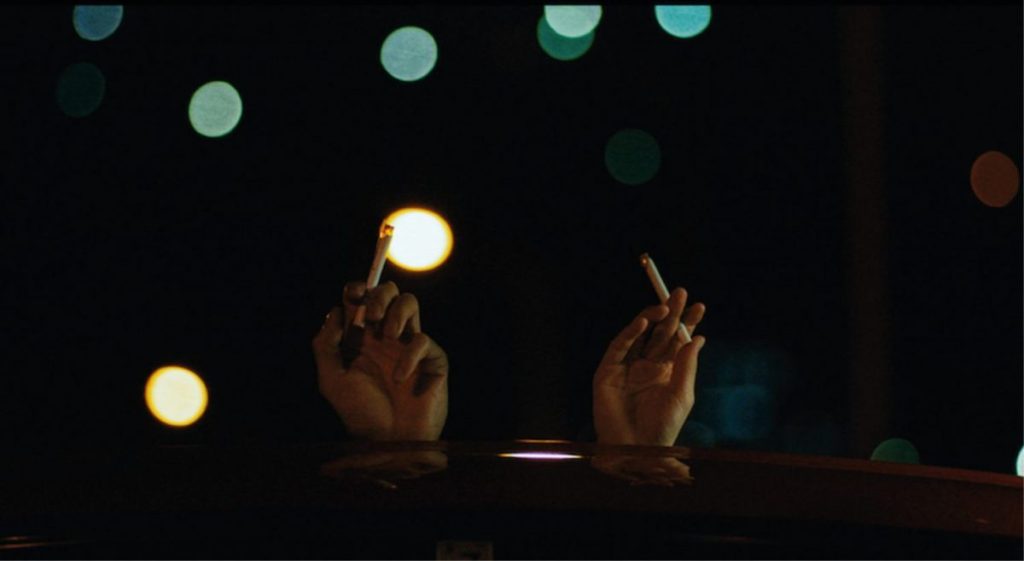
But the heart of Drive My Car lies in the driving. Massive sections of both the film and story concern Kafuku’s relationship with his hired driver, a young woman named Misaki Watari (brought to life in one of the year’s best performances by Toko Miura). The film does a better job than the story at fleshing out Watari into her own character, with her own guilt over her past actions. In both characterizations she is reserved, nearly silent, and wins Kafuku’s respect through one major quality: she’s a hell of a driver. She’s not particularly fast or flashy behind the wheel, but she’s extremely focused and, simply, astoundingly competent, with Kafuku likening the experience to occasionally forgetting a real person is driving. She is haunted, and channels her angst into driving much in the same way Kafuku channels his into the theater. It’s her art form. She maintains a constant focus on the road, on moving forward, on reaching her next destination. It’s an activity Kafuku finds freeing and deeply existentially meaningful. His bond with Watari grows as it becomes clear that they appreciate the same things about it, namely, the constant forward movement. Kafuku listens to recordings of whatever play he is putting on during his drives, seeing it as a time for rehearsal and introspection. Watari shows no preference at all for listening content; her chosen driving activity is smoking, something Kafuku initially prohibits in the car. Both of these habits are individual, based on a sense of the drive as ritual, and it is through this individuality that Watari and Kafuku eventually recognize their profound need for each other. It’s a relationship that is in no way romantic, and probably can’t even be described as a friendship. But they’re partners in grief, and in torment over their own roles in creating that grief. They understand each other, and they understand the catharsis inherent in the road, in the constant journey towards some destination or another. It’s something they’ve both adopted as a purpose in an attempt to deal with their pasts, and they allow one another to experience it. By the moment, late in the film, where Kafuku breaks his rule and offers her a cigarette, the connection between the two has built the film into something so rich and complex that you barely realize it was happening.
Drive My Car is the kind of film destined to have a million pieces written on it, to be discussed into oblivion, to be instantly characterized as a high water mark and confined to its status as a Great Movie. But it’s also the kind of film that’s worth keeping sight of as an actual film, on its own terms, away from any of the surrounding talk. The film itself would seem to support that idea, of interiority away from public perception. That perception has become a part of it, for better or for worse, and considering its own examination of that phenomenon, it’s worth mentioning. It postulates that existence in the public eye tells you exactly zero about a person, and uncovering the totality of a person’s inner being is impossible no matter how well you really know them. For a film with manifold mysteries and an actual character inconsistent with the awards-darling image that’s beginning to be foist upon it, that’s a fitting insight.

 The Movie Files