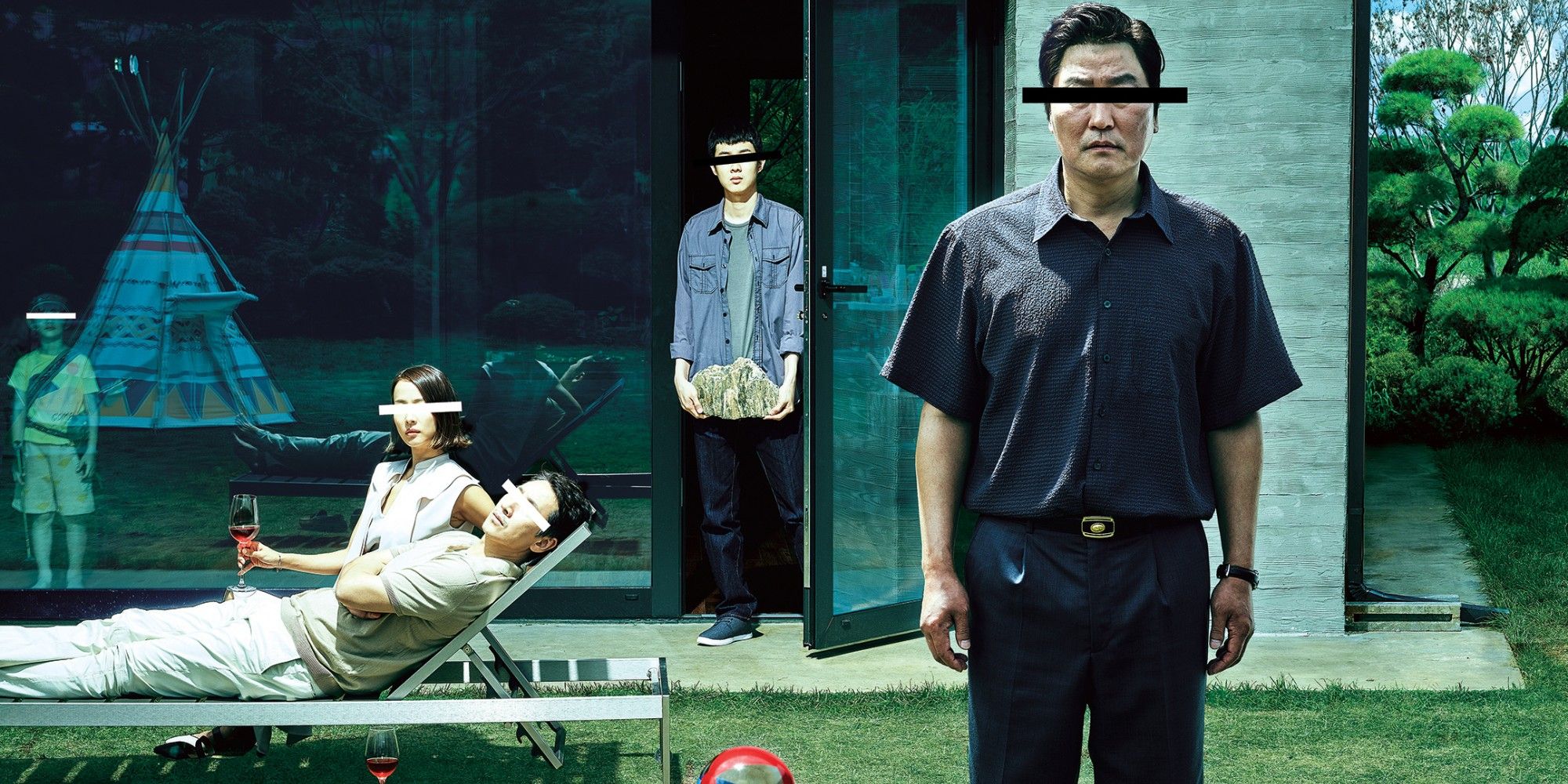
It has been four days since I finally saw Bong Joon-Ho’s Palme D’Or winner Parasite, and I haven’t been able to get it out of my head. Additionally, I haven’t been able to figure out how to review it. Everything you may have heard is true, both about the quality of the film (it’s a straight-up masterpiece) and the correct way to approach it: I managed to duck almost any information about the plot in the months before I could see it and my experience benefitted greatly. So, in the interest of preventing anyone receiving any knowledge, whether they don’t want to or think they want to know, I will not be discussing the plot of the film in this review. Which is problem number one in how to review it.
Problem number two is that I’m not sure how to properly extol the virtues of this generational work of art without going into spoiler territory (and pretty much anything is a spoiler, so that’s easy to do). Since at this point it probably isn’t hard to figure out, and since this is an oddly-structured review, I’m gonna go ahead and commence with the rating, which is usually at the bottom:
Rating: 5/5. No, wait, 6/5. Is that illegal? It’s my blog and my review, I am the law and can do as I please. Yeah, but it feels wrong. 5/5, but I’d go higher if I could.
With that out of the way, I would like to go further into what I touched on earlier: it is extremely important knowing that you see this film knowing as little about it as possible. Don’t watch any trailers, don’t read any plot summaries or outlines, nada. Here is some stuff that is perfectly harmless to know, in FAQ/Q&A form:
Who directed it?
Bong Joon-Ho, the South Korean auteur best known previously for such films as Memories of Murder, The Host, Okja, and Snowpiercer (I did not care for Snowpiercer, although I may have to rewatch it, so if you didn’t like that one, don’t worry).
What is it about?
Nice try.
What are its awards prospects?
If we lived in a kind and just world, it would be the heavy favorite for every Oscar category, up to and including best animated short, for which it does not qualify. However, since the world is cruel and unfair and freaking Green Book won the whole thing last year, this is destined to get nominated for a bunch of stuff like Roma did last year and then get screwed by something inferior, like Roma did last year.
Who’s in it?
The standout and would-be (in a perfect world) best actor nominee is Song Kang-Ho, a Bong regular who has appeared in The Host, Memories of Murder, and Snowpiercer. The cast is outstanding all around, with especially noteworthy turns from Cho Yeo-Jong, Park So-Dam, Choi Woo-Shik, and Lee Sun Gyun.
Is it actually as good as you’ve made it out to be?
Yes.
Well, what makes it so good?
The aforementioned acting, the cinematography is excellent, impeccable set design, brilliant storytelling, powerful social commentary, and pretty much everything about it.
Is it still good if you don’t like movies with subtitles?
If you can’t watch foreign movies because of the subtitles, you make me sad. But also, I assume, yes. It’s become enough of a success domestically that it has expanded to a wide release from its original release in a handful of theaters. Also, it rules. It would probably still rule if you couldn’t understand a word anyone was saying. And it rules more than anything you’ve seen in a while because you can. This is a film that should absolutely be accessible to an audience that doesn’t typically watch foreign films. It’s not slow or dense or anything that comes with the foreign-language stigma that The Seventh Seal has left the American moviegoer with for decades. Parasite will, along with the success of Roma, be looked back on as a seminal moment in American acceptance of international film, hopefully because it does what Roma didn’t and become the first foreign language film to win best picture. It’s the clear best film of the year in a fantastic year, loaded with brilliant work such as The Irishman, Once Upon a Time in Hollywood, Pain and Glory, Us, and more. You will regret missing this.
Is it metaphorical?
So metaphorical. (If nothing else has convinced you, see the movie and you can get the joke.)
Alright. I feel my point has been made. Review over. Hopefully the next movie I review (likely The Lighthouse or Marriage Story depending on when I can get to the former) I can do in a more traditional way, although if it manages to be as good as Parasite, I can’t complain.
You wouldn’t be crazy to assume that Martin Scorsese’s latest foray into the world of organized crime, a world practically synonymous with the man at this point, would be a lot like his previous such efforts, such as Goodfellas, Casino, and The Departed. Those films are all fast-paced, exciting, relentlessly entertaining, universally appealing (well, except for Casino, which isn’t very good but maybe needs a rewatch. I addressed this in my Scorsese ranking article, which has been updated to include this film). The Irishman, while on the surface the same sort of movie as those, strikes a very different tone. And it does it masterfully, as great as the legendary director has been in a long time.
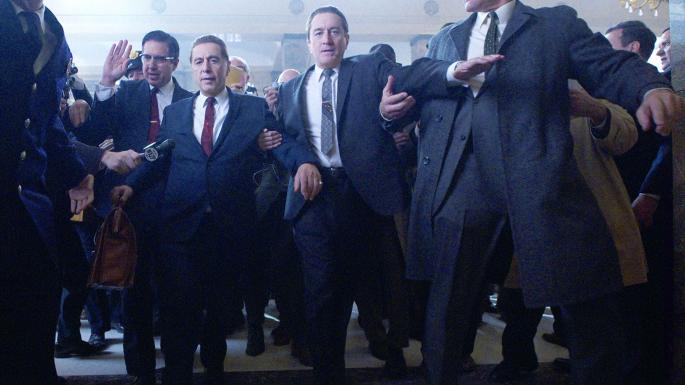
Let’s start with where The Irishman is the same as Scorsese’s prior gangster efforts. Robert De Niro and Joe Pesci are here, with both of them giving stunning and haunting performances (although the MVP of the film has yet to come). The film spans decades, is accompanied by voiceover narration, and contains lots and lots of violence. As you probably already know, it’s of certifiably epic length (3 and a half hours), which is a category none of its counterparts can touch it in. But that’s where the similarities pretty much end. The Irishman eliminates the atmosphere of excitement and action that defines Goodfellas and The Departed and the like. Instead, we’re treated to a mood of quiet reflection and the overarching theme of aging. In that sense, The Irishman isn’t a story about gangsters rising to and falling from grace, it’s a story about humans coming to terms with their own mortality and whether or not the lives they led were worth it.
The film opens with a tracking shot through the halls of a retirement home. The camera lands on Frank Sheeran (De Niro), who begins to recount a road trip he and crime boss Russell Buffalino (Pesci) took to a wedding. From the road trip framing device, we enter the story of Sheeran’s youth, and how he got acquainted with Buffalino. It began when he started allowing the meat truck he drove to be hijacked by mobsters, a charge he beat with the help of mob lawyer Bill Buffalino (a shockingly good Ray Romano). Bill introduces him to his cousin, Russell, who takes an interest in Sheeran immediately. Frank begins to take care of things for Buffalino and the mob, including several notable hits. Frank continues to rise in Buffalino’s opinion, while he also becomes more enamored with the mob lifestyle. In a critical early scene, Frank finds out his daughter, Peggy (Lucy Gallina as a child, Anna Paquin as an adult), has been hit by a grocer. Frank makes Peggy come and watch as he brutally beats the man, which visibly shakes Peggy. This begins a complicated relationship between the two of them that adds immeasurably to the film.
Frank’s relationship with Russell eventually results in his recommendation to take on the position of a bodyguard of sorts to Jimmy Hoffa. Hoffa is played by Al Pacino, who owns the thing from the moment he shows up. It’s a brilliant performance, equal parts typical recent-Pacino shouting and nuanced acting that’s better than he’s been in decades. His Hoffa is a creation of pure charisma without whom the film probably wouldn’t work.
Hoffa also strikes up a great relationship with Frank’s daughter Peggy- she’s closer to him than she is to her father (and much closer than she is with Russell, who she detests, despite her father’s protests). Hoffa takes complete control of the rest of the film, offering up some of its best moments, such as his nonchalant reaction to JFK’s assassination and his subsequent refusal to fly the flag atop the International Brotherhood of Teamsters headquarters at half mast. His confrontation with Anthony “Tony Pro” Provenzano (Stephen Graham, also excellent) will ensure you’re never late for a meeting (well, maybe a little late, if you account for traffic).
Frank, meanwhile, embarks on what has been (accurately) described as something of a mobster Forrest Gump. He’s present at several important moments in mafia history, claiming responsibility for notable killings such as that of “Crazy Joe” Gallo. De Niro plays these moments with alternating coolness and bravado that a lesser actor wouldn’t be able to muster at this point in their career. Pesci, meanwhile, is silent but deadly, in a role that could be considered against type due to his subdued nature. The film rolls along with typical Scorsese-an flourishes; for instance, at nearly every introduction of a minor character, a block of text appears with their name and the date and cause of their death. It’s funny, trust me. The de-aging effects don’t intrude at all, and while they may not be as effective as they should be, they get the job done.
So, if you have not yet seen The Irishman, maybe duck out here. I personally don’t think it matters all that much, but it’s your call and if I were in your position I’d probably stop reading. Your call. You’ve been warned.
The climactic event of the film is Frank’s killing of Hoffa, who, up to that point, had been maybe his closest friend. It’s built up to masterfully: Pesci turns his quiet demeanor into a frightening weapon to make it clear to Frank that he has no choice in the matter. Jesse Plemons fields unimportant questions about the logistics of a fish he transported in the back seat of his car recently (again, you have to trust me that it’s funny. Unless you’ve seen the film, in which case you know how funny it is). And then they’re alone. Frank and Jimmy walk into a house- we know what’s about to happen, Frank knows what’s about to happen, Hoffa is clueless. They enter, Hoffa sees it’s empty (a brilliant visual reference to Tommy’s whacking in Goodfellas, by the way), and he turns to leave. Frank shoots him twice in the back of the head.
The scene is heartbreaking for two reasons. The first is De Niro- Frank performs the killing with such resignation. He doesn’t hesitate for a second, he doesn’t try to say any last words to his friend, he just shoots him, like it’s business. Because, of course, it is. The second is Pacino. His portrayal of Hoffa is so masterful until the bitter end. His realization of his fate is accompanied by the directive to Frank that they should get out of there. It’s delivered in a perfect way- he can’t believe that his friend would do this to him, he doesn’t believe that he would, but yet it’s the only rational explanation. In Pacino’s voice, you can detect a sliver of doubt, of the thought that maybe Frank would turn on him. But mainly he really believes that Frank’s leaving with him, and that he’s leaving at all. It’s a masterclass in one line, and it’s a perfect finale to an epic performance.
After Hoffa’s killing, Frank’s relationship with Peggy ends. Of course, he doesn’t admit the crime to anyone, even comforting Hoffa’s wife (Welker White, superstitious babysitter Lois Byrd in Goodfellas) and telling her that he’ll turn up at some point. Oscar winner Anna Paquin notably doesn’t speak at all in her role as adult Peggy, save for in one scene (and even then, barely). She simply asks her father why he hasn’t called Hoffa’s wife yet. It’s a seemingly simple question, but everything about it- Paquin’s delivery, the emphasis on the character’s silence throughout the film- suggests that she knows exactly why. She knows what her father has done for a living for decades, and she knows that killing Hoffa is absolutely something he could’ve been ordered to do. There’s clearly no doubt in her mind that he did it. Despite this being the only scene in the film where she speaks, the character of Peggy is an essential one. Throughout, she casts knowing glances at her father, expressing emotions of deep anguish and sorrow at his intrinsic violence. His lifestyle fundamentally upsets her, and so she fears him. Yet she loves Hoffa. She has from her childhood, when he was the only one of Frank’s friends she would talk to, and to her adulthood, when she dances with him multiple times at a dinner honoring Frank. The camera focuses on her often, as if to exemplify her silent, contemptuous stares and her joy at Hoffa’s presence. It’s through Peggy that Frank realizes that what he’s done is wrong, and only after he loses her that he starts to look back and regret.
The ending of The Irishman echoes the endings of other Scorsese gangster films in a fascinating way. The film concludes with an elderly Frank Sheeran, alone in a nursing home, presumably on his last night alive. He asks the visiting priest if, on his way out, he could leave the door slightly open. The final shot is of Sheeran, sitting alone, viewed through the crack in the doorway. By this point, all of his friends and associates are dead, he’s been abandoned by his daughter, and he has nothing left. The message here is a new, and much darker, one for Scorsese. At the end of Goodfellas, Henry Hill laments the fact that he’s had to leave behind life in the mob, that he has to “live the rest of his life like a schnook”. Casino finishes with Ace Rothstein musing that Las Vegas isn’t what it used to be, comparing it to an adult version of Disneyland. Both of these men, Hill and Rothstein, miss their ideals of the Good Old Days, including the bloodshed that came with them. In The Irishman, Sheeran doesn’t look back on his past with fondness or loss, his overwhelming emotion is regret. The finale of the film, detailing Sheeran’s elderly life, drives this point home- that Frank regrets it all. He regrets his alienation of his daughter Peggy, he regrets the killing of his friend, he regrets all of his life choices. The difference between Frank’s perspective and those of Hill and Rothstein is that the latter two had merely finished their careers in the mob. Sheeran is at the end of his life. This perspective allows him to see the futility of it all. And that’s the takeaway from The Irishman: no matter who you are, and how you lived, it won’t matter once you get to the end. While Scorsese certainly hasn’t come to the end, of his career or his life, his observation gives his film a profound depth that he hasn’t achieved in his past similar work. That’s what makes The Irishman so different, and that’s what makes it so great.
As readers of this blog likely know, Quentin Tarantino is one of my favorite directors of all time. I, to some extent, love every one of his films. So his latest offering, Once Upon a Time in Hollywood, was a big deal to me. The day leading up to it I could concentrate on nothing else (if we’re being honest, weeks is a more accurate term). My expectations were so high that anything short of a complete masterpiece would’ve left me disappointed.
Reader, I was not disappointed.
As for exactly where it ranks in Tarantino’s filmography, my updated ranking can be found here. But suffice it to say that it’s on the high end. It’s among my favorite Tarantino films, which places it with my absolute favorite films of all time. It dethrones Jordan Peele’s masterful Us as the best film of the year so far. It doesn’t merely create or recall a world, it is a world. A world so distinct and enjoyable that leaving it isn’t a lot of fun. So I’m not going to rush in exploring it.
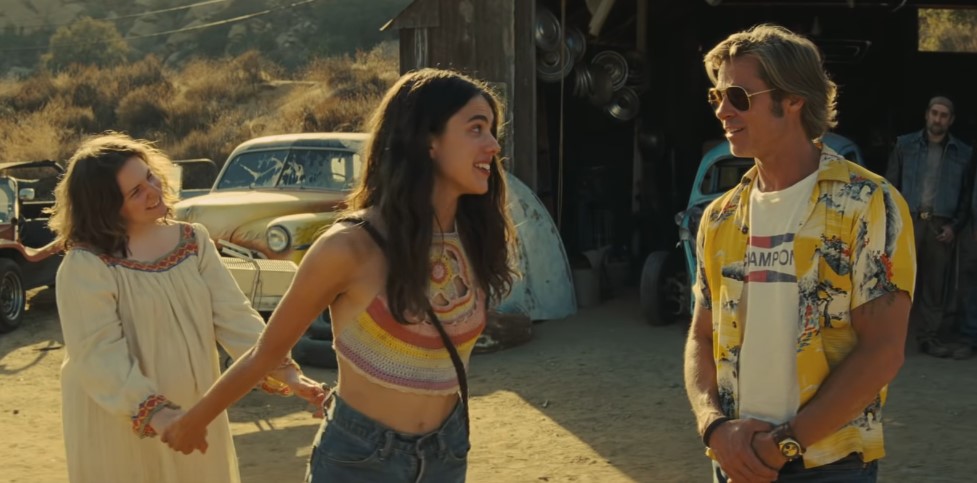
Hollywood is many things, but the most notable thing it is is Quentin Tarantino’s depiction of an age that died with Sharon Tate in the summer of 1969. It’s also Tarantino asking us a question that many will find in poor taste: what if it didn’t have to end? Tarantino’s obsession with revising history began with 2009’s Inglourious Basterds, and it persists a decade on. The subject this time is the Manson family murders. Tarantino teases these throughout the movie, penetrating the deliberate atmosphere he creates with occasional reminders that there is a darkness lurking beneath the surface here. Take the sole appearance of Damon Herriman’s Manson- he can’t be on screen for a minute. For the most part his face isn’t even shown. But the scene is terrifying. This is the pattern Tarantino employs when he wants to build tension in this film- he relies on the history surrounding the events. One of the other brilliantly tense scenes involving the family is far less brief and far less vague- the danger is clear and present. This scene, in which Brad Pitt’s Cliff Booth visits the Spahn Movie Ranch at which the Manson family is residing, is a classic Tarantino masterclass in tension akin to the opening scene of Inglourious Basterds or the bar scene in Inglourious Basterds or the restaurant scene in Inglourious Basterds or the adrenaline shot scene in Pulp Fiction (you thought I was gonna go with Basterds again, didn’t you?). This scene is the centerpiece of Pitt’s performance, one of the best of his career. The other scene in which Pitt shows off his skill is the finale, which I will address later. But Pitt’s performance is one of many in the film. Margot Robbie is brilliant as Sharon Tate, 10 year old Julia Butters astounds in her tragically limited role, and stars who only appear in one or two scenes (Al Pacino, Kurt Russell, the late Luke Perry, etc) make strong impressions. But the film’s defining performance belongs to Rick f***ing Dalton himself, Leonardo DiCaprio. It’s his performance in this film that dethrones The Wolf of Wall Street‘s Jordan Belfort as his career best (something I’m proud to say I called from the first trailer). His meltdown in his trailer after flubbing his lines is an all time moment that will live on as one of the film’s most famous. The all-around great acting is what solidifies the film as a masterpiece, and it makes the film fun to watch even as it doesn’t really seem to be doing anything.
That’s where I think people will be divided on this film. For the vast majority of its runtime, nothing really happens. It mainly consists of its characters hanging out and enjoying 1969, or at least Tarantino’s 1969. But even if you (wrongly) dislike this part, you’re bound to like what happens in the film’s brutal finale. The murders at the film’s center finally happen… kind of. The day before the Manson family members descend on Cielo drive is gone over in meticulous detail, with every action of Dalton and Booth and Tate and her housemates described by Kurt Russell’s narrator. Then it gets dark. Cliff smokes an acid-dipped cigarette and takes his pitbull for a walk, Rick gets even drunker than he already is and relaxes in his pool. But not before taking some time to scream at some hippies that he doesn’t want doing drugs in his neighborhood. The hippies, of course, are members of the Manson family, intent on committing the murders the film has been building up to (a TV in the final segment of the film even announces that what is happening next is “the moment you’ve all been waiting for” in an extremely self-aware and tongue-in-cheek moment). Cliff gets back just in time, resulting in a brilliant and quintessentially Tarantino sequence involving pitbull maulings, the consequences of the acid-dipped cigarette, and Chekhov’s flamethrower. It’s glorious. It’s fantastic to see the Manson family get what they deserve, and it’s exhilarating to watch Tarantino’s cinematic prowess make it happen.
Once Upon a Time in Hollywood is essential viewing for anyone who loves movies, the era of history in which it’s set, and especially those who love the work of Quentin Tarantino. If it is indeed his last film, it’s hard to think of a more fitting finish. It’s full of references to his previous work (Antonio Margheriti!) and it’s so distinctly Tarantino-esque that, maybe more than any other of his films, you’d be able to figure out who directed it in the opening five minutes. It’s been over a week since I saw it for the first time, and I still haven’t all the way processed how great it was. This film is perfect. If you haven’t seen it already, go do it. Something this good doesn’t happen often.



 The Movie Files